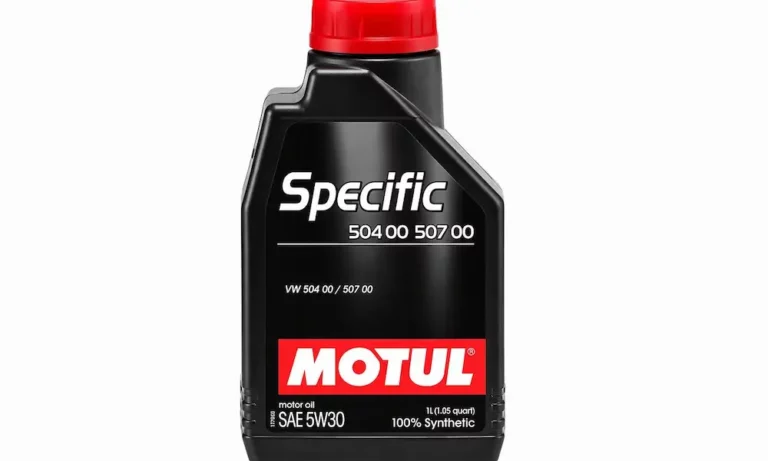
Picking the wrong oil for your Volkswagen can quietly destroy a turbocharger or clog a catalytic converter. This guide breaks down exactly what the VW 504 00 oil equivalent means, why it matters, and which bottles you should actually grab off the shelf. Stick around — the brand comparison table alone is worth the read.
What Is VW 504 00 Oil, Exactly?
The VW 504 00 specification isn’t just a viscosity grade. It’s a full performance standard designed for modern turbocharged gasoline engines. Think of it as a very detailed report card that an oil must pass before Volkswagen says “yes, use this in our engines.”
Volkswagen introduced this standard in the mid-2000s as part of their “LongLife III” program. It replaced older specs like 502 00 and 503 00 for most modern applications. In the US market, it became the go-to spec around the 2017 model year, when VW’s EA888 engine family became the dominant powertrain across the Jetta, Golf GTI, Passat, and Tiguan lineup.
The core idea is simple: modern engines run hotter, spin faster, and have more sensitive exhaust systems. They need a cleaner, more stable oil than what worked in the early 2000s.
Why VW 504 00 Replaced Older Specs in the US
The old VW 502 00 spec worked fine for its era. But it relied on higher concentrations of additives that left behind more ash, phosphorus, and sulfur during combustion. Those byproducts are bad news for modern exhaust hardware.
Here’s what changed:
- Catalytic converters get poisoned by phosphorus and sulfur deposits
- Particulate filters get physically clogged by sulfated ash
- Direct injection engines accumulate carbon on intake valves when the oil is too volatile
The shift to ultra-low sulfur gasoline in the US in 2017 made the switch to 504 00 chemistry possible. Cleaner fuel means fewer acidic combustion byproducts. That let VW authorize these lower-ash formulations without sacrificing protection.
The Technical Requirements Behind the Standard
You don’t need a chemistry degree to understand this, but knowing the key numbers helps you spot a genuinely compliant oil.
| Physical Property | Test Method | Requirement |
|---|---|---|
| High Temp / High Shear Viscosity | CEC L-36-A-90 | ≥ 3.5 centipoise |
| Noack Evaporation Loss | CEC L-40-A-93 | < 11% |
| Total Base Number | DIN ISO 3771 | ≥ 6.0 mgKOH/g |
| Kinematic Viscosity at 100°C | ASTM D 445 | 11.5–12.3 cSt |
| Pour Point | ASTM D 97 | −39 to −51°C |
Two numbers matter most here. The HTHS viscosity of 3.5 centipoise ensures the oil stays thick enough to protect bearings and turbo shafts under extreme heat. The Noack limit below 11% means the oil doesn’t evaporate and thicken up in the passages feeding your turbocharger.
Both requirements work together to keep a thin, stable protective film exactly where the engine needs it most.
How the Certification Process Actually Works
Getting an official VW 504 00 approval isn’t cheap or quick. The Baumusterprufung approval program is one of the toughest certification regimes in the industry.
Here’s the path an oil must follow:
- Meet ACEA C3 baseline — roughly 1,400 hours of engine testing just to qualify
- Pass VW’s internal PV tests — covering fuel economy, corrosion, and soot handling
- Clear the Radio Nucleonic Test — radioactive isotopes measure molecular-level wear during operation
- Complete 16+ additional engine tests totaling a minimum of 10,000 hours of operation
Only after all of that does a manufacturer get the official letter allowing them to print “Approved for VW 504 00” on their bottle.
This is why you should care about that word: approved. An oil labeled “meets the requirements of” or “recommended for” hasn’t done this work. It’s a marketing claim, not a certification.
VW 504 00 vs. Other VW Oil Specs
This is where a lot of VW owners get confused. Here’s a clean breakdown.
| Specification | Engine Type | Typical Viscosity | Key Characteristic |
|---|---|---|---|
| VW 502 00 | Older gasoline | 5W-40, 5W-30 | Higher ash, standard intervals |
| VW 504 00 | Modern gasoline | 5W-30, 0W-30 | Mid-ash, long-life, DI-safe |
| VW 507 00 | Modern diesel | 5W-30, 0W-30 | DPF-safe, low ash |
| VW 508 00 | Ultra-efficient gas | 0W-20 | Low friction, not backward compatible |
The 504 00 is backward compatible with 501 01, 502 00, 503 00, and 503 01. So if your older VW called for one of those, a 504 00 oil covers you.
Don’t mix it up with 508 00. That thinner 0W-20 spec is designed for newer engines with tighter tolerances. Using 504 00 in a 508 00 engine can reduce fuel economy and stress the variable valve timing system. Going the other way — 508 00 in a 504 00 engine — risks leaving the oil film too thin for the hardware.
Why 504 00 and 507 00 Usually Come Together
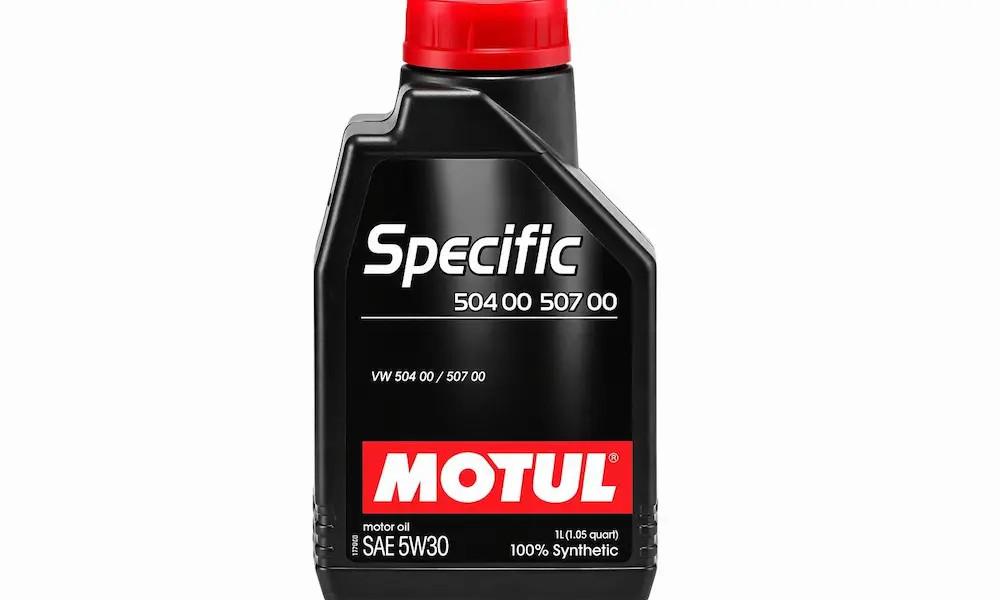
In the US, almost every 504 00 product also carries the 507 00 diesel approval. That’s intentional. Both specs share the same physical requirements for shear stability and high-temperature protection. The low-ash chemistry that protects diesel particulate filters also benefits catalytic converters and gasoline particulate filters in modern gas engines. It’s a unified solution — one oil for the whole VW Group garage.
The Best VW 504 00 Oil Equivalents Available in the US
Here’s what you’ll actually find on shelves or online.
| Product | Viscosity | Distribution | Notes |
|---|---|---|---|
| Castrol Edge 5W-30 K | 5W-30 | Walmart, AutoZone | Fluid Titanium Technology |
| Mobil 1 ESP 5W-30 | 5W-30 | Walmart, NAPA | Outstanding oxidation resistance |
| Pennzoil Platinum Euro LX 0W-30 | 0W-30 | Amazon, Walmart | Gas-to-liquid PurePlus base oil |
| Valvoline European XL-III 5W-30 | 5W-30 | Advance Auto, NAPA | LSPI protection built in |
| Ravenol VMP 5W-30 | 5W-30 | Blauparts, online | PAO base, zero shear loss |
| Liqui Moly Top Tec 4200 | 5W-30 | NAPA, online | Stable film at long drain intervals |
| Amsoil European Car Formula | 5W-30 | Dealers, online | 100% synthetic, Low-SAPS formula |
Mass-Market Picks
Castrol Edge Euro is VW’s longtime partner brand. Their Fluid Titanium Technology claims to physically transform the oil structure under pressure, reducing friction at peak load. It’s widely available and a safe default choice for most US drivers.
Mobil 1 ESP earns strong marks for oxidation resistance and engine cleanliness. If you’re running longer drain intervals on your GTI or Tiguan, this one holds up well.
Pennzoil Platinum Euro LX uses a natural gas-derived base oil rather than crude oil. The result is fewer impurities and excellent low-temperature flow — a good pick if you’re in a colder state.
Valvoline European XL-III specifically addresses low-speed pre-ignition (LSPI), a problem unique to turbocharged direct-injection engines where fuel-and-oil droplets ignite before the spark plug fires. It’s the right call if you drive hard or live at high altitude.
Specialty and Enthusiast Picks
Ravenol VMP 5W-30 uses PAO (polyalphaolefin) base stocks and their USVO technology to prevent shear thinning throughout the full drain interval. Enthusiasts with modified or high-output EA888 engines often prefer it for extra thermal headroom.
Liqui Moly Top Tec 4200 has a devoted following in the VW community. It’s formulated to keep the turbocharger and timing chain deposit-free over long intervals — exactly what the EA888 needs.
Amsoil AEL is a dealer-distributed product, so it’s not as convenient to grab quickly. But it delivers certified 504 00 protection with a fully synthetic Low-SAPS formula and rapid cold-start oil pressure — important in the Mountain West and Upper Midwest.
How VW 504 00 Protects Your Specific Engine
Turbocharger Protection
Your VW’s turbo spins above 150,000 RPM while sitting in exhaust heat. When you shut the engine off, the oil trapped in the bearing housing faces “heat soak” — a period of extreme temperature with no active circulation. A 504 00 synthetic base oil resists breaking down during this phase. Standard oils can “coke” — baking into carbon deposits that block the narrow passages feeding the turbo. When that happens, the bearing starves, and the turbo eventually seizes.
Intake Valve Deposits
Direct injection sprays fuel straight into the combustion chamber, not onto the intake valves. So the valves never get a fuel bath to wash away oil residue. Over time, crankcase vapors bake onto the hot valves and form hard carbon crusts. The low Noack volatility of a 504 00 oil reduces how much oil vapor reaches those valves in the first place, significantly extending the time before you’d need an intake cleaning service.
Timing Chain Longevity
The EA888’s timing chain is sensitive to abrasive soot particles. If those particles clump together instead of staying suspended in the oil, they grind down the chain links and sprockets. The dispersant additives in a 504 00 formulation hold soot in suspension until the oil filter catches it — protecting the variable valve timing system and preventing the expensive repairs that come with a stretched chain.
Picking the Right Viscosity for Your Climate
Not every VW 504 00 oil is the same viscosity. Here’s how to choose:
- 5W-30 — works for most of the continental US. Good all-season protection in moderate to hot climates
- 0W-30 — better for cold-climate states like Minnesota, Montana, or Alaska. The lower pour point means faster oil pressure on a −20°F morning
In hot climates like Arizona or Texas, the HTHS viscosity of your 504 00 oil does the heavy lifting. A quality 5W-30 synthetic with a 504 00 approval actually outperforms many conventional 5W-40 oils here because the synthetic base stocks resist thermal breakdown far better.
Maintenance Tips That Actually Extend Engine Life
| Component | Role | What to Use |
|---|---|---|
| 504 00 Approved Oil | Lubrication and heat transfer | Officially approved only |
| Oil Filter | Contaminant removal | Mann, Mahle, or Genuine VW |
| Drain Plug Gasket | Leak prevention | Replace at every oil change |
| Fuel Quality | Acid mitigation | Tier 1 fuels when possible |
VW’s factory interval is up to 10,000 miles or one year in the US. But if your driving falls into “severe service” — short city trips under 10 miles, heavy traffic idling, mountainous terrain, or extreme heat — consider moving service up to 5,000–7,500 miles. Short trips prevent the engine from fully warming up, which allows fuel and moisture to dilute the oil faster than normal.
Also: don’t cheap out on the filter. Genuine VW, Mann, or Mahle filters are engineered for the bypass valve pressures and filtration capacity needed over a 10,000-mile interval. A budget filter with a weak bypass valve can starve the turbo on a cold start — exactly what your expensive synthetic oil is designed to prevent.
How to Confirm You’re Buying the Real Thing
Watch for these phrases on the label:
- ✅ “Approved for VW 504 00” — oil has been tested and certified
- ✅ “Licensed by Volkswagen Group” — same meaning
- ⚠️ “Meets the requirements of VW 504 00” — marketing claim, not a certification
- ⚠️ “Recommended for VW 504 00 engines” — not the same as approval
For vehicles still under warranty, use only oils with explicit approval language. The testing required to earn that approval involves over 10,000 hours of engine time and proprietary wear analysis. A product that skipped that process hasn’t proven it can do the job.
Genuine 504 00 oils cost more than standard synthetics. That’s not a markup — it’s the cost of PAO or ester base stocks and a clean additive package that won’t poison your catalytic converter. If the price seems too good to be true, check the fine print before you pour it in.