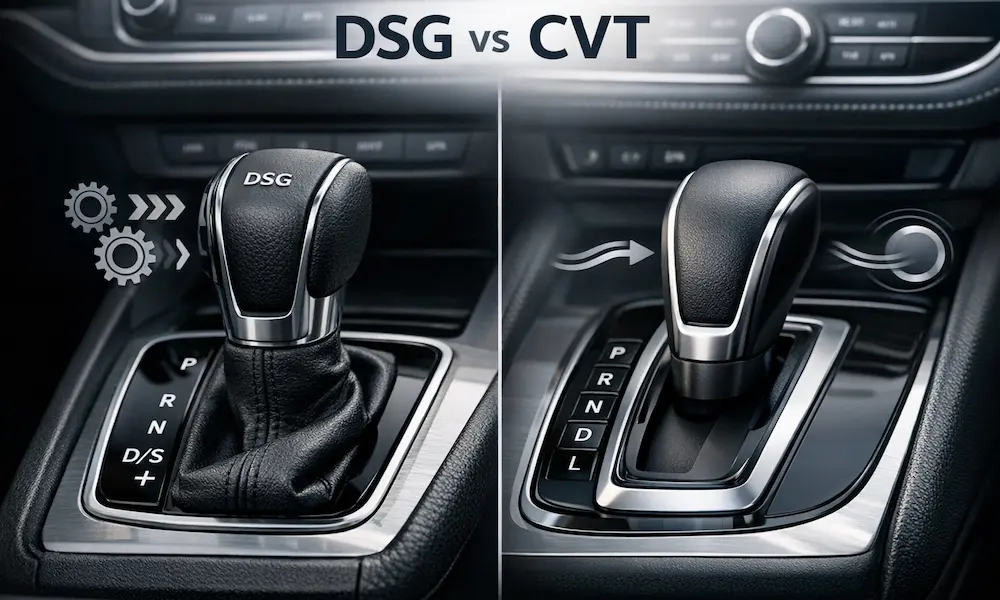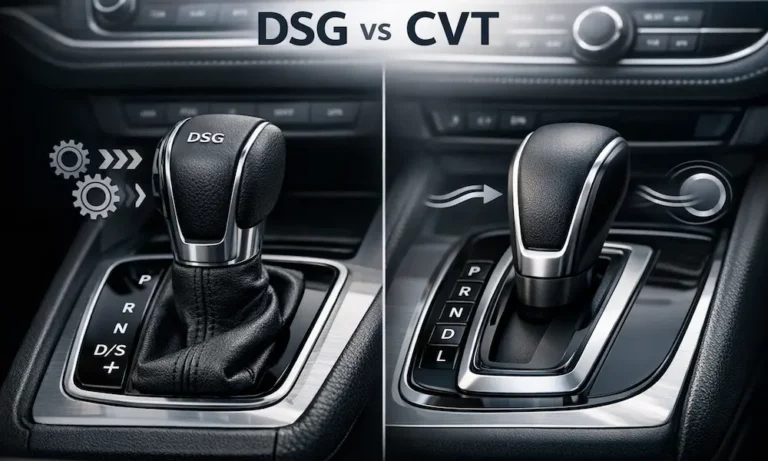
You’re staring at two similar cars on the lot. Same price, same features—but one’s got a DSG and the other’s rocking a CVT. Which one won’t leave you stranded or broke five years from now? Let’s cut through the marketing speak and figure out what these transmissions actually mean for your daily drive and your wallet.
What’s a DSG and How Does It Work?
A Direct Shift Gearbox is basically two manual gearboxes stuffed into one housing. One shaft handles odd gears (1, 3, 5, 7), while the other manages even gears (2, 4, 6). Each shaft connects to its own clutch.
Here’s the clever bit: while you’re cruising in third gear, the system’s already got fourth gear lined up and ready. When it’s time to shift, one clutch releases while the other grabs—all in about 8 milliseconds. No torque gap, no lurching.
You’ll find two types of DSG systems in 2025 models:
Wet clutch DSGs bathe the clutch plates in oil for cooling. They handle high-torque monsters like the Golf R (up to 700 Nm) but sacrifice some efficiency because those plates are constantly spinning in fluid.
Dry clutch DSGs skip the oil bath for better fuel economy. They’re lighter and more efficient, but they can’t handle the heat from high-performance engines or heavy loads.
What’s a CVT and How’s It Different?
A Continuously Variable Transmission ditches gears entirely. Instead, it uses two cone-shaped pulleys connected by a steel belt or chain. By adjusting how wide or narrow these pulleys get, the system creates an infinite range of ratios.
Think of it like a bike with infinite gears instead of just 10 or 21. The engine can sit at its sweet spot—around 2,000 to 3,000 RPM—no matter if you’re crawling through a parking lot or merging onto the highway.
Modern CVTs come in three main flavors:
Belt-driven CVTs use hundreds of tiny steel segments linked together. Honda and Nissan love these for their smoothness and quiet operation.
Chain-driven CVTs replace the belt with a high-strength chain. Subaru’s Lineartronic system uses this design because chains handle torque better and last longer under stress.
Direct-Shift CVTs add a traditional first gear to handle launch from a stop, then hand off to the CVT for everything else. Toyota pioneered this setup to fix the sluggish, rubber-band feel that plagued earlier CVTs.
How They Actually Feel Behind the Wheel
This is where things get personal.
The DSG Experience
If you’re into spirited driving, a DSG delivers. Shifts are lightning-quick and precise—the Golf GTI with its 7-speed DSG hits 60 mph in 5.9 seconds, compared to 6.5 with the manual. You feel every gear change, and the transmission responds instantly when you mash the throttle.
But here’s the catch: DSGs can feel clunky in stop-and-go traffic. Because it’s essentially a computer-controlled manual, the transmission has to “feather” the clutch when you’re crawling along. This creates a jerky, hesitant sensation that many drivers mistake for a mechanical problem.
It got so bad in the U.S. that Volkswagen replaced the DSG in the 2025 Taos with a traditional 8-speed automatic. Americans kept showing up at dealerships convinced their transmission was broken.
The CVT Experience
CVTs provide seamless acceleration with zero shift shock. There’s no interruption in power delivery—just smooth, continuous acceleration. For daily commuting, it’s less tiring and more relaxing than constantly feeling gear changes.
The downside? The “rubber band effect.” Floor the accelerator and the engine jumps to, say, 5,000 RPM and stays there while the car slowly gains speed. It sounds like the engine’s screaming its head off while the speedometer barely moves.
Manufacturers have gotten smarter about this. Most 2025 CVTs now include “stepped” programming that simulates traditional gear shifts during hard acceleration. It’s fake, but it makes the driving experience feel more normal.
Fuel Economy: Who Wins?
CVTs dominate in city driving, no contest. By keeping the engine in its most efficient RPM range constantly, they beat DSGs by 10% to 15% in stop-and-go traffic.
Highway driving levels the playing field. Once you’re cruising at steady speeds, the DSG’s mechanical efficiency shines. Its direct clutch connection eliminates the power losses from fluid couplings, and tall overdrive gears keep engine speeds low.
| Driving Condition | DSG Advantage | CVT Advantage |
|---|---|---|
| City/Stop-and-Go | – | 10-15% better MPG |
| Highway Cruising | Matches CVT | Slight edge in some models |
| Spirited Driving | Better throttle response | Engine stays in power band |
| Heavy Traffic | Can feel jerky | Smooth and effortless |
What Breaks and When
Let’s talk money. Transmissions are expensive to fix, and these two couldn’t be more different in their failure modes.
DSG Maintenance Reality
DSGs are precision instruments. The fluid doesn’t just lubricate—it also acts as hydraulic medium and coolant. Skip the 40,000-mile service? You’re asking for trouble.
The mechatronic unit—the brain that controls shifts—is the weak point. When it fails, you’re looking at $1,200 to $3,600 for replacement. A full transmission swap? North of $6,000.
The good news: stick to maintenance schedules and DSGs last. The bad news: there’s zero wiggle room on those service intervals.
CVT Maintenance Reality
CVTs are simpler mechanically but extremely sensitive to heat. The fluid maintains a specific friction coefficient between the belt and pulleys. If it breaks down and the belt slips, it scores the pulley surfaces. Game over.
Service intervals run 30,000 to 60,000 miles depending on driving conditions. Most shops won’t rebuild them—you’re replacing the entire unit for $4,000 to $8,000.
Early CVTs (2000s-era Nissans especially) earned a terrible reputation. But modern chain-driven units from Subaru and Honda have proven far more durable, with many lasting well past 150,000 miles with proper maintenance.
| Maintenance Factor | DSG | CVT |
|---|---|---|
| Service Interval | 40,000 miles (strict) | 30,000-60,000 miles |
| Routine Service Cost | $300-$500 | $150-$400 |
| Major Repair Cost | $3,500-$6,500 | $4,000-$8,000 |
| Critical Failure Point | Mechatronic unit | Belt/pulley slippage |
| Heat Sensitivity | High (wet clutch models) | Very high |
Performance Comparison: Real Numbers
Let’s look at actual 2022-2025 performance data:
| Model | Transmission | 0-60 MPH | Quarter Mile |
|---|---|---|---|
| VW Golf R | 7-Speed DSG | 4.3 sec | 12.7 @ 108 mph |
| Hyundai Elantra N | 8-Speed DSG | 5.4 sec | 13.8 @ 102 mph |
| VW Golf GTI | 7-Speed DSG | 5.9 sec | 14.0 @ 102 mph |
| Subaru WRX | Chain CVT | 6.0 sec | 14.1 @ 98 mph |
| VW Golf GTI | 6-Speed Manual | 6.5 sec | 14.6 @ 99 mph |
| Acura Integra | Chain CVT | 7.8 sec | 15.6 @ 91 mph |
The DSG’s lightning-fast shifts give it a clear edge in straight-line acceleration. But modern chain-driven CVTs aren’t slouches—the Subaru WRX’s CVT actually beats the GTI’s manual transmission.
Towing Capacity: The Reality Check
Planning to tow? Both DSG and CVT have serious limitations compared to traditional automatics.
CVTs struggle with towing because of heat buildup. The constant friction between belt and pulleys generates massive temperatures under load. Most CVT vehicles are limited to 1,500-2,000 pounds of towing capacity.
Subaru’s chain-driven units push this to 5,000 pounds in the Ascent, but they require heavy-duty oil coolers and strict maintenance schedules.
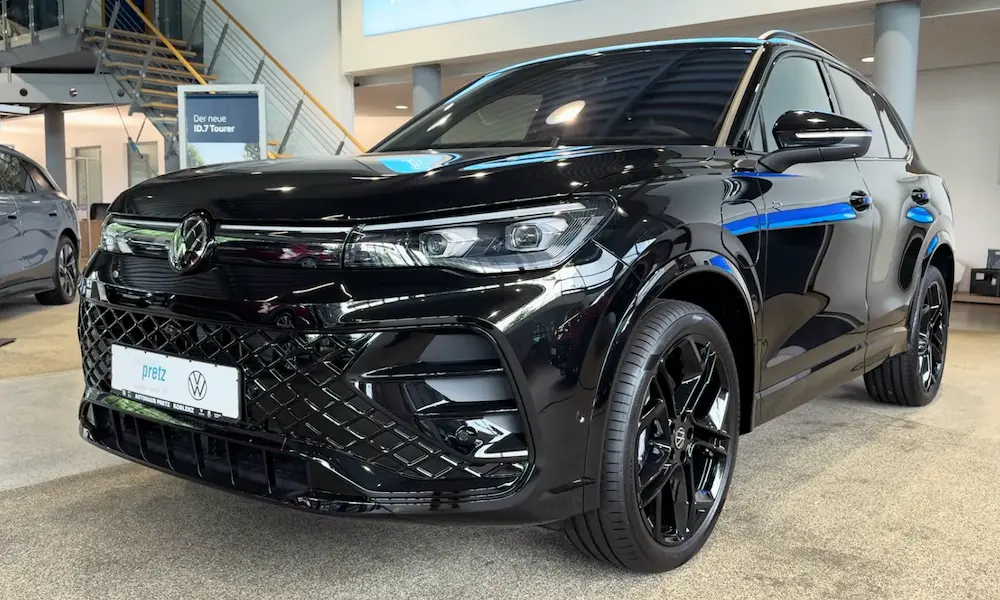
DSGs handle more torque than CVTs, but they’re vulnerable during low-speed towing maneuvers. Backing a trailer uphill or crawling in traffic while towing can overheat the clutch packs. The 2025 VW Tiguan with its DSG is rated for just 1,800 pounds, while the larger Atlas with a traditional automatic handles 5,000 pounds.
If you need serious towing capability, neither transmission is your best bet. Traditional torque-converter automatics still dominate this space.
Best Models in 2025
Top CVT Vehicles
The Honda Civic and Accord continue to set the standard with refined belt CVTs that include simulated shift points. They’re smooth, efficient, and Honda’s reliability record speaks for itself.
Subaru’s entire lineup uses chain-driven Lineartronic CVTs that have proven far more durable than early belt designs. The Crosstrek and Outback deliver excellent fuel economy without the fragility that plagued first-generation CVTs.
Toyota’s hybrid eCVT—found in the Prius and Camry Hybrid—uses a planetary gearset instead of belts or pulleys. It’s technically not a CVT at all, but it delivers infinite ratios through a combination of electric motors and gears. These systems are virtually bulletproof, often lasting 200,000+ miles.
Top DSG Vehicles
The VW Golf R and GTI showcase what DSGs do best: rapid-fire shifts and engaging driving dynamics. The 7-speed DQ381 wet-clutch unit handles the GTI’s 241 hp effortlessly.
Hyundai’s Elantra N takes the dual-clutch concept further with an 8-speed N-DCT that includes a “Grin Shift” mode—basically an overboost function that holds maximum power for 20 seconds.
Kia’s hybrid approach puts electric motors into DSG housings (e-DCT systems). The Sportage Hybrid delivers 50 MPG estimates while maintaining the sporty feel of a dual-clutch.
The Hybrid Wild Card: eCVT Systems
Here’s where things get interesting. Hybrid vehicles are surging while pure EV sales flatten, and the eCVT is a big reason why.
Toyota’s eCVT uses no belts, no clutches, and no friction surfaces. It’s a planetary gearset with two electric motors that blend power from the engine and battery pack. One motor acts as a generator, the other drives the wheels, and the engine connects through the middle.
This setup combines CVT-like efficiency with gear-driven durability. There’s virtually nothing to wear out except bearings. Toyota’s hybrid systems routinely exceed 300,000 miles without major transmission work.
The catch? eCVTs only work in hybrids. You need that second motor-generator to make the system function.
Resale Value and Long-Term Costs
Japanese vehicles with CVTs consistently crush their European DSG competitors in resale value. A Toyota Camry or Honda Civic retains over 50% of its value after five years. European models with DSGs often drop below 45%.
Why? Perception of reliability. Toyota and Honda’s CVTs have proven themselves over millions of miles. DSGs, especially early Volkswagen units, earned a reputation for expensive failures that the market hasn’t forgotten.
Total cost of ownership over 10 years tells a similar story. A CVT might save you $1,500-$3,000 in fuel costs, but one catastrophic failure at 120,000 miles wipes out those savings. Meanwhile, hybrid eCVTs deliver the best of both worlds: fuel savings plus extreme longevity.
Which One Should You Actually Buy?
Here’s the straight answer:
Choose a DSG if:
- You value driving engagement over everything else
- You do mostly highway driving or spirited back-road runs
- You’re okay with occasional low-speed jerkiness
- You’ll religiously maintain it every 40,000 miles
- You want the fastest shifts possible
Choose a CVT if:
- Your commute involves heavy city traffic
- Fuel economy is your top priority
- You want smooth, effortless driving
- You’re not towing anything heavy
- You prefer Japanese reliability reputations
Choose a hybrid eCVT if:
- You want the absolute lowest operating costs
- Maximum reliability matters more than anything
- You’re keeping the car 10+ years
- You can handle the hybrid premium up front
The DSG vs CVT debate isn’t about which is “better”—it’s about matching the transmission to how you actually drive. A DSG in a Golf R is pure genius. That same transmission in a Taos stuck in traffic is miserable. A CVT in a Civic commuter is perfect. That same setup in a sports car feels lifeless.
Figure out what you need, not what enthusiast forums tell you to want. Your transmission should disappear into the background of your daily drive, not constantly remind you it exists—whether through jerky shifts or droning engines.
The transmission war isn’t ending anytime soon. But now you know enough to pick the right side for your driving reality.