
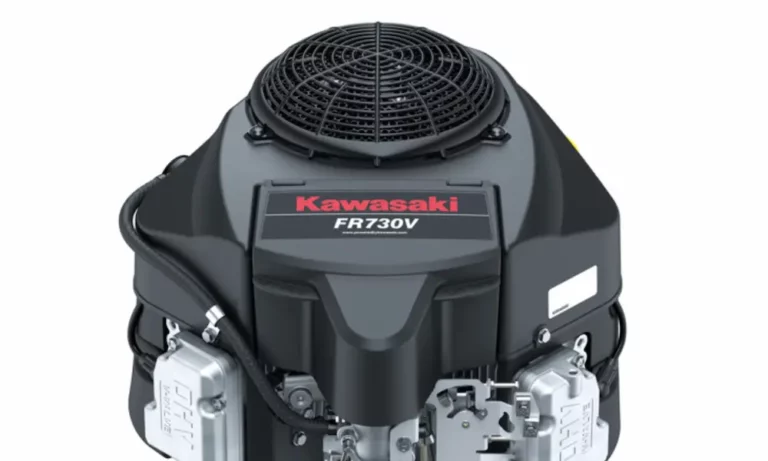
Getting your Kawasaki FR730V oil capacity wrong can kill an engine fast. Too little oil and you’re looking at bearing failure. Too much and you’ve got aeration problems. This guide covers exact capacities, the right oil grades, filter specs, and maintenance intervals — so your 726cc V-twin keeps running strong.
How Much Oil Does the Kawasaki FR730V Take?
The short answer: 2.2 quarts (2.1 liters) when you change both the oil and filter together.
But here’s the detail most people miss — the capacity changes depending on what you’re doing:
| Service Condition | Liters | U.S. Quarts |
|---|---|---|
| Oil + Filter Replacement | 2.1 L | 2.2 qt |
| Oil Only (No Filter Change) | 1.8 L | 1.9 qt |
| Initial Fill (Dry Engine) | 2.1 L | 2.2 qt |
That 0.3-quart difference isn’t trivial. Your spin-on filter holds a meaningful chunk of oil. If you skip the filter but pour in a full 2.2 quarts anyway, you’ll overfill the crankcase. Overfilling causes oil aeration — basically, your pump whips air into the oil — and that kills lubrication fast.
According to the Kawasaki FR730V engine specs, this 726cc engine produces up to 24 HP at 3,600 RPM. That’s a lot of stress on a relatively small oil sump, which is exactly why precise fill levels matter so much here.
The Dipstick Trick Most Owners Get Wrong
Here’s something that trips up a lot of FR730V owners: don’t screw the dipstick in when checking oil.
The Kawasaki FR730V uses a dipstick integrated into the filler cap. When you check the level, you rest the dipstick on top of the threads — you don’t thread it down into the housing. If you screw it in before reading, the stick sits roughly 0.5 to 0.75 inches deeper than intended. That gives you a false “Full” reading while the actual oil level could be dangerously low.
According to Kawasaki engine maintenance guidance, if the oil reads below the “ADD” mark under those conditions, your engine might be running on less than 1.5 quarts total. At that point, bearing failure is a real risk — not a maybe.
Always check on level ground. Always rest the dipstick, never thread it.
What Oil Should You Use in the Kawasaki FR730V?
The FR730V needs oil rated API Service Class SJ or higher. But viscosity depends on your climate. There’s no single “best” oil for every situation.
| Operating Environment | Recommended Grade | Why |
|---|---|---|
| Standard / Multi-Season | SAE 10W-40 | Balanced protection for typical mowing conditions |
| Extreme Heat (above 104°F) | SAE 20W-50 | Prevents oil thinning and excess consumption |
| Cold Weather (below 32°F) | SAE 5W-20 | Ensures fast oil flow on cold starts |
| Cool Northern Climates | SAE 10W-30 | Standard alternative for colder regions |
The Kawasaki Engines USA FAQ lists SAE 10W-40 as the primary recommendation for most conditions. But if you’re mowing through a Texas summer or running the engine on a snow-clearing attachment, you need to match the grade to your temps.
Why Kawasaki KTECH™ Oil Is Worth Considering
Kawasaki specifically recommends their KTECH™ engine oils for the FR730V. The key reason is zinc (ZDDP) content.
KTECH oils contain higher zinc levels than most modern automotive oils. Why does that matter? Because zinc provides critical wear protection for camshaft lobes and valve tappets — high-load components that take a beating in a constant-speed engine like this one. Most automotive oils have reduced zinc to protect catalytic converters. Your FR730V doesn’t have a catalytic converter, so you want that zinc working for the metal-on-metal contact points in your valve train.
You can skip KTECH if you want, but whatever you choose, make sure it’s API SJ or higher and matched to your ambient temperature.
Kawasaki FR730V Oil Filter: Part Numbers and Alternatives
The current OEM oil filter for the FR730V is part number 49065-0736, which replaces older numbers 49065-7007 and 49065-0721. You can find the genuine filter at Kawasaki Engines USA’s genuine parts page or through suppliers like Hillyridge.
What Makes the OEM Filter Different
The genuine Kawasaki filter isn’t just a generic can. It includes two features that matter:
- Pressure-activated bypass valve: If the filter gets clogged or the oil is too thick on a cold start, this valve opens so oil still reaches your main galleries — unfiltered, but flowing. That prevents immediate bearing seizure.
- Silicone anti-drain back valve: Because the FR730V has a vertical shaft and a side-mounted filter, oil can drain back into the sump when the engine sits. This valve keeps oil in the filter so you get near-instant pressure on startup.
Aftermarket Filter Cross-Reference
| Manufacturer | Part Number | Notes |
|---|---|---|
| Kawasaki (OEM) | 49065-0736 | Factory spec; pressure-activated bypass |
| WIX | 57035 / 51056 | 57035 is a direct cross |
| NAPA Gold | 7035 / 1056 | High-quality media option |
| Fram | PH8170 | Widely available, standard grade |
| Briggs & Stratton | 492932S | Common small engine cross |
| John Deere | AM125424 | Standard for Deere-branded units |
| Baldwin | B7165 | Industrial-grade construction |
All of these share the standard 3/4″-16 mounting thread. Some technicians prefer the WIX 51348 — it’s the same thread and gasket diameter but has a longer canister. That larger body bumps total oil capacity up to roughly 2.5 quarts and adds more filter media, which helps in high-dust environments.
Kawasaki FR730V Maintenance Schedule
The FR730V’s longevity comes down to sticking to a real maintenance schedule — not just whenever you remember.
| Maintenance Task | Interval | Notes |
|---|---|---|
| Oil Level Check | Before every use | Rest dipstick, don’t thread |
| First Oil Change | 8 hours | Removes break-in metal debris |
| Standard Oil Change | Every 100 hours or annually | More frequent in dusty/hot conditions |
| Oil Filter Replacement | Every 200 hours | Per Kawasaki spec |
| Cooling Fin Cleaning | Every 100 hours | Dirty fins = oil overheating |
The 8-Hour Break-In Change Is Not Optional
When a new engine runs for the first time, piston rings and moving parts seat to their final tolerances. That process creates fine metallic particles. If those stay in the oil, they act as an abrasive on your bearings and valve train.
Kawasaki specifies the first oil change at 8 hours of operation. Some equipment manufacturers suggest 20-25 hours, but 8 hours is the safer call for protecting high-precision components during that critical break-in window.
The Filter-Every-Oil-Change Debate
Kawasaki’s spec says change the filter every 200 hours — meaning every other oil change. But many professional mechanics change it every 100 hours alongside each oil change. Their reasoning is solid: the filter holds about 0.3 quarts of used, contaminated oil. If you add fresh oil but leave the dirty filter, that old oil mixes right back in and starts degrading your fresh fill immediately.
If you’re running the engine hard or in dusty conditions, change the filter every time.
Drain Plug and Filter Torque Specs
The FR730V uses a cast aluminum crankcase. Aluminum threads strip easily if you overtighten, so don’t go by feel alone.
Oil drain plug torque: 7 Nm (5.2 ft-lb)
That’s low on purpose. It’s just enough to seal without chewing up the threads. Kawasaki even offers a dedicated oil drain hose (Part# 51044-0902) to make draining easier and reduce repeated thread stress.
For the oil filter, some service manuals list 13 to 23 ft-lb, but overtightening at 23 ft-lb often bonds the gasket permanently to the block, making removal a nightmare next time. Professional consensus favors: hand-tight, then 3/4 of a turn. That seals the gasket without locking it in place.
Here are the broader torque specs for the 726cc block:
| Fastener | Torque (Nm) | Torque (ft-lb) |
|---|---|---|
| Cylinder Head Bolts | 46 Nm | 33.9 ft-lb |
| Connecting Rod Bolts | 10 Nm | 7.4 ft-lb |
| Spark Plug | 22 Nm | 16.2 ft-lb |
| Flywheel Bolt | 56 Nm | 41.3 ft-lb |
| Intake Manifold | 9 Nm | 6.6 ft-lb |
| Crankcase Cover | 27.5 Nm | 20.3 ft-lb |
How the FR730V Compares to Its 726cc Siblings
The FR730V shares its 726cc block with the FS730V and FX730V. Oil capacity is identical across all three at 2.2 quarts — so if you run a mixed fleet, you can standardize your oil and filter inventory.
| Feature | FR730V | FS730V | FX730V |
|---|---|---|---|
| Sump Capacity | 2.2 qt | 2.2 qt | 2.2 qt |
| Air Filtration | Single-Stage | Dual-Element | Heavy-Duty Canister |
| Starter Type | Bendix | Bendix | Heavy-Duty Shift/Recoil |
| Rated Horsepower | 24.0 HP | 24.0 HP | 23.5 HP |
| Target Market | Residential | Professional | Heavy Commercial |
The FS730V uses dual-element air filtration to keep finer particles out — which also protects the oil from contamination in commercial settings. The FR730V is the residential-grade option, but it runs the same internal lubrication design.
Long-Term Storage: Protect the Oil System
If your FR730V will sit for more than 30 days, don’t just park it and walk away. Used oil contains acidic combustion byproducts that corrode bearing surfaces over time.
Here’s the storage routine:
- Change the oil before storage — fresh oil doesn’t have the acidic byproducts that eat at bearings
- Drain the fuel system to prevent gum deposits
- Remove the spark plugs and add one or two drops of fresh engine oil into each cylinder
- Turn the engine over by hand several times to coat the cylinder walls
- Stop turning when you feel resistance — that means both valves are closed, sealing the combustion chamber from moisture
This process keeps the internal surfaces protected and ready to run when you pull the mower back out next season.
Quick-Reference: Kawasaki FR730V Key Specs
| Spec | Detail |
|---|---|
| Displacement | 726cc (44.3 cu. in.) |
| Oil Capacity (with filter) | 2.2 qt / 2.1 L |
| Oil Capacity (without filter) | 1.9 qt / 1.8 L |
| Recommended Oil | SAE 10W-40, API SJ or higher |
| OEM Oil Filter | 49065-0736 |
| First Oil Change | 8 hours |
| Standard Oil Change Interval | 100 hours / annually |
| Drain Plug Torque | 7 Nm / 5.2 ft-lb |
| Max Power | 24.0 HP at 3,600 RPM |
The Kawasaki FR730V oil capacity is simple once you know the rules: 2.2 quarts with a filter change, 1.9 quarts without. Use the right viscosity for your climate, don’t thread the dipstick, and stick to that 8-hour break-in change. Do those things consistently and this engine will run for thousands of hours without complaint.


