Kubota fluid prices can sting — especially when your tractor holds 15 gallons. Good news: several high-quality alternatives work just as well. But pick the wrong one, and you’re looking at a pump rebuild that costs more than the tractor itself. This guide walks you through the best Kubota UDT hydraulic fluid equivalents, what to avoid, and how to save serious money without gambling on your machine.
UDT vs. Super UDT2: You Need to Know the Difference First
Before you grab a random jug off the shelf, you need to know which fluid your tractor actually needs. These two products aren’t interchangeable.
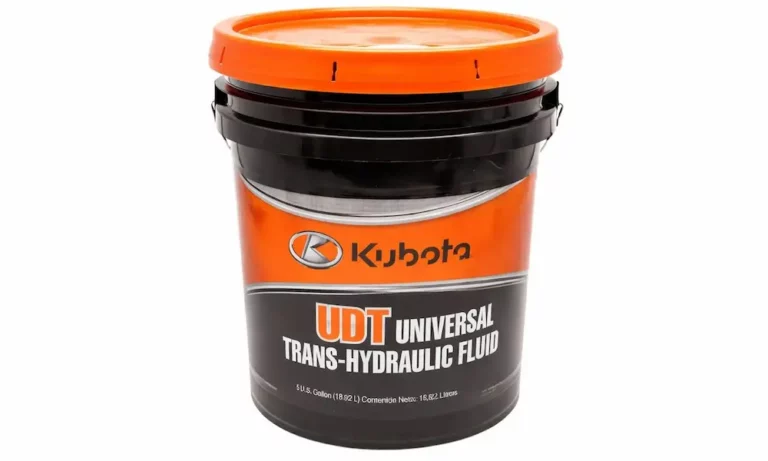
Standard Kubota UDT is a mineral-based, multi-purpose hydraulic and transmission fluid. It works well in moderate climates and general-use applications.
Kubota Super UDT2 is a full-synthetic fluid built for modern hydrostatic transmissions (HST), extreme temperatures, and higher mechanical stress.
Here’s why the gap between them matters:
| Technical Metric | Standard UDT | Super UDT2 Synthetic |
|---|---|---|
| Viscosity Index | ~137 | ~199 |
| Low-Temp Viscosity at -40°F | Under 70,000 cP | Under 16,000 cP |
| Gear Wear Protection Duration | 60 minutes | 90 minutes |
| Pour Point | Not rated | -42°C (-44°F) |
| Viscosity at 100°C | Not rated | 8.1 cSt |
The viscosity index tells you how stable the fluid stays as temperatures swing. Super UDT2’s index of 199 versus UDT’s 137 means the synthetic holds its thickness much better from a cold January morning to a hot August afternoon. That stability matters enormously for hydrostatic pump protection during cold starts.
Bottom line: If your tractor has an HST system, it almost certainly needs Super UDT2 or a full-synthetic equivalent. Using standard UDT in an HST machine is a shortcut to expensive repairs.
What Makes Kubota Hydraulic Fluid Special
You might wonder why you can’t just pour in any hydraulic oil. Here’s the thing — your Kubota’s transmission case serves triple duty. It’s the hydraulic reservoir, the transmission housing, and the wet brake bath all at once. The fluid has to handle all three jobs simultaneously.
The chemical makeup of Super UDT2 includes:
- Hydrotreated paraffinic distillates — the base oil that provides thermal stability
- Sulfonated calcium salts — detergents that prevent sludge and varnish buildup
- Phosphorodithioic acid derivatives — anti-wear agents that protect gear surfaces and bronze pump components
- Friction modifiers — polymers that control how wet brakes and PTO clutches engage
That last category — friction modifiers — is critical. Without them, your wet brakes can “grab and release” rapidly, creating a vibrating racket called brake chatter. That’s not just annoying. It physically stresses your axle components and can lead to brake failure over time.
Standard hydraulic oil from a hardware store doesn’t have this additive package. It’s not even close.
The Best Kubota UDT Hydraulic Fluid Equivalents Right Now
Here’s the practical breakdown. Match your tractor’s requirement (UDT or Super UDT2) to the right aftermarket option.
| Manufacturer | Product Name | Replaces | Key Specifications |
|---|---|---|---|
| Mobil | Mobilfluid 424 | Kubota UDT | J20C, GL-4, Allison C-4 |
| Mobil | Delvac Tractor Hydraulic Fluid | Kubota Super UDT2 | J20C, High Performance Synthetic |
| Shell | Spirax S4 TXM | Kubota UDT | J20C, Ford M2C134-D |
| Chevron | 1000 THF | Kubota UDT | J20C, Kubota UDT, Allison C-4 |
| Valvoline | Unitrac Tractor Hydraulic Oil | Kubota UDT | J20C, Direct UDT Replacement |
| AMSOIL | 5W-30 Synthetic Tractor Hydraulic (ATH) | Kubota Super UDT2 | All-Weather, Full Synthetic |
| TRIAX | Agra UTTO Supreme | Kubota Super UDT2 | Full Synthetic, -52°F Pour Point |
| Lucas Oil | Universal Hydraulic & Transmission | Kubota UDT | J20C, Budget Option |
| Castrol | Transmax Agri Trans Plus 80W | Kubota UDT | Anti-squawk, J20C |
Best for Standard UDT Replacement: Mobilfluid 424
Mobilfluid 424 is the most widely trusted aftermarket alternative for Kubota UDT. It meets the J20C specification, controls wet brake chatter effectively, and works well in hydrostatic drives and differentials. You’ll find it at most farm supply stores, and it costs significantly less than OEM fluid.
Best for Super UDT2 Replacement: TRIAX Agra UTTO Supreme
If your tractor runs an HST system or you’re working in extreme cold, TRIAX Agra UTTO Supreme is the strongest Super UDT2 substitute available. It stays fluid down to -52°F, carries an exceptionally high viscosity index, and is specifically formulated to replace all major OEM agricultural fluids. Kubota owners who switch to TRIAX often report a noticeably quieter HST pump — which is a direct sign of reduced mechanical stress.
Best Budget Option: Lucas Oil Universal Hydraulic & Transmission Fluid
For older Kubota models without HST systems, Lucas Oil’s universal fluid meets J20C and won’t drain your wallet. It’s not the choice for a modern BX or L-series with a hydrostatic drive, but it’s a solid pick for simpler gear-drive models doing light work.
Why Your HST System Is Picky About Fluid
Hydrostatic transmissions run at pressures between 2,500 and 3,500 PSI — with spikes up to 4,500 PSI under heavy load. At those pressures, the fluid itself is the power. It’s not just lubricating the system — it is the transmission.
When a fluid can’t handle those pressures, something called shear happens. The long-chain molecules that give the oil its thickness get physically torn apart. Once a fluid shears, it permanently loses viscosity. The result: internal leakage, mushy controls, reduced pulling power, and eventually, transmission failure.
Super UDT2’s superior shear stability is precisely why Kubota engineered it for their HST-equipped machines. AMSOIL ATH and TRIAX Agra UTTO Supreme both share this shear stability, making them the only aftermarket options worth considering for high-pressure HST applications.
Cold starts are another HST vulnerability. When mineral-based UDT gets thick in cold weather, the hydraulic pump can’t draw oil fast enough. The vacuum it creates pulls in air instead. Those air bubbles collapse against metal surfaces with enough force to erode the pump from the inside — a process called cavitation. Super UDT2’s pour point of -42°C eliminates this risk entirely.
Never Use 303 Tractor Fluid in a Modern Kubota
This warning deserves its own section because the mistake is shockingly common — and the damage is serious.
You’ve probably seen those bargain-priced “303” tractor hydraulic fluids in bright yellow jugs claiming to work for “any tractor.” Don’t touch them. The John Deere 303 specification was retired in 1974 — over 50 years ago.
There’s no valid formulation standard guiding what goes into these products today. Testing by the Petroleum Quality Institute of America found that over 90% of them fail basic viscosity and anti-wear requirements. Here’s how they compare to modern standards:
| Metric | Modern J20C Standard | Typical 303 Fluid | Impact on Your Kubota |
|---|---|---|---|
| Zinc & Phosphorus (Anti-Wear) | High | ~60% lower than standard | Rapid gear wear |
| Calcium Sulfonates (Detergency) | High | ~73% lower than standard | Sludge buildup |
| Low-Temp Viscosity | Controlled for cold starts | Extremely thick | Pump cavitation |
| Oxidative Stability | Resists thickening | Increases 25% in 100 hours | Sluggish hydraulics |
| Seal Compatibility | Passes Allison C-4 test | Most fail C-4 test | Transmission leaks |
Many of these fluids use “line flush” oil — a byproduct of cleaning lubricant production equipment. It’s a random mix of chemicals that were never meant to be combined. According to Lubrizol’s analysis of obsolete tractor fluids, these products represent a clear and documented risk to modern hydraulic systems. For HST tractors especially, 303 fluid is one of the leading causes of premature pump failure.
How Much Can You Actually Save?
Genuine Kubota Super UDT2 often runs $50 or more per gallon at the dealer. A large M-series tractor that holds 15 gallons turns one fluid service into a several-hundred-dollar oil bill. High-quality aftermarket synthetics can cut that cost by 40–60%.
| Tractor Series | Sump Capacity | OEM Fluid Cost (~$52/gal) | Aftermarket Cost | Estimated Savings |
|---|---|---|---|---|
| BX Series | 2.5–3.2 gal | $130–$166 | $63–$96 | ~$67–$70 |
| B Series | 3.3–4.0 gal | $171–$208 | $84–$124 | ~$84–$87 |
| L Series | 5.0–9.5 gal | $260–$494 | $96–$260 | ~$164–$234 |
| M/MX Series | 11.0–15.0 gal | $572–$780 | $220–$495 | ~$352–$384 |
That’s real money — especially if you’re running a commercial operation with multiple tractors. The savings become substantial over the machine’s lifetime.
One important caveat: if your tractor is still under warranty, stick with genuine Kubota Super UDT2. If anything fails, you don’t want a fluid dispute to void your coverage. Once the warranty expires, switching to a quality aftermarket synthetic is a smart, well-supported decision.
Don’t Mix Fluids — Do a Full Drain Instead
It might be tempting to top off your UDT with a quart of Super UDT2 or mix brands when you’re in a pinch. Don’t do it.
Mixing mineral-based UDT with a synthetic fluid dilutes the cold-weather flow and shear stability that make synthetic worth buying in the first place. Most fluids are chemically compatible — they won’t gel or react — but you’ll lose the performance advantages you paid for.
The right approach is a complete drain and refill whenever you switch brands or move from mineral to synthetic. While you’re at it, clean the suction screen. It’s the single most important step for protecting an HST pump — and it takes about ten minutes.
Most contamination-related wear in hydraulic systems doesn’t come from chemical fluid failure. It comes from metal particles and dirt that entered through a dirty breather or accumulated from gear break-in. Fresh fluid in a clean system lasts dramatically longer than good fluid in a dirty one.
What the Fluid Change Interval Actually Looks Like
Kubota’s recommended change interval for Super UDT2 in most models is every 200 hours or annually, whichever comes first. For high-hour commercial use, that timeline adds up fast.
If you’re switching to a full-synthetic equivalent like AMSOIL ATH or TRIAX Agra UTTO Supreme, both products are formulated to match or exceed OEM change intervals. Some operators running light-duty cycles report extending changes modestly — but don’t push it without a fluid analysis from a lab to confirm the oil is still performing.
Always replace the hydraulic filter at every fluid change. Kubota’s filters are engineered for specific flow rates and filtration efficiency with their fluids. An aftermarket filter that looks identical might not filter at the same micron rating — and in a high-pressure HST system, that difference shows up as accelerated wear.