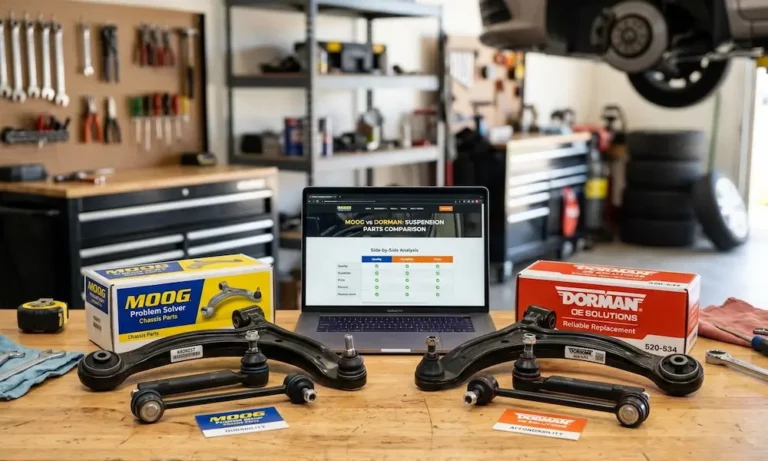
Picking the wrong suspension part can cost you twice — once for the part, and again for the labor when it fails early. If you’re stuck choosing between Moog vs Dorman, this breakdown cuts through the noise and tells you exactly which brand wins for your specific repair.
What Each Brand Actually Stands For
These two brands have been around since the early 1900s, but they took completely different paths.
Moog (founded 1919) built its name on one idea: don’t just copy the factory part — beat it. Their “Problem Solver” philosophy means every premium component includes design upgrades over the original equipment.
Dorman (founded 1918) went a different route. Their “OE FIX” strategy targets two pain points: broken factory designs and repairs that take way too long. With roughly 133,000 distinct parts and thousands of new products added yearly, Dorman also covers parts your dealer may have already discontinued.
So from day one, these brands are solving different problems — and that’s exactly what you need to understand before you buy.
Moog’s Engineering Edge: What Makes It Different
The Gusher Bearing Technology
Most cheap ball joints use a plastic or nylon socket to cradle the ball stud. Under heavy loads or heat, that plastic deforms and wears fast.
Moog’s gusher bearing replaces the plastic with a porous powdered metal design. Lubricant flows through the metal, creating a metal-to-metal interface that handles higher loads and generates less friction. The result? Less steering wander and longer service life.
Greasable Fittings vs. Sealed-for-Life Designs
Factory suspension parts are almost always sealed for life. That sounds convenient until the grease breaks down, gets contaminated with moisture or road grit, and the part dies. At that point, you’re replacing it — no other option.
Moog’s Problem Solver components often include zerk fittings so you can flush old grease and pump in fresh lubricant. For high-mileage vehicles or trucks that take a beating, this feature alone can add years to a component’s life.
Moog’s Three Tiers: CK, K, and RK
This is where a lot of buyers get burned. Not all Moog parts are created equal.
| Moog Series | What You Get | Best For |
|---|---|---|
| CK / K (Problem Solver) | Gusher bearing, greasable fittings, e-coating, induction-hardened studs | Long-term durability, heavy-duty use |
| RK (Value Line) | OE-style sealed design, standard materials | Budget repairs, short-term ownership |
The CK and K lines are the real deal. The RK line is a budget alternative — Moog-validated, but without the premium upgrades. If you’re buying Moog expecting Problem Solver quality, double-check you’re not grabbing an RK part by mistake.
Induction-Hardened Studs and Corrosion Coatings
Moog applies e-coatings (electrophoretic coating) to cast iron and steel control arms. These coatings bond to complex shapes, covering internal surfaces and weld points where rust likes to hide.
Independent metallurgical testing confirms that Moog ball joints outperform budget aftermarket competitors in multi-axial stress fracture resistance — by more than 5 times in some durability tests.
Dorman’s Engineering Edge: Labor Savings and OE FIX Solutions
The Loaded Knuckle: Dorman’s Best Idea
Replacing a wheel bearing on a front-wheel-drive car traditionally needs a hydraulic press. In rust-belt states, those bearings seize to the knuckle, and what should be a 2-hour job turns into a 4-hour battle — one that can crack or destroy the knuckle itself.
Dorman’s answer is the loaded steering knuckle. It arrives with the bearing, hub, and backing plate already pressed in. You bolt it on. Done. No press needed, no guesswork, no seized hardware disasters.
For DIYers without a press or shops working against a clock, this is genuinely one of the smartest solutions in the aftermarket.
Re-Engineering Factory Design Failures
Dorman doesn’t just replace parts — they study why parts fail, then fix the root cause. Their engineering teams analyze failure data across millions of vehicles and release upgraded versions of chronically problematic components.
Examples include:
- Stainless steel transmission lines replacing rust-prone mild steel originals
- Reinforced intake manifolds for models known to crack at coolant passages
- Upgraded blend door actuators with more durable internal gearing
| Dorman Program | What It Does | Typical Parts |
|---|---|---|
| OE Solutions | Exact fit for hard-to-find parts | Hardware, sensors, brackets |
| OE FIX | Redesigned to prevent original failure | Loaded knuckles, reinforced manifolds |
| HD Solutions | Chassis parts for medium/heavy trucks | Steering boxes, leaf springs |
| Refurbished Electronics | Restored control modules | ABS modules, instrument clusters |
Where Dorman Shines (and Where to Be Careful)
Mechanics consistently give Dorman high marks for mechanical “hard parts” — suspension arms, cast knuckles, engine hardware. These parts are reliable and often genuinely better than the factory design they replace.
Electronics are a different story. Many technicians caution against Dorman sensors, actuators, and purge valves, noting a higher perceived failure rate versus OEM options. The practical takeaway: trust Dorman for metal parts, be cautious with complex electronics.
The Pressed-In Ball Joint Rule You Can’t Ignore
Here’s a Moog technical detail that every DIYer and tech should know. If your vehicle uses a control arm where the ball joint presses into a hole in the arm, Moog engineers advise replacing that joint only once.
Every time you press a joint out and a new one in, the mounting hole deforms slightly. This is called progressive machining — and it reduces the force needed to keep the joint seated. On the second replacement, you should replace the entire control arm to stay safe.
This rule applies regardless of which brand you’re installing.
Moog vs Dorman: Labor Economics Side by Side
| Repair | Moog Approach | Dorman Approach | Typical Labor Time |
|---|---|---|---|
| Control Arm | Upgraded bushings and CK ball joints | Rust-inhibitive coatings, easy fitment | 1.5–3.0 hours |
| Ball Joint | Gusher bearing, greaseable socket | Direct OE replacement, simplified hardware | 1.0–2.0 hours |
| Steering Knuckle | Complete assembly option | Loaded Knuckle with pre-pressed hub | 2.0–4.0 hours |
| Tie Rod Ends | Gusher bearing, wrench flats for torque | Direct fit with all necessary hardware | 0.5–1.0 hour |
Keep one thing in mind: no matter which brand you choose, any significant steering or suspension work requires a four-wheel alignment afterward. Replacing control arms, knuckles, or tie rods changes your caster, camber, and toe settings. Skip the alignment and you’ll chew through tires in months. Budget $100–$200 for this — it’s not optional.
Salt Belt Drivers: This Changes the Equation
If you’re in Michigan, Ohio, Pennsylvania, or anywhere else that gets heavy road salt, the environmental durability of your parts matters as much as the metallurgy.
Dorman’s stainless steel replacements for mild steel originals are a genuine upgrade in these climates. Their loaded knuckle also solves a very real problem — when bearings and knuckles are welded together by rust, pressing them apart isn’t always possible without destruction.
Moog’s e-coatings on control arms provide solid corrosion resistance, but for the most labor-intensive salt-belt repairs, Dorman’s bolt-on assemblies have a clear practical advantage.
Warranty Comparison: What’s Actually Covered
| Feature | Moog CK (Premium) | Moog RK (Value) | Dorman OE Solutions |
|---|---|---|---|
| Warranty Length | Limited Lifetime | 3 Years | Limited Lifetime |
| Fleet Coverage | Limited | None/Limited | 12 Months |
| Greasable | Usually yes | Rarely | Varies |
| Price Point | High | Low | Mid-range |
| Best Use Case | Long-term durability | Budget repairs | Labor savings, OE fixes |
One important caveat on all these warranties: they cover the replacement part only. They don’t cover labor. If a part fails and you need it re-installed, that cost comes out of your pocket. That’s a strong argument for buying a better part the first time — the labor to do it twice often costs more than the upgrade would have.
So Which Brand Should You Actually Buy?
Here’s the honest answer: it depends on what you’re fixing.
Choose Moog CK/K when:
- You want maximum durability on critical steering and suspension pivot points
- You’re driving a work truck or towing vehicle
- You plan to keep the vehicle long-term
- You want greasable joints that extend the maintenance cycle
Choose Dorman OE FIX when:
- You’re dealing with a known factory design failure
- The original repair requires specialty tools you don’t have
- You’re in a rust-belt state fighting seized components
- You need a part the dealer no longer stocks
The smartest approach many experienced technicians use is combining both: Moog Problem Solver parts for individual joints and pivot points, Dorman loaded assemblies for complex, time-intensive repairs. That strategy gives you durability where it counts and efficiency where the factory design makes things unnecessarily hard.
One thing both brands agree on? Don’t cut corners on suspension. These parts keep your wheels pointed in the right direction — and that’s not a system you want to gamble on with the cheapest option available.