Your temperature gauge is climbing. The car’s sitting still. And the fan? Silent. A radiator cooling fan not working isn’t just annoying — it can wreck your engine fast. This guide breaks down every reason it fails, how to test each part, and what to fix first. Stick around, because the culprit is often not what you’d expect.
Why Your Radiator Cooling Fan Actually Matters
At highway speeds, air rams through your radiator naturally. But the moment you’re stuck in traffic, idling in a parking lot, or crawling up a hill, that airflow disappears.
That’s when your cooling fan takes over. It pulls air through the radiator to keep coolant temps between 200 and 230°F. Without it, coolant boils, pressure spikes, gaskets blow, and engines seize.
A radiator cooling fan not working isn’t a “fix it next week” problem. It’s a fix-it-now situation.
Two Types of Cooling Fans — And How Each Fails
Before you start diagnosing, you need to know which system you’re dealing with.
| Fan Type | Power Source | How It’s Controlled | Common Use |
|---|---|---|---|
| Fixed Mechanical | Crankshaft/Belt | Engine RPM | Vintage & heavy industrial |
| Viscous Clutch | Crankshaft/Belt | Thermal fluid expansion | Trucks, SUVs, RWD sedans |
| Electric | Battery/Alternator | ECU, relay, or module | Modern passenger cars |
| Flex Fan | Crankshaft/Belt | Centrifugal force | Performance aftermarket |
Most cars built in the last 15 years use electric fans controlled by the ECU. Older trucks and large SUVs still use mechanical fan clutches. Each fails differently, so your diagnosis depends on which one you have.
Mechanical Fan Problems: It’s Almost Always the Clutch
If you drive a truck or a rear-wheel-drive SUV, your fan is bolted to the water pump and driven by a belt. A viscous fan clutch sits between the pulley and the blades, using silicone fluid to control engagement speed based on heat.
Two Ways a Fan Clutch Fails
It stops engaging (freewheeling): The silicone fluid leaks out. The fan just spins lazily with no real force behind it. You’ll often see a thick, greasy ring of road grime on the clutch — that’s the leaked fluid collecting dirt. The engine overheats, especially at low speeds or idle.
It stops disengaging (seized clutch): The internal valving locks up. The fan runs at full blast constantly, creating a loud roaring sound at high RPM. It also hammers the water pump bearings and strains the drive belt.
How to Test a Mechanical Fan Clutch
You don’t need fancy tools for this. Try these three tests:
- The spin test: Engine off and cold — grab the fan and spin it by hand. A healthy clutch gives firm, smooth resistance. If it spins freely like a pinwheel, the fluid is gone. If it won’t move at all, it’s seized.
- The newspaper test: Engine warm and idling — carefully push a rolled newspaper into the spinning fan blades. A working clutch shreds it. If the paper stops the fan, the clutch is slipping badly.
- The tachometer test: Use a non-contact tachometer at operating temperature. A healthy fan clutch should hit around 1,100 RPM at idle when hot. Under 500 RPM? The clutch is shot.
Electric Fan Problems: A Chain of Parts That Can Break
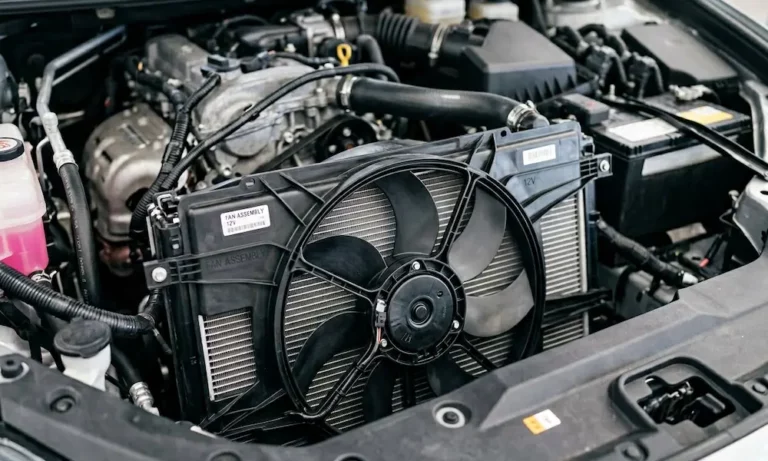
Electric fans fail because something in the command chain breaks down. The motor might be fine, but if the relay, fuse, sensor, or wiring fails, the fan sits still while your engine cooks.
Here’s what’s in that chain:
Fuses: Check These First
It takes 30 seconds and saves you hours of chasing ghosts. A blown fuse cuts all power to the fan instantly. Fan motors draw 20 to 40 amps — if the motor’s bearings are worn or the windings are shorted, it pulls extra current and kills the fuse. Check your fuse box diagram and test it with a multimeter. Don’t just eyeball it; a fuse can look fine and still be blown.
Relays: Small Part, Big Impact
The relay is a switch the ECU controls to send high-current power to the fan. When the ECU sees the engine getting hot, it energizes the relay coil, which snaps the contacts closed and powers the motor.
Relay contacts pit and corrode over thousands of cycles. The relay clicks, but electricity won’t flow through the damaged contacts. The easiest test? Swap it with an identical relay from another slot in the fuse box. If the fan runs with the new relay, you found your problem.
Watch for melted plastic around the relay socket too — that’s a sign of high resistance generating heat, which can damage the socket itself.
The Coolant Temperature Sensor: The Brain Behind the Fan
The Engine Coolant Temperature sensor is a thermistor sitting in the coolant stream, usually near the thermostat housing. As coolant heats up, the sensor’s resistance drops, and it sends a changing voltage signal back to the ECU.
If the sensor lies to the ECU — reporting cool temps when the engine is actually boiling — the ECU never triggers the fan. You can check live ECT data with an OBD2 scanner while the engine warms up. If the gauge on your dash climbs but the scanner shows a cool reading, the sensor is your culprit.
Fan Control Modules: Modern Vehicles Get Complicated
Many newer cars ditch the simple relay for a solid-state Fan Control Module that uses Pulse Width Modulation to vary fan speed. Instead of full-on or full-off, the module runs the fan at exactly the speed needed — 20% for light cooling, 100% for maximum airflow.
These modules are more efficient, but diagnosing them requires an oscilloscope or a professional-grade scan tool. If everything else checks out, a failing PWM module is often the hidden culprit in modern car overheating issues.
Step-by-Step Electric Fan Diagnostic Process
Don’t just start throwing parts at it. Follow this order and you’ll find the problem without wasting money.
| Step | What to Do | What It Tells You |
|---|---|---|
| 1. Fuse check | Visual + multimeter test | Rules out a blown circuit |
| 2. A/C bypass test | Turn A/C to max cold | If fan runs, motor and relay are good |
| 3. Relay swap | Swap with identical relay | Isolates internal relay failure |
| 4. Direct jumper test | Apply 12V straight to motor | Confirms if motor itself works |
| 5. OBD2 live data | Check ECT sensor reading | Verifies sensor accuracy |
The A/C bypass test is your fastest shortcut. When you crank the A/C, the system commands the fan on immediately to cool the condenser. If the fan runs with the A/C on but not when the engine is hot, your motor and relay are fine — the temperature sensing circuit is the problem.
If the fan doesn’t run even with the A/C on, disconnect the fan connector and jump 12 volts directly from the battery to the motor pins. Fan spins? The motor’s good. The problem is upstream — wiring, relay, or ECU output.
Wiring and Connectors: The Silent Killers
Bad wiring causes more fan failures than people realize, and it’s easy to miss.
Ground Faults
The fan motor needs a clean path back to the battery to complete the circuit. Many electric fans ground to the chassis near the radiator support. Rust or a loose bolt at that ground point means the fan gets intermittent power or none at all.
Test it with a multimeter. With the fan commanded on, measure voltage drop between the fan’s ground pin and the negative battery terminal. More than 0.2 volts means the ground connection is bad.
Corroded Connectors
Moisture gets into connectors. Copper oxidizes. That green crusty buildup acts as an insulator, creating resistance that either prevents the fan from running at full speed or generates enough heat to melt the connector housing entirely. When you replace a fan motor, always inspect the connector. If there’s any heat damage or corrosion, replace the pigtail connector too — otherwise you’ll burn out the new motor.
What Your Car Is Telling You: Symptoms Decoded
Sometimes your car gives you clues before things go critical.
- Overheats at idle, fine at speed: This is the classic sign of a total fan failure. At 35-45 mph, natural airflow handles cooling. At a stoplight, nothing does.
- A/C blows cold moving, warm at stops: The fan isn’t pulling air through the A/C condenser. Fans run, or your A/C suffers.
- Fan runs constantly, even after engine off: A relay stuck closed keeps commanding the fan on. A few minutes after shutdown is normal. Running until the battery dies is not.
- Jet-engine roar from the engine bay: Either a seized mechanical fan clutch or a broken electric fan blade causing imbalance.
- Grinding or chirping: Fan motor bearings are failing. The fan may still spin, but not for long.
- Visible wobble on the fan blades: A failing bearing or bent shaft. Fix this immediately — a wobbling blade can contact the radiator and punch a hole in it.
The A/C Connection You Probably Didn’t Know About
Your radiator cooling fan isn’t just for the engine. The A/C condenser sits directly in front of the radiator, and it needs airflow to convert refrigerant gas back into liquid.
A pressure switch — called a trinary switch — monitors refrigerant pressure. When it climbs past roughly 250 psi, it signals the ECU to run the fan, even if the engine temperature is completely normal. This is why your fan kicks on the second you hit the A/C button.
If the fan fails, the A/C pressure climbs, the compressor cuts out, and you get warm air from your vents at every red light.
How the ECU Controls Fan Operation
Your ECU doesn’t just flip the fan on and off. It makes calculated decisions.
- Vehicle speed input: Above 50 mph, the ECU typically shuts the fan off. Ram air does the job more efficiently.
- Fail-safe mode: If the ECT sensor fails, the ECU often runs the fan at full speed constantly as a protective measure. If your fan runs non-stop after replacing no parts, check for a fault code on the temperature sensor circuit.
- Turbocharged engines: The ECU may trigger the fan based on intake air temps to keep the intercooler effective, not just coolant temperature.
Understanding this logic explains why a radiator cooling fan not working sometimes isn’t a broken motor — it’s the ECU making a decision based on bad sensor data.
OEM vs. Aftermarket: Does It Matter?
Yes — especially with electric fans. Cheap replacement fans often move less air, have weaker weatherproofing, and burn out faster. High-performance brands like SPAL or Maradyne are popular for a reason: higher CFM ratings and better sealing mean they actually replicate what your car needs.
For a daily driver, match or exceed the original fan’s specs. Underpowered replacements will keep your engine in a constant struggle against heat, especially in summer traffic or towing situations.