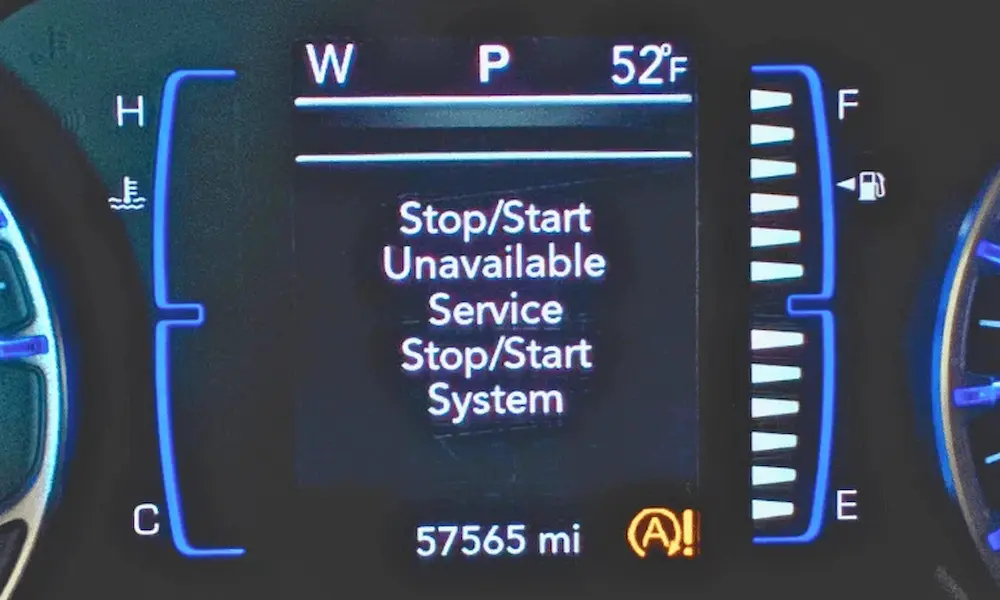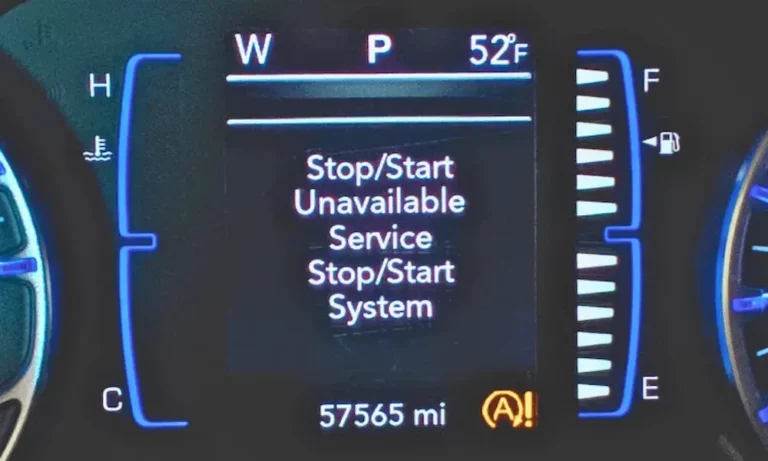
That “stop/start unavailable service stop/start system” message just popped up on your Jeep’s dash, and now you’re wondering if something’s seriously wrong. Sometimes it’s nothing. Sometimes it’s a failing battery. This post breaks down every cause — from normal system behavior to real hardware faults — so you know exactly what you’re dealing with before spending a dime.
What Do These Messages Actually Mean?
Your Jeep’s Electronic Stop-Start (ESS) system talks to you through the instrument cluster. But not every message means something’s broken.
Here’s a quick breakdown of what each indicator tells you:
- Green light — System is active and ready to shut the engine off at a stop
- Grey light — System is on but conditions aren’t right to trigger an Autostop (totally normal)
- Flashing amber/yellow + “Service Stop/Start System” — There’s a real fault that needs a diagnostic scan
- “Stop/Start Unavailable” — A current condition is blocking the system (could be temporary)
The grey light trips people up the most. It’s not a fault. The system is just saying, “I’m here, but I’m busy doing something else right now.”
Why Is Stop/Start Unavailable Showing Up?
This is the big question. The ESS system checks a long list of conditions before it’ll shut the engine off. If any single item fails that checklist, you get the “stop/start unavailable” message.
Your HVAC System Is Working Too Hard
This is the most common culprit. If your cabin hasn’t reached your target temperature yet, the engine stays running to power the A/C compressor or heater.
Specific settings that block Autostop:
- MAX A/C mode
- Full defrost with high fan speed
- Rear defroster (engine may restart after just 30 seconds)
Give the cabin time to reach temperature. The message often clears on its own.
The Battery Isn’t Charged Enough
Your Jeep’s Intelligent Battery Sensor (IBS) watches battery voltage constantly. If it drops below 11.3 volts, or if your accessories are pulling more than 70 amps, the system won’t risk an Autostop. It needs to know the engine can restart reliably.
You might see the message specifically say “Battery Charging.” That means the system is replenishing the battery and will come back once it’s satisfied.
You’re in 4WD or Off-Road Mode
Driving in 4H, 4L, or an off-road Selec-Terrain mode? ESS disables itself automatically. It won’t cut the engine when you need maximum power available instantly.
Environmental or Driving Conditions
Several other factors block Autostop:
| Condition | Why It Blocks Autostop |
|---|---|
| Ambient temp outside 41°F–140°F | Protects battery chemistry |
| Steering wheel turned sharply | System assumes you’re maneuvering |
| Road grade steeper than 15% | Prevents rollback risk on restart |
| Fuel below 1/8 tank | Safety buffer |
| Hood ajar or open | Engine won’t auto-restart near a technician |
| Door open or seatbelt unlatched | Safety lockout |
Most of these resolve themselves once conditions change.
What “Service Stop/Start System” Actually Means
This one’s different. A flashing amber light with the “service stop/start system” message means there’s a stored fault code. You need a scan tool to read it.
Common codes include:
- U113E — Loss of communication with the IBS
- B2193 — IBS internal monitoring failure
- P00FD — Battery voltage delta between primary and auxiliary
Don’t ignore this one. It won’t fix itself by driving around.
The Dual-Battery System: Why It Makes Things Complicated
If you drive a Wrangler (JL), Gladiator (JT), or Grand Cherokee, your Jeep runs two batteries. This is intentional — and it’s where most “service stop/start system” headaches come from.
How the Two Batteries Work Together
The primary battery handles engine starts and high-load functions. The auxiliary battery powers accessories — infotainment, lights, climate fans — while the engine is off during an Autostop.
When the auxiliary battery starts failing, it drains the primary battery constantly, even when the Jeep is parked. The primary battery never fully charges, and the ESS system stays permanently disabled.
Techs recommend replacing both batteries at the same time. An old auxiliary battery will degrade a new primary battery fast.
Where Are These Batteries Hidden?
Battery locations vary a lot by model:
| Model | Primary Battery | Auxiliary Battery |
|---|---|---|
| Wrangler JL | Engine bay (passenger side) | Under the PDC/fuse box |
| Gladiator JT | Engine bay (passenger side) | Under the PDC/fuse box |
| Grand Cherokee | Under front passenger seat | Under passenger or driver seat |
| Cherokee KL | Engine bay (driver side) | N/A (standard models) |
| Compass MP | Engine bay | Engine bay (if equipped) |
On the Wrangler and Gladiator, accessing the auxiliary battery means either unbolting the PDC or pulling the passenger-side wheel-well liner. On the Grand Cherokee, slide the front passenger seat all the way forward and lift the floor panel.
Always use AGM batteries. The ESS system cycles the battery far more than a standard vehicle does. A regular lead-acid battery will fail quickly and trigger constant service lights.
The High-Amp Fuse Array: A Sneaky Failure Point
Inside the Power Distribution Center (PDC) on Wrangler and Gladiator models, there’s a block of high-amperage fuses (100–150 amps) connecting the two batteries. These aren’t standard fuses you can swap individually — they’re a dedicated array.
The N3 Fuse Problem
The N3 fuse in this array is a frequent ESS killer. A single accidental short — during a jump-start, or a wrench slipping near the terminals — can blow it instantly. When it blows, the charging path between the batteries severs, and you get a permanent “service stop/start system” light.
The fuse array is a separate Mopar part (SKU 68368854AA). You don’t need to replace the entire PDC, just the array.
| Fuse Position | Amperage | Function |
|---|---|---|
| N1 | 150A | Auxiliary battery positive connection |
| N2 | 100A | Main power feed to cabin |
| N3 | 150A | ESS system isolation/charging |
| N5 | 100A | Alternator/charging system feed |
The Hood Pin Nobody Talks About
Here’s a sneaky one. Jeep ESS systems use two separate hood sensors. The first triggers the “Hood Open” warning on your dash. The second is a dedicated plunger switch specifically for ESS and remote start.
If that second switch gets misaligned, corroded, or bumped out of position, the ESS system thinks the hood is open — even when it’s not. The engine won’t auto-restart near what it believes is an open engine bay.
The frustrating part? This fault often shows “stop/start unavailable” without a “hood open” warning. It looks like a ghost fault. Check that secondary plunger switch before tearing into anything else.
IBS Calibration: The Fix Most People Skip
After any battery replacement, the IBS needs to relearn your battery’s capacity. This process — called quiescent learning — requires the Jeep to sit completely undisturbed for at least 2–4 hours.
If you disturb the vehicle during this window (open a door, turn on a light), the calibration restarts. The ESS system can stay “unavailable” for days until the IBS gets a clean learning cycle.
According to Mopar’s technical service bulletin, some techs disconnect the negative cable from the IBS during this period to guarantee no current flows through the sensor and corrupts the calibration.
This step gets skipped constantly. It explains why many battery replacements seem to “not fix” the ESS message right away.
Diagnostic Steps in Order
Before throwing parts at the problem, work through this sequence:
- Check the info menu first. Your Jeep often displays the specific reason for the inhibition — “Cabin Heating/Cooling,” “Battery Charging,” etc. If there’s a clear reason showing, wait and drive normally.
- Load test each battery individually. Voltage alone isn’t enough. Each battery must hold voltage under heavy amperage draw. A voltage delta between the two batteries will set fault codes and disable the system.
- Inspect the IBS wiring harness. Wiggle it while watching a scan tool for communication drops. The power feed wire should show at least 11.8 volts. Check the high-amp fuse array for continuity.
- Check the hood plunger switches and ground points. Ground G906A and engine-to-chassis ground straps must be clean, tight, and rust-free. Corroded grounds create enough electrical noise to confuse the ESS logic.
Aftermarket Fixes If You’re Done With ESS Entirely
A lot of Jeep owners just want the system off permanently. Two popular options exist:
Stop-Start Eliminator Module — A plug-and-play device that connects to your diagnostic port or dash switch. It remembers your last ESS setting and reapplies it every time you start the Jeep. No fault codes. No interference with other systems.
Auxiliary Battery Delete (Wrangler/Gladiator) — Disconnecting the auxiliary battery’s negative cable and pulling Fuse 42 from the PDC forces the Jeep to run on the primary battery only. This eliminates the risk of a failing aux battery dragging down the main one — but it disables ESS entirely. Tape off any disconnected terminals carefully. A short during this process will blow the expensive fuse array.
Quick Maintenance Checklist to Keep ESS Healthy
- Replace both batteries as a matched set — never just one
- Only use AGM batteries — standard lead-acid fails fast under ESS cycling
- Let the vehicle sit undisturbed for 4+ hours after any battery service
- Clean battery terminals and the IBS regularly — look for white, blue, or greenish powder
- Keep ground point G906A and engine ground straps tight and corrosion-free
- Check the secondary hood plunger switch if you get “unavailable” with no other obvious cause
The “stop/start unavailable” message is usually just the system doing its job. But when “service stop/start system” shows up with an amber light, that’s your Jeep telling you it’s found something worth investigating — and now you know exactly where to look.