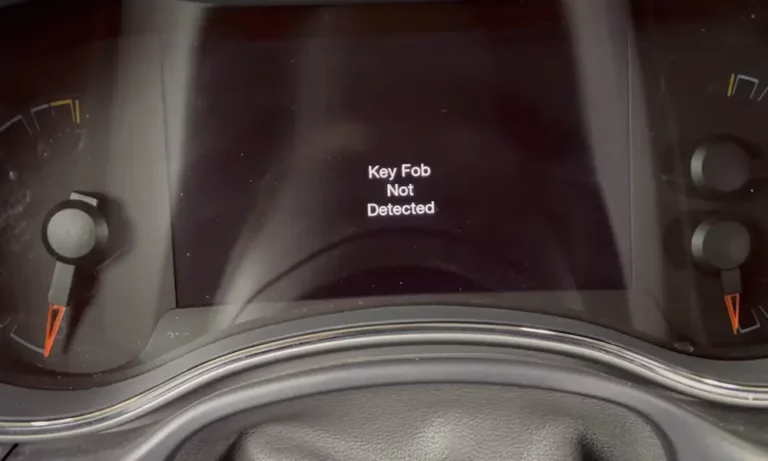
Your Jeep flashes “key fob not detected” and suddenly you’re stuck in a parking lot. It’s frustrating, but it’s usually fixable without a tow truck or a hefty dealership bill. This guide walks you through every fix — from the 30-second battery trick to resetting your RF Hub module — so you can get back on the road fast.
What Does “Key Fob Not Detected” Actually Mean?
When your Jeep displays this message, it means the vehicle’s security system can’t confirm your key fob’s identity. Your Jeep uses a system called Passive Entry Keyless Go (PEKG), which requires a constant handshake between your fob, the Radio Frequency Hub Module (RFHM), and the Body Control Module (BCM).
If that communication breaks down, your Jeep won’t start — or in some cases, won’t even shut off.
It’s not always a hardware failure. Most of the time, the fix is simpler than you think.
The Most Common Causes
Before pulling fuses or calling a locksmith, check the basics.
Dead fob battery — This is the #1 cause. Jeep fobs use a CR2032 or CR2025 coin cell battery. Once voltage drops below a certain threshold, the fob can’t produce a reliable signal.
Weak vehicle battery — Your RF Hub and BCM are sensitive to voltage drops. A vehicle battery that won’t hold a proper resting voltage can mimic a fob failure entirely.
RF interference — Smartphones, Wi-Fi routers, and even nearby neon signs with switching-mode power supplies can disrupt your fob’s signal within a surprisingly short range.
RF Hub module failure — Especially in SUVs, the RFHM sits behind the rear cargo quarter trim panel and is prone to moisture and corrosion over time.
Lost sync after battery swap — Replacing the fob battery sometimes breaks the rolling code sync between your fob and the RF Hub.
Try This First: The Emergency Start Trick
If your Jeep shows “key fob not detected” right now, don’t panic. There’s a built-in backup.
Your key fob contains a passive RFID chip that doesn’t need battery power. The Start/Stop button has an antenna that reads it through inductive coupling — like a contactless card reader.
Here’s what to do:
- Press the brake pedal firmly
- Use the nose (top end) of the key fob to physically press the Start button
- Hold it there for a few seconds
This works in over 90% of dead-battery situations. It won’t work if your vehicle’s main battery is dead or if the RF Hub itself has failed.
How to Replace the Jeep Key Fob Battery
If the emergency start trick works, replace your fob battery as soon as possible.
What you need: CR2032 or CR2025 coin cell (check your owner’s manual)
Steps:
- Find the small notch on the fob’s edge and pry it open with a flat coin
- Remove the old battery
- Insert the new one with the positive (+) side facing up (or as marked inside the housing)
- Snap the fob back together
After the swap, resync it:
- Insert your key into the ignition
- Cycle from OFF to ON five times within 10 seconds
- Press any button on the fob
For push-button start models, hold the fob against the start button and cycle the engine to resync the RFID chip with the BCM.
Check Your Vehicle Battery Too
A dying 12V battery is a sneaky culprit. If your vehicle battery’s resting voltage is too low, the RF Hub and BCM struggle to authenticate incoming fob signals.
If your Jeep has Electronic Start/Stop (ESS) technology, it runs a dual-battery system. Both the main and auxiliary batteries need checking — a failing auxiliary battery can introduce electrical noise that looks exactly like a key fob not detected error.
Use a multimeter to check resting voltage. Anything below 12V is a red flag.
How to Do a Hard Reset (RF Hub & BCM)
If the fob battery is fresh and your vehicle battery checks out, try a hard reset. This clears frozen software states in your electronic control modules.
Here’s how:
- Remove the negative battery cable first, then the positive
- Wait 15 to 30 minutes — this drains residual power from capacitors
- Briefly touch the two disconnected cables together (away from the battery) to force a full capacitor drain
- Reconnect positive first, then negative
- Do a few door lock/unlock cycles to recalibrate the passive entry sensors
This process resets the RF Hub’s volatile memory, which often clears error states that survive a simple ignition cycle.
Check the Fuses
A blown fuse can cut power to your keyless entry system entirely. Here’s where to look for each model:
| Model | Fuse Location | Key Fuse Details |
|---|---|---|
| Grand Cherokee (WK2) | Engine compartment PDC & driver footwell | Fuse F51 (15A): Keyless Entry/Ignition |
| Wrangler (JL) | Engine compartment PDC & glovebox | Relay K1/K3: Starter relays; BCM/RFHM in main array |
| Renegade (BU) | Under hood, under dash & rear trunk | Under-dash panel for security modules |
Wrangler JL and Gladiator JT owners: Check the large gray PEKG harness connector in the driver’s footwell. Loose pins at Pin 25 (Driver Sense — Green/Yellow) and Pin 26 (Driver Return — Green/White) are a common cause of complete system failure, especially in aftermarket-modified or previously repaired vehicles.
Is There a Recall Covering Your Jeep?
Before spending a dollar, check if your Jeep is already covered.
TSB 08-064-21 — Affects certain Jeep Renegade models throwing DTC B1053-64 (Signal Plausibility Failure). The fix is an RFHM software reflash using the wiTECH diagnostic suite. The vehicle’s battery must stay between 13V and 14V during the flash or the procedure fails.
Recall 24V123 — Covers certain Jeep Grand Cherokees with widespread RF Hub module failures that block keyless entry and ignition. Affected owners get a free RF Hub replacement at authorized dealerships.
Recall 56C — Specific to certain Jeep Wrangler models. A pinched remote start antenna cable during factory assembly interrupts the RF path, causing key detection failures and TPMS issues. Fix is a cable replacement.
Enter your VIN at NHTSA’s recall lookup to check your vehicle’s status.
2018+ Jeeps: The Security Gateway Module Changes Everything
If your Jeep is a 2018 or newer model, there’s an extra layer to be aware of: the Secure Gateway Module (SGM).
This is a cybersecurity firewall that blocks unauthorized writes through the OBD-II port. Standard scan tools can read fault codes, but programming a new fob or clearing a security lockout? Blocked.
To bypass it, a technician needs a specialized “12+8” bypass cable that intercepts the CAN signals directly. Tools like Autel, XTool, or JScan work once the bypass adapter is connected. This is why DIY key programming on newer Jeeps carries real risk if you don’t have the right equipment.
What’s It Going to Cost?
Here’s a realistic breakdown of your options:
| Fix Type | Cost Range (USD) | Best For |
|---|---|---|
| DIY (battery + resync) | $5 – $15 | Dead fob battery |
| Automotive locksmith | $130 – $400 | On-site programming, 30–50% cheaper than dealers |
| DIY with bypass cable | $50 – $150 | 2018+ models, tech-savvy owners |
| Dealership | $300 – $600+ | Warranty vehicles, RF Hub replacements |
Locksmiths are increasingly the smart middle-ground. They’re mobile, often available 24/7, and use professional diagnostic tools that handle SGM-equipped vehicles. That said, if your Jeep is under warranty or covered by a recall, go straight to the dealership — the fix is free.
WIN Module vs RF Hub: Know the Difference
Older Jeeps (roughly 2008–2020) use a Wireless Ignition Node (WIN) rather than an RF Hub. The failure symptoms are different, so knowing which system you have saves time.
| Feature | WIN Module | RF Hub Module |
|---|---|---|
| Common failure symptom | Engine runs after key removal; wiggling required to start | “Key fob not detected” message; passive entry dead |
| Typical failure cause | Worn internal contacts from repeated key insertions | Moisture and corrosion in rear panel |
| Location | Steering column | Rear quarter trim panel |
| Fix approach | Rebuild (preferred) or replace | Replace + seal wiring harness |
WIN module rebuilding is often better than full replacement because it keeps your original VIN and security programming intact — no expensive dealership reprogramming needed.
Work Through It in Order
The jeep key fob not detected message sounds alarming, but it rarely means a major repair. Start with the fob battery. If that doesn’t work, try the emergency start method. Then check your vehicle battery, run a hard reset, and inspect the fuses. Only after all that should you start looking at RF Hub replacement or dealer diagnostics.
Most people solve it within the first two steps.