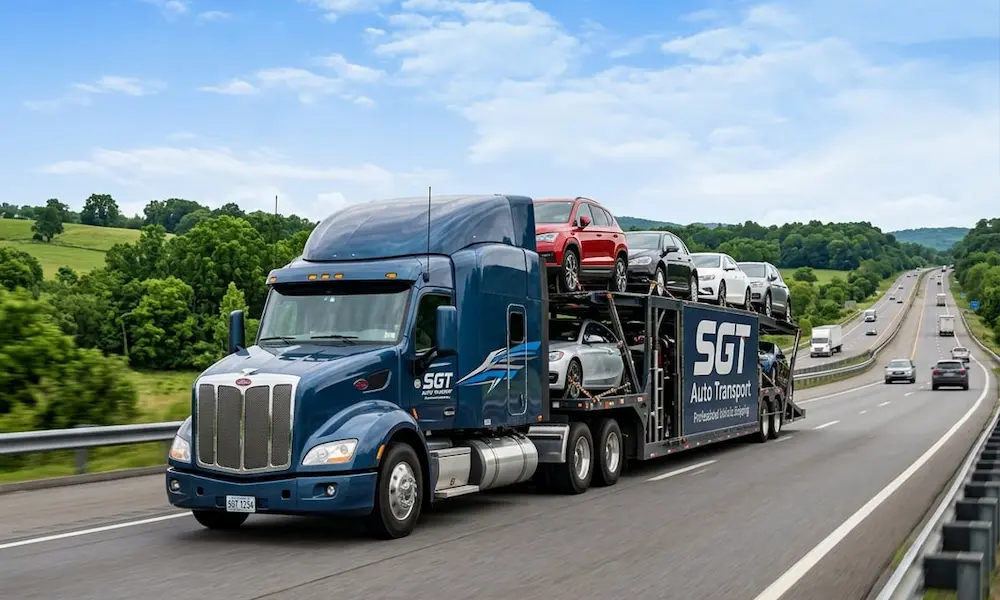
Shipping your car feels stressful enough without worrying about hidden fees, shady carriers, or price hikes after you’ve already signed. These SGT Auto Transport reviews dig into the real experience — the good, the frustrating, and the stuff nobody tells you upfront. Read to the end before you book anything.
What Is SGT Auto Transport, Actually?
SGT Auto Transport isn’t a trucking company. It’s a freight broker — a middleman connecting you with independent carriers who do the actual driving.
The company is based in Bohemia, New York, and has been operating since around 2014. It holds active broker authority under USDOT number 2521690, registered with the Federal Motor Carrier Safety Administration.
Because SGT doesn’t own trucks or employ drivers, it has zero crash incidents under its own DOT number. That sounds great until you realize the carrier they assign you — a third party — is the one actually responsible for your car.
That distinction matters more than most people think.
What Services Does SGT Auto Transport Offer?
SGT covers a wide range of shipping needs. Here’s a quick breakdown:
Open Transport
The standard option. Your car rides on an open multi-car trailer — the same kind dealerships use. It’s the most affordable and the fastest to schedule. You’re exposed to weather and road debris, but statistically, most cars arrive just fine.
Enclosed Transport
Your car goes inside a fully enclosed trailer. It costs 30–50% more than open transport, but it’s worth it for classic cars, luxury vehicles, or anything you’d lose sleep over. Carriers need higher insurance thresholds to operate these trailers, which limits availability.
Electric Vehicles
EV transport requires special handling due to heavy battery packs and undercarriage sensitivity. SGT has adapted its carrier network to accommodate this.
Inoperable Vehicles
If your car doesn’t run, you must disclose that before booking. SGT dispatches a carrier with a winch or hydraulic lift. Don’t hide this — it triggers a cancellation fee if discovered at pickup.
Door-to-Door vs. Terminal-to-Terminal
Door-to-door is the default. The driver gets as close to your address as safely possible. If your street is too narrow for an 18-wheeler, you’ll meet the driver in a nearby parking lot.
Terminal-to-terminal means you drop your car at a storage yard and pick it up at another one near your destination. It’s more flexible for rigid schedules, but your car could sit in a staging yard longer.
SGT Auto Transport Pricing: How It Actually Works
No upfront deposit. That’s the first thing SGT promotes, and it’s genuinely a nice touch. You only pay once a carrier gets assigned to your route.
But here’s where things get complicated.
What Drives Your Quote Up or Down
| Factor | Impact on Price |
|---|---|
| Distance | Primary cost driver; cost per mile drops on longer routes |
| Vehicle size/weight | Larger SUVs and trucks cost more; they take up trailer space |
| Transport type | Enclosed costs 30–50% more than open |
| Season | “Snowbird” migration (winter south, spring north) spikes prices |
| Route popularity | Rural or remote routes cost significantly more |
The initial quote comes from an algorithm. It estimates the current wholesale carrier rate. If the market shifts before a carrier accepts your load, the rate changes — and so does your price.
The Two Payment Options
Discounted Cash Price: You pay the broker fee by card when a carrier confirms. The rest goes directly to the driver in cash, cashier’s check, or money order at delivery. This protects the driver from chargebacks and gets you a lower overall rate.
Regular Price: You pay everything upfront via electronic transfer, PayPal, or card. It’s more convenient, but you pay slightly more to cover processing fees.
The Bait-and-Switch Problem: Real or Exaggerated?
This is the most common complaint across SGT auto transport reviews — and it’s worth being direct about.
You book at, say, $1,375. A few days later, a rep calls to say no carrier will accept that rate. Now it’s $1,575. You either pay the increase or risk missing your move date.
SGT’s BBB profile shows 197 complaints over 36 months, with this pricing pattern appearing repeatedly.
The company’s response? The extra money goes entirely to the carrier — they don’t pocket it. That’s technically accurate. Brokers post loads on national load boards, and drivers pick the jobs that pay enough. If your route pays too little, your car sits.
But here’s the real problem: the initial quote is often optimized to look cheaper than competitors. That increases your chance of a price hike later. You’re operating with incomplete information; the broker has the real-time data.
What to do about it: Ask the sales rep directly — “What’s the probability this quote holds?” Get that conversation in writing.
The $199 Cancellation Fee: Know This Before You Sign
SGT enforces a firm $199 cancellation penalty. The triggers are broader than most people expect.
You get hit with the fee if:
- You cancel before the original pickup window expires
- You book with multiple brokers simultaneously (they check)
- You don’t respond to two contact attempts within 48 hours
- You misrepresent your vehicle (weight, condition, operability)
- You submit a verbal cancellation — only written email cancellations count
The double-booking rule catches a lot of people. If you hedge your bets by booking with two brokers at once, expect the penalty. All brokers pull from the same national load boards, so your duplicate entry creates confusion that drives costs up for everyone.
If a price hike pushes you over budget and you want out, you must wait for the original pickup window to expire before canceling — otherwise you’re still on the hook for $199.
Carrier Vetting: The Weak Link in the Model
SGT claims a network of 25,000–30,000 vetted carriers, screened for insurance compliance and safety ratings. That sounds reassuring.
But one widely documented Reddit thread tells a different story. A verified account describes a carrier crashing on day one of transit from Texas to Indiana. The consumer’s car never left Texas — it sat in a police impound lot. Meanwhile, the broker reportedly provided false location data for three weeks, claiming the truck had broken down in Illinois.
That’s not a minor communication glitch. That’s a fundamental breakdown in oversight.
One important note: under federal FMCSA guidelines, carriers must maintain liability and cargo insurance to operate on interstate highways. Open transport carriers typically carry $100,000–$150,000 in coverage. Enclosed carriers can go up to $3,000,000. But if the carrier lies about their location and your broker relies entirely on self-reported data, none of that coverage protects you from weeks of confusion and stress.
Insurance and Liability: What SGT Actually Covers
SGT doesn’t provide physical damage insurance. The carrier does. This surprises a lot of people.
What carrier insurance covers:
- Collision damage during transit
- Fire
- Theft of the vehicle
- Severe weather (hail, flooding)
What it doesn’t cover:
- Personal items left inside the car
- Damage not documented on the Bill of Lading at pickup AND delivery
The Bill of Lading is everything. At pickup, you and the driver walk around the car together and document every scratch, dent, and ding. At delivery, you do it again. If new damage appears, write it on the final Bill of Lading before the driver leaves. If you skip this, your claim will almost certainly fail.
SGT allows up to 100 pounds of personal items in the trunk. But those items aren’t covered by anyone. Ship them separately if they matter to you.
The Gap SGT Doesn’t Fill
Some competitors offer contingent cargo insurance — a backup policy that covers your deductible if the carrier’s insurer denies your claim or drags their feet. SGT doesn’t offer this. If you’re shipping a high-value car, that’s a meaningful gap compared to brokers like Montway, which carries $250,000 in contingent coverage, or Ship A Car Direct, which offers a $500 Damage-Free Guarantee.
Hawaii and International Shipping: The Complex Stuff
SGT handles multimodal shipping — meaning your car goes overland to a port, then onto a ship.
For Hawaii, they coordinate delivery to West Coast ports (Long Beach, Oakland, Seattle, and others), then ship to Honolulu, Kahului, Hilo, or Nawiliwili Harbor. Here’s what the numbers look like:
| Origin | Destination | Transit Time | Estimated Cost |
|---|---|---|---|
| Miami, FL | General Hawaiian Port | 20–25 days | $2,849–$3,149 |
| New York, NY | Honolulu, Oahu | 20–25 days | $2,849–$3,149 |
| Atlanta, GA | Kahului, Maui | 18–23 days | $2,649–$2,849 |
| Houston, TX | Hilo, Big Island | 24–29 days | $2,949–$3,249 |
| Cincinnati, OH | Hilo, Big Island | 25–30 days | $3,449–$3,749 |
Terminal hours are strict. Kahului port on Maui operates 7 AM–3 PM weekdays only, with a midday closure. Missing that window means your car waits longer.
For international shipping, SGT uses Roll-On/Roll-Off vessels or containers to Europe, the Middle East, Asia, Africa, and Australia. You’ll need your original title (lien-free) and a bill of sale if the title name doesn’t match yours exactly. Export hubs include Baltimore, Charleston, Galveston, and Houston.
SGT Auto Transport Reviews: What Real Customers Say
The aggregate numbers look solid:
| Platform | Rating | Volume |
|---|---|---|
| Google Reviews | 4.7/5 | 6,700+ reviews |
| Trustpilot | 4.5/5 | 1,400–2,000+ reviews |
| ConsumerAffairs | 4.4/5 | Moderate volume |
| Better Business Bureau | B+ | 197 complaints (36 months) |
The Positive Pattern
When everything goes right, SGT works well. Customers frequently highlight:
- Fast, easy quoting with no upfront payment
- Responsive communication from carrier drivers
- On-time pickups and clean deliveries
- Helpful sales reps who explain the process clearly
The no-deposit policy keeps coming up. For people comparing three or four brokers simultaneously, not having to put money down makes the decision much lower risk initially.
The Negative Pattern
The bad reviews cluster around three themes:
Price hikes after signing. Customers report increases of $200–$300 appearing days after the contract is signed, with pressure to accept before the pickup window closes.
Communication failures. When a carrier doesn’t show, hold times stretch, chat bots produce scripted non-answers, and actual solutions are hard to reach.
Carrier behavior. In rare but serious cases, customers report unprofessional or aggressive driver conduct at delivery — including threats to delay handover. SGT’s ability to intervene in these situations appears limited.
How SGT Compares to the Competition
SGT wins on two specific things: guaranteed exact pickup dates and price matching. Most top brokers won’t commit to an exact date because interstate routing is too unpredictable. SGT takes that risk, which makes them genuinely useful for military PCS moves, medical relocations, or non-refundable flight schedules.
But on structural consumer protections, the comparison isn’t flattering:
| Broker | Price Lock? | Contingent Insurance | Exact Date? | BBB Rating |
|---|---|---|---|---|
| SGT Auto Transport | No | No | Yes | B+ |
| Sherpa Auto Transport | Yes (Price Lock Promise) | No | No | A+ |
| Ship A Car Direct | No | $500 guarantee | No | A+ |
| Montway Auto Transport | No | $250,000 | No | A+ |
| AmeriFreight | No | Optional plan | No | A+ |
Sherpa’s Price Lock Promise directly solves the bait-and-switch problem — if the market rate exceeds your quote, Sherpa absorbs the difference up to a limit. That’s a fundamentally different consumer experience.
SGT’s Legal Activity: What It Says About the Industry
In 2026, SGT Auto Transport filed a federal lawsuit alongside Montway against competitor Nexus AT LLC, alleging Lanham Act violations and deceptive advertising. The core claim: Nexus allegedly used false metrics or misleading search tactics to steal consumer traffic.
Federal Judge Kennelly largely denied the motion to dismiss, allowing the case to proceed to discovery.
This matters because it shows how seriously top brokers protect their digital reputation and brand integrity. In a market where Google rankings and review scores directly drive bookings, companies are willing to go to federal court over search traffic. It’s also a reminder to read reviews critically — the incentives to game them exist across the entire industry.
Who Should Use SGT Auto Transport
SGT makes sense if:
- You need a guaranteed specific pickup date
- You want no upfront deposit until a carrier confirms
- Your route is a high-traffic corridor (East Coast, Florida, California, Texas)
- You have some budget flexibility in case the rate adjusts
Think carefully before booking if:
- You’re on a fixed, non-negotiable budget
- You’re shipping something high-value or irreplaceable without your own supplemental insurance
- Your route is remote or rural — carrier availability drops sharply
- You have no flexibility around the cancellation window
The bottom line on SGT auto transport reviews is genuinely mixed — and that’s not a cop-out. When the market cooperates, they execute well. When it doesn’t, their pricing model and cancellation policy shift the risk almost entirely onto you. Go in knowing that, get every price confirmation in writing, and inspect your car thoroughly at both ends.