Shipping a car cross country sounds simple until you get five different quotes and have no idea why they’re all over the place. The truth? Pricing in this industry is anything but fixed. This post breaks down exactly how much to ship a car cross country, what drives the cost up (or down), and how to avoid getting burned by sneaky fees.
What Does It Actually Cost to Ship a Car Cross Country?
For a coast-to-coast trip — think Los Angeles to New York — you’re looking at roughly $1,200 to $2,500 for standard open transport. Forbes pegs this as a reliable working range for 2025-2026.
That might sound steep, but compare it to driving 2,800 miles yourself. You’d rack up fuel costs, two to three nights of hotels, food, and serious mileage depreciation on your car. When you do the math, the true cost of driving often approaches or exceeds $1,200 — and that’s before you factor in time off work.
How Distance Affects Your Per-Mile Rate
Here’s something that surprises most people: the further you ship, the cheaper it gets per mile.
| Shipping Distance | Typical Total Cost | Cost Per Mile |
|---|---|---|
| Under 500 miles | $300 – $750 | $1.25 – $2.50 |
| 500 – 1,500 miles | $650 – $1,200 | $0.65 – $1.25 |
| 1,500 – 2,000 miles | $900 – $1,500 | $0.48 – $0.85 |
| 2,000+ miles (cross country) | $1,200 – $2,500 | $0.35 – $0.70 |
Why does the rate drop? Once a carrier hits a major interstate corridor, it’s open highway. Fewer stops, fewer traffic-choked urban streets, and more miles per day. That efficiency gets passed to you as a lower per-mile rate.
The Biggest Factor: Open vs. Enclosed Transport
Your single most important pricing decision is choosing between open and enclosed carriers. This choice alone can swing your quote by 30% to 75%.
| Factor | Open Transport | Enclosed Transport |
|---|---|---|
| Market availability | ~95% of carriers | ~5% of carriers |
| Vehicle protection | Exposed to elements | Fully protected |
| Vehicles per trailer | 7 – 10 | 2 – 6 |
| Cost premium | Baseline pricing | 30% – 75% higher |
| Best for | Daily drivers, standard cars | Classics, exotics, luxury EVs |
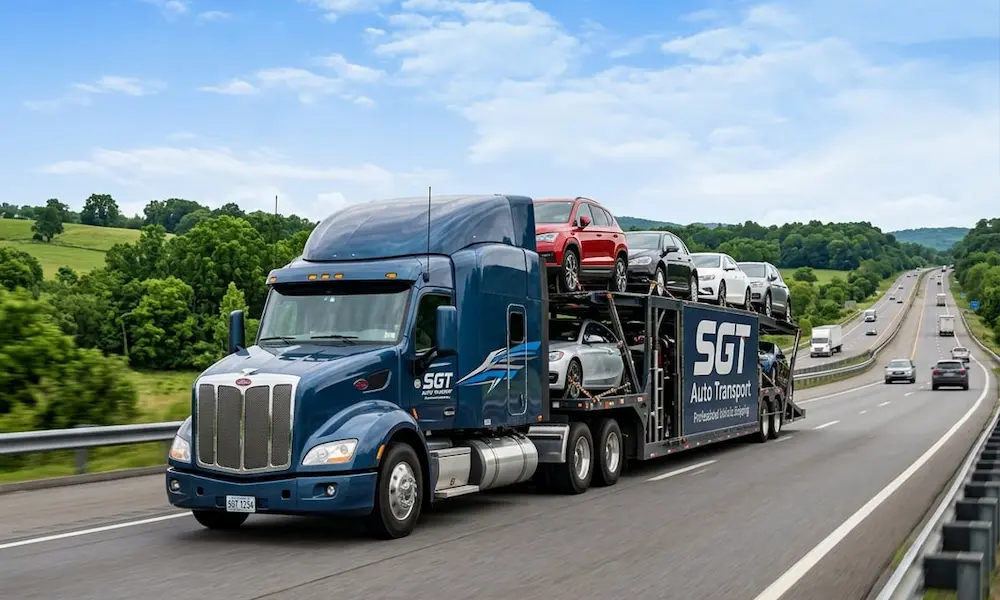
Open transport is the industry standard. Your car rides on a multi-level open trailer — the same kind you’ve seen hauling new cars to dealerships. It’s exposed to weather and road dust, but it’s perfectly safe for most vehicles.
Enclosed transport puts your car inside a sealed trailer. It’s ideal for high-value or classic vehicles, but the limited supply of enclosed carriers — only about 5% of the national fleet — means you’ll pay a serious premium. Enclosed trailers carry fewer vehicles per trip, so carriers charge more per slot to cover their costs.
Bottom line: if you’re not shipping a Ferrari, open transport is the smart, cost-effective choice.
Real Cross-Country Route Costs: What Popular Lanes Actually Cost
Route popularity plays a huge role in what you pay. High-traffic corridors between major cities mean more competition between carriers — which keeps prices competitive. Remote routes? Expect a premium.
| Route | Distance | Open Transport | Enclosed Transport |
|---|---|---|---|
| California → New York | 2,700 – 2,900 mi | $1,124 – $1,300 | $1,911 – $2,400 |
| California → Texas | 1,400 – 1,500 mi | $1,000 – $1,100 | $1,475 – $1,600 |
| Florida → New York | 1,200 – 1,400 mi | $837 – $1,148 | $1,377 – $1,952 |
| Illinois → California | 2,000 – 2,100 mi | $1,200 – $1,250 | $1,900 – $2,019 |
| Florida → Washington | 3,100 mi | $1,500 – $1,700 | $2,500 – $2,700 |
Routes that cut through the Rocky Mountains or terminate in low-population states — think Wyoming or North Dakota — typically come with longer wait times and higher surcharges because carriers struggle to find return freight.
What Else Bumps Up Your Quote
Distance and transport type set your baseline. But several other factors push that number up fast.
Vehicle Size and Condition
Standard quotes assume a midsize sedan. Bigger vehicles eat up more trailer space and add weight, pushing carriers closer to federal load limits.
- SUVs and full-size trucks: Add $150 – $250 to the base rate
- Lifted trucks or vehicles with roof racks: Additional fees apply — these change the entire trailer’s loading configuration
- Non-running vehicles: Carriers need winches or forklifts to load them. Expect a surcharge of $150 – $300 for inoperable vehicles
The Federal Motor Carrier Safety Administration (FMCSA) regulates maximum vehicle weights on commercial carriers, so any vehicle that throws off that balance costs you more.
Door-to-Door vs. Terminal-to-Terminal
Door-to-door is the standard option. The carrier comes as close to your address as a massive truck can physically get. It’s convenient but slightly pricier.
Terminal-to-terminal means you drop your car at a freight depot and pick it up from another. This can trim 5% to 10% off the base cost — but factor in the hassle of getting to and from terminals, plus potential daily storage fees if you don’t pick up promptly.
Seasonal Demand and Fuel Surcharges
Timing your shipment smartly can save you real money.
- Summer (peak season): High demand from moves, relocations, and college schedules. Expect to pay $250 – $375 more than off-peak rates
- “Snowbird” routes (fall): Carriers heading south to Florida or Arizona are slammed with demand — prices spike. Spring reversals see northbound routes drop
- Diesel fuel spikes: Carriers pass fuel cost increases directly to consumers via surcharges, potentially adding $100 – $300 to your quote
Shipping in early spring or late autumn hits the sweet spot for availability and price.
Brokers vs. Carriers: How the Industry Actually Works
Most people don’t realize they’re almost always dealing with a broker, not the actual truck driver. Understanding this distinction saves you from a lot of confusion — and potential scams.
What Brokers Actually Do
Brokers don’t own trucks. They post your shipment on industry load boards — the biggest being Central Dispatch — where carriers bid to take your job. The broker’s commission typically runs $150 – $300 on top of the carrier’s fee.
That sounds like a markup, but brokers earn it. They verify carrier safety records, confirm insurance certificates, check FMCSA operating authority compliance, and find you a replacement carrier fast if something goes wrong. Doing all that yourself would take hours and require industry access you simply don’t have.
The Lowball Quote Trap
This is the most common scam in auto transport. Here’s how it works:
- A shady broker quotes you $600 when the real market rate is $950
- You sign and pay a non-refundable deposit
- The broker posts your car on the load board at that unrealistically low rate
- No carrier bites — because the pay isn’t worth it
- Days later, the broker calls saying “prices have spiked” and demands hundreds more
Outlier quotes significantly below market average almost always lead to delays and back-end price increases. If a quote looks too good to be true, it is.
How to protect yourself:
- Demand binding or price-locked quotes
- Reject quotes more than 20% below the market average for your route
- Check BBB ratings and verified reviews before booking
Top Brokers Compared
| Broker | Best For | Pricing Tier | Notable Feature |
|---|---|---|---|
| AmeriFreight | Reliability & discounts | Mid-to-high | No upfront payment until carrier is secured; AFta gap protection |
| Montway | High-volume, nationwide | Mid-level | Massive carrier network; A+ BBB |
| Sherpa Auto | Price transparency | Higher | “Price Lock Promise” — they cover up to $300 if load board demands more |
| SGT Auto | Guaranteed pickup dates | Mid-level | Strict timing guarantees; rare in this industry |
Hidden Fees You Need to Watch For
Shady brokers bury these in the fine print. Know them before you sign anything.
- Dispatch or processing fees: $100 – $300 added at checkout, separate from the quoted price
- Redelivery and terminal fees: If the carrier can’t access your street and you don’t meet them nearby, your car ends up in a terminal — at your expense
- Expedited shipping premiums: Need it fast? The broker has to inflate the load board bounty dramatically to pull a carrier off their route. This costs a lot.
- Undisclosed vehicle modifications: Roof racks, lift kits, or aftermarket spoilers you didn’t mention? The driver can legally demand more money at pickup
Always disclose your vehicle’s exact specs upfront. It’s not worth the surprise at your driveway.
How Long Does Cross-Country Shipping Take?
Auto transport isn’t Amazon Prime. Carriers run on fluid schedules, and FMCSA Hours of Service regulations cap drivers at 11 hours of driving per day, followed by a mandatory 10-hour rest. That works out to roughly 400 – 500 miles of forward progress daily.
Expect these general windows:
- Under 500 miles: 1 – 3 days
- 500 – 1,500 miles: 3 – 7 days
- 1,500 – 2,500 miles: 5 – 10 days
- Cross country (2,500+ miles): 7 – 14 days
Also note: transit time (from pickup to delivery) is different from total fulfillment time. Add one to seven days for a carrier to be assigned before your car even gets picked up. Brokers provide pickup windows of three to five days, not exact dates.
Insurance: What’s Actually Covered
Every licensed carrier must carry cargo insurance — but the coverage gaps might shock you.
- Federal minimum cargo insurance can be as low as $5,000 – $10,000 per vehicle. That’s not much for a $40,000 car.
- Reputable open carriers typically hold $100,000 – $250,000 aggregate policies
- Enclosed carriers often carry $250,000 – $1,000,000+
The catch? Aggregate limits mean the coverage gets split across all vehicles on the trailer if there’s a major incident. A multi-car accident on an open carrier could leave each owner significantly underinsured.
Standard cargo policies also typically exclude “Acts of God” — hail, tornadoes, flooding. If you’re shipping a higher-value vehicle, supplementary gap insurance (usually $50 – $150) fills those holes and can reimburse up to $1,000 toward personal deductibles. AmeriFreight’s AFta Plan is a solid example of this kind of protection.
The Bill of Lading: Your Most Important Document
The Bill of Lading (BOL) is your receipt, contract, and condition report all in one. At pickup AND delivery, walk the entire car with the driver. Note every scratch, dent, and chip before signing.
If new damage shows up at delivery, write it on the BOL before you sign — and before the driver leaves. Signing a clean BOL without noting damage legally releases the carrier from liability. Filing a damage claim requires time-stamped photos, your annotated BOL, and a formal written report within 24 – 48 hours of delivery.
How to Prep Your Car Before Shipping
A few simple steps protect your car and prevent disputes.
- Wash the car thoroughly — a clean exterior lets you and the driver accurately document the car’s condition on the BOL
- Drop the fuel tank to ¼ full — a full tank adds 100+ pounds of unnecessary weight and pushes the carrier toward federal load limits
- Remove personal belongings — carriers are licensed to transport vehicles, not household items. Loose items aren’t insured and can become dangerous in transit
- Disable toll transponders — remove them or put them in a shielding bag. Otherwise, your EZ-Pass racks up charges across 15 states on the carrier’s route
- Disable Sentry Mode (Tesla) or similar security systems — constant vibration triggers alarms and drains the battery fast
- Fold in mirrors, retract antennas, remove roof racks — anything sticking out can catch wind at highway speeds and damage other vehicles on the trailer
- Check coolant ratings — if shipping into cold climates, make sure your antifreeze is rated for the temperatures your car will sit in overnight
Montway’s prep checklist and Monarch Transport’s step-by-step guide are both worth bookmarking before your shipment day.
The Bottom Line on Cross-Country Car Shipping Costs
Knowing how much to ship a car cross country isn’t just about getting the cheapest quote — it’s about understanding what drives the price and protecting yourself from the traps. Budget $1,200 – $2,500 for open transport on a true coast-to-coast route. Choose a broker with transparent, binding pricing. Document everything on the Bill of Lading. And if your quote seems suspiciously cheap, trust that instinct — it almost certainly is.