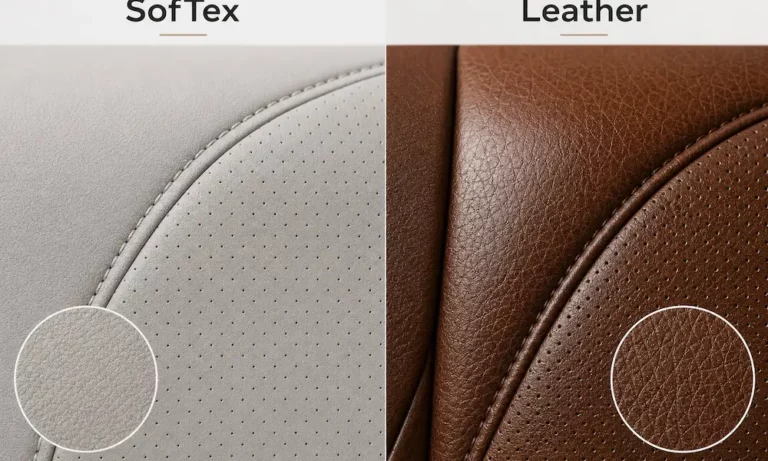
You’re shopping for a new Toyota and hit the upholstery decision. Leather sounds premium. SofTex sounds… made up? This guide breaks down exactly how these two materials compare on comfort, durability, maintenance, and value — so you can pick the right one for your life.
What Is Toyota SofTex, Exactly?
SofTex isn’t just fancy vinyl. It’s a multi-layered thermoplastic polyurethane material Toyota first introduced in 2012 on the Prius and Camry. Today it shows up as standard equipment on popular mid-tier trims like the RAV4 XLE Premium and the 4Runner TRD Off-Road Premium.
Here’s why that matters: SofTex was engineered to solve the specific problems leather can’t handle — heat, stains, weight, and high-maintenance ownership.
It’s not trying to be leather. It’s trying to beat it where it counts.
How SofTex and Leather Are Actually Built
Understanding the softex vs leather debate starts at the material level.
What Leather Is Made Of
Leather is cowhide — natural collagen fibers chemically treated to prevent decay. Its strength comes from how tightly those fibers pack near the surface. Full-grain leather is the top tier, followed by top-grain, then corrected-grain — which is the heavily processed stuff that can feel stiff and plasticky.
No two hides are identical. You’ll find natural scars, thickness variations, and insect marks. Manufacturers work around these imperfections, not through them.
What SofTex Is Made Of
SofTex starts with a high-strength textile base layer. Over that, Toyota applies a thermoplastic polyurethane coating embossed with a grain pattern that mimics animal hide. Every square inch is structurally identical — no surprises, no weak spots.
The result? A material that’s soft out of the box, stays flexible in cold weather, and doesn’t need years to “break in.”
One underrated advantage: SofTex weighs roughly half as much as genuine leather. In EVs and hybrids, that weight reduction actually contributes to better range and efficiency.
| Material Property | Toyota SofTex | Genuine Leather |
|---|---|---|
| Base Composition | Thermoplastic Polyurethane | Natural Animal Collagen Fibers |
| Weight | ~Half the weight of leather | Dense and relatively heavy |
| Texture Consistency | Uniform (manufactured) | Variable (natural grain) |
| Tactile Feel | Soft and pliable from day one | Firm initially, softens over time |
| Appearance | Mimics leather grain and sheen | Natural grain with unique patina |
Softex vs Leather in Hot and Cold Weather
For most American drivers, this is where the decision gets made.
Summer Heat Performance
Leather absorbs infrared and ultraviolet radiation. In Arizona or Florida, that means seats that can genuinely burn exposed skin after sitting in a parking lot.
SofTex uses a UV-reflective coating that bounces infrared radiation rather than absorbing it. The seats stay noticeably cooler under identical sun exposure. SofTex also dissipates moisture faster than heavily coated leather — which helps prevent that uncomfortable sweaty-back feeling on long summer drives.
Winter Cold Performance
Leather is a heat sink. It stays cold for a long time, and because it’s thick and dense, seat heaters take longer to push warmth through to the occupant.
SofTex is thinner and lighter, so it has less thermal mass. It doesn’t get as brutally cold, and once you turn the seat heaters on, you feel that warmth faster. For commuters in Chicago or Kansas City, that faster warm-up time is a real daily quality-of-life difference.
| Climate Scenario | SofTex Performance | Leather Performance |
|---|---|---|
| Direct Sunlight (Summer) | Reflects infrared; stays cooler | Absorbs UV; becomes very hot |
| Extreme Cold (Winter) | Warms quickly with seat heaters | High thermal mass; slow to warm |
| High Humidity | Engineered for moisture dissipation | Can feel sticky if pores are sealed |
| Best Regional Fit | Southwest, Florida, extreme climates | Moderate climates |
Durability: Which Seat Survives Real Life?
The average American vehicle is now over 12 years old. Your seats need to last.
Cracking and Surface Degradation
Leather contains natural oils that keep its collagen fibers flexible. Heat and sunlight pull those oils out over time. Without regular conditioning, leather stiffens and cracks — especially on side bolsters where you slide in and out every day.
SofTex is chemically inert. It doesn’t contain natural oils, so there’s nothing for the sun to strip away. High-mileage Toyota owners consistently report that SofTex seats with 100,000+ miles still look close to new, while leather seats of the same age often show cracking and “puddling” (stretching in the seat base).
Kids, Pets, and Spills
SofTex’s non-porous surface stops liquids from soaking into the padding. Wipe it down with a damp cloth and you’re done.
Reddit users in the Toyota Sienna community regularly praise SofTex for surviving years of juice boxes, goldfish crackers, and child seat friction. Pet owners in the 4Runner forums note that SofTex handles dog nails far better than leather, which can be permanently scarred by a single scratch.
Also worth noting: many leather seats are perforated for ventilation. Those tiny holes trap crumbs, sunscreen, and liquid — and once it’s in there, it’s nearly impossible to clean out completely.
The Patina Question
Here’s where leather fans have a legitimate point. Leather ages beautifully when cared for properly. It develops a patina — a unique character that makes a well-maintained 10-year-old seat look distinguished rather than worn.
SofTex doesn’t do that. It looks the same on day 3,000 as it did on day one. That’s its strength — but for some buyers, it’s also a dealbreaker.
| Wear Factor | Toyota SofTex | Genuine Leather |
|---|---|---|
| Surface Cracking | Highly resistant | High risk without conditioning |
| Stretching / Puddling | Minimal | Common over time |
| Pet Claw Resistance | High | Moderate |
| UV Fading | Designed to reflect radiation | Sensitive to prolonged exposure |
| Aging Profile | Static (stays looking new) | Dynamic (develops character/patina) |
Maintenance: What You Actually Have to Do
Keeping SofTex Clean
Toyota’s official recommendation is simple: vacuum loose debris, then wipe with a soft cloth dampened in a diluted neutral detergent (about 1%). For tougher stains, an alcohol-based cleaner works well.
What to avoid: greasy protectants like certain Armor All formulas. They leave a residue that attracts dirt and creates an unnatural shine that looks worse over time. Also skip anything solvent-based — it can dissolve the polyurethane coating.
No conditioning required. Ever.
Maintaining Leather the Right Way
Leather maintenance is a multi-step ritual. You clean the surface to remove grit that acts like sandpaper on the grain. Then you apply a quality conditioner with humectants and oils to keep the collagen fibers from drying out.
In dry or sun-heavy climates, you should condition every three to six months. Skip this and you’re accelerating the cracking timeline. Specialty cleaners and conditioners run between $50 and $150 per year depending on what you buy.
| Cleaning Tool | SofTex | Leather |
|---|---|---|
| Microfiber Cloth | ✅ Best for all tasks | ✅ Prevents scratching |
| Neutral Soap / Water | ✅ Primary cleaner | ✅ Surface cleaning |
| Leather Conditioner | ❌ Unnecessary, leaves streaks | ✅ Essential for longevity |
| Alcohol-Based Cleaners | ✅ Safe for tough stains | ❌ Strips natural oils |
| Solvent-Based Cleaners | ❌ Risk of surface damage | ❌ Ruins finish |
| Stiff Brushes | ❌ Abrades synthetic grain | ❌ Scratches natural grain |
Environmental Impact: The Honest Version
Toyota positions SofTex as the greener choice — and there’s real data to back that up.
Where SofTex Wins
SofTex manufacturing produces approximately 85% fewer CO₂ emissions than traditional synthetic leather production. More importantly, it generates 99% fewer volatile organic compounds (VOCs) — the chemicals responsible for that strong “new car” chemical smell, which can have long-term health implications in enclosed spaces.
It’s also 100% vegan, which matters to a growing segment of buyers. Traditional leather tanning uses chromium salts and enormous amounts of water — both significant environmental concerns.
Where Leather Advocates Push Back
SofTex is a plastic derived from fossil fuels. It won’t biodegrade. When the seat reaches end-of-life, it sits in a landfill for centuries.
Leather, ironically, is a byproduct of the food industry. Hides exist whether or not they become car seats. Tanning them into durable upholstery can be framed as upcycling waste rather than creating new demand for animal products.
Neither material is perfect from an environmental standpoint. SofTex produces fewer emissions in manufacturing. Leather is biodegradable but tied to high-impact industries.
| Environmental Metric | Toyota SofTex | Genuine Leather |
|---|---|---|
| Greenhouse Gas Emissions | Significantly lower in production | High (livestock and tanning) |
| Volatile Organic Compounds | 99% reduction | Variable |
| Animal Welfare | 100% Vegan | Sourced from livestock |
| Biodegradability | Non-biodegradable (plastic) | Naturally biodegradable |
| Chemical Toxicity | Low (no chromium) | Potentially high (chrome tanning) |
The Real-World Cost Comparison
Upfront Price Difference
SofTex typically comes standard on Toyota’s mid-tier “Premium” trims. Leather usually requires jumping to the top trim level — often a $2,000 to $4,000 jump depending on the model. On a Toyota Sienna or RAV4, that’s a meaningful difference in monthly payment.
Does It Affect Resale Value?
Toyota consistently leads resale value rankings, and interior condition is a major driver of that. Leather carries a slight prestige premium in appraisal guides — sometimes $500 to $1,000 more. But here’s the catch: that advantage disappears fast if the leather looks worn, cracked, or poorly maintained.
A clean, well-maintained interior drives resale value more than the material itself. A five-year-old SofTex seat that looks showroom-fresh often outperforms a five-year-old leather seat that’s been neglected.
Total Cost of Ownership
Add it up: lower entry price, zero conditioning costs, no professional deep cleans required, and resistance to the expensive permanent damage that hits leather owners. Over a 10-year ownership period, SofTex is the clear economic winner for most drivers.
| Economic Factor | Toyota SofTex | Genuine Leather |
|---|---|---|
| Upfront Cost | Mid-tier trim (lower) | Top-tier trim (higher) |
| Annual Maintenance Cost | Minimal | $50–$150 (conditioners/cleaners) |
| Resale Impact | High if condition is maintained | High only if well-maintained |
| Long-Term Repair Risk | Low | Moderate (cracking, reupholstery) |
SofTex in the RAV4 and 4Runner: Real-World Results
RAV4: The Family Hauler Test
The RAV4 is America’s best-selling SUV, and a huge percentage ship with SofTex. Family owners consistently report that it survives car seat installations, muddy soccer cleats, and years of spilled drinks without cracking or staining.
In RAV4 Hybrid and Prime models, the weight savings also contribute directly to the fuel efficiency numbers Toyota advertises.
4Runner: The Off-Road Verdict
The 4Runner community was initially skeptical of synthetic seats. After a decade of real-world use in dusty, muddy, high-UV conditions, the verdict flipped. Off-roaders now prefer SofTex specifically because they can wipe it down with a wet rag after a trail run. The overlanding community — people who take their trucks seriously — has largely adopted SofTex as the practical choice over leather.
So, Which One Should You Actually Choose?
Here’s a straight answer based on your situation:
- You live in the South, Southwest, or Florida → SofTex. The infrared-reflective coating makes a genuine daily comfort difference.
- You have kids or pets → SofTex. It’s not even close on stain resistance and scratch recovery.
- You care about vegan or low-VOC interiors → SofTex. It’s the obvious pick.
- You want the best economic value → SofTex wins on entry price and long-term cost.
- You want that aged leather patina and you’ll actually maintain it → Genuine leather is worth the premium and the work.
The softex vs leather debate used to favor leather by default. In 2026, SofTex earns the win for most American drivers — not because it’s cheaper, but because it performs better where everyday life actually happens.