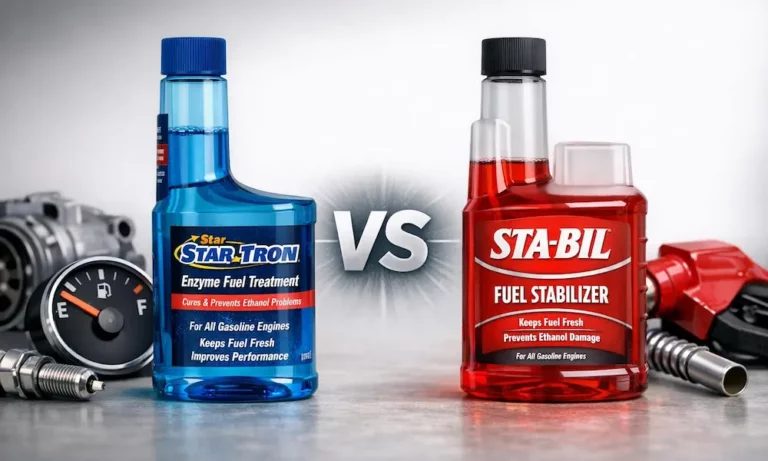
Your engine won’t start after sitting all winter. Sound familiar? Bad gas is the #1 culprit behind seasonal engine failures — and the right fuel stabilizer can prevent the whole headache. This guide breaks down the Star Tron vs Sta-Bil debate so you can pick the right product for your specific situation. Stay with me — the answer might surprise you.
Why Your Gasoline Goes Bad (And Why It Matters)
Gasoline starts degrading in as little as 30 days. The light-end volatiles evaporate first, leaving behind a heavier, harder-to-ignite liquid. Then oxygen kicks off a chain reaction called oxidation, which produces varnish — that sticky, yellowish gunk that clogs carburetors and gunks up fuel injectors.
And if your gas contains ethanol (most pump gas does), things get worse fast.
Ethanol pulls moisture out of the air. Once that moisture hits around 0.5%, the ethanol and water bond together and sink to the bottom of your tank — a process called phase separation. You’re left with two problems:
- The gasoline on top loses its octane boost and knocks under load
- The water-ethanol layer on the bottom corrodes steel tanks and pits aluminum parts
That’s why fuel stabilizers exist. But not all of them work the same way.
What Is Sta-Bil and How Does It Work?
Sta-Bil has been around since 1958, made by Gold Eagle Company. It’s a petroleum-based stabilizer that uses a concentrated package of antioxidants, acid neutralizers, and metal deactivators suspended in a purified petroleum distillate solvent.
The solvent does two things: it blends fast with your fuel even in cold weather, and it carries the active ingredients deep into the fuel system. The antioxidants stop oxidation before it starts, preserving fuel for up to 24 months in storage.
Sta-Bil also expanded its lineup to tackle moisture and ethanol-related problems specifically. The Sta-Bil 360 and Marine formulas introduced something called Vapor Technology. Instead of only protecting surfaces the liquid touches, these formulas release a vapor that coats the entire interior of your fuel system — including tank walls above the fuel line. That’s a big deal for equipment sitting idle in a humid garage or boat slip all winter.
Sta-Bil Product Lineup at a Glance
| Product | Best For | Protection Period | Key Feature |
|---|---|---|---|
| Sta-Bil Storage (Red) | Long-term dormant storage | Up to 24 months | High-concentration antioxidant package |
| Sta-Bil 360 Performance | Daily drivers and year-round use | Up to 12 months | Vapor technology for above-fuel-line protection |
| Sta-Bil 360 Marine | Boats and humid environments | Up to 12 months | Enhanced metal deactivators + PEA cleaners |
| Sta-Bil Fast Fix | Diagnosing existing deposits | N/A | Dissolves existing gum and varnish |
What Is Star Tron and How Does It Work?
Star Tron, made by Star brite, takes a completely different approach. Instead of antioxidants, it uses enzymes — biological catalysts — to change how fuel and water behave at a molecular level.
Here’s what makes it interesting: Star Tron doesn’t just try to coat metal surfaces or neutralize acids. Its enzymes reduce the surface tension between fuel and water, breaking moisture down into sub-micron droplets. Those droplets disperse evenly through the gasoline, get carried into the engine, and safely exit as steam through the exhaust. No pooling water. No phase separation.
Star Tron also claims to break up large clusters of fuel molecules, increasing surface area during combustion for a more complete burn. That’s why it’s marketed as a year-round performance additive — not just a storage product. Users report cleaner engines, fewer hard starts, and improved fuel economy with regular use.
Star Tron Concentration Guide
| Cap Color | Best For | Treat Rate | Cost Per Treated Gallon |
|---|---|---|---|
| Red Cap | Small engines, lawn & garden | 1 oz per 6 gallons | Higher per gallon |
| White Cap | Marine and automotive | 1 oz per 16 gallons | Moderate |
| Green Cap | Diesel and industrial | 1 oz per 32 gallons | Very low |
The White and Green cap versions make Star Tron surprisingly cost-competitive at scale. A bottle might cost more upfront, but you’re using far less per gallon.
Star Tron vs Sta-Bil: How They Handle Water Differently
This is where the real difference shows up — and it matters a lot if you deal with ethanol-blended fuel.
Sta-Bil’s approach: It uses non-alcoholic water removers and corrosion inhibitors that bond with water molecules and form a protective film on metal surfaces. Think of it as a defensive shield. Sta-Bil assumes water will get in and focuses on preventing it from causing damage to your tank and fuel system components.
Star Tron’s approach: It goes on the offensive. The enzymes micronize water into particles so small they can’t pool or phase-separate. They get flushed out through normal combustion. The goal is to prevent the water from ever becoming a problem in the first place.
That said, field testing from Practical Sailor found that neither product is a cure-all. If a tank is already severely contaminated — or exposed to a dramatic temperature drop — both Star Tron and Sta-Bil can get overwhelmed. In those cases, you need a complete tank drain and flush. No additive can fix that.
What the Tests Actually Show
The 5-Year Project Farm Test
In a widely discussed five-year durability experiment, metal and rubber samples sat submerged in stabilizer-treated fuel to simulate long-term storage. Here’s what stood out:
- Sta-Bil dominated metal protection. After three years, the Sta-Bil-treated sample was completely corrosion-free — the best result of any product tested.
- Both products kept engines running. Fuel treated with either Star Tron or Sta-Bil for 20+ months still fired up a test generator without starting fluid.
- Sta-Bil preserved volatility better. It was the only aged fuel mixture that could be ignited with a simple lighter — meaning it did a better job holding onto the light-end hydrocarbons you need for cold starts.
Practical Sailor’s Marine Trials
Practical Sailor tested fuel additives specifically in marine environments, focusing on aluminum corrosion and water separation. Their verdict:
- Sta-Bil 360 Marine earned “Best Choice” for superior aluminum and copper alloy protection — critical since aluminum is the most vulnerable metal in ethanol-heavy environments.
- Star Tron earned “Budget Buy.” It had virtually zero non-volatile residue (meaning it burns incredibly clean), but it lagged on aluminum protection compared to the marine-specific Sta-Bil formula.
Side-by-Side Test Data
| Performance Metric | Sta-Bil Marine | Star Tron |
|---|---|---|
| Non-volatile residue | 0.01% (low) | Not detected (excellent) |
| Water/fuel separation (6 hrs) | Clean | Clean |
| Aluminum corrosion protection | Excellent | Moderate |
| Estimated cost per gallon treated | ~$0.09 | ~$0.07 |
Which One Should You Use?
The honest answer: it depends on how you’re using your equipment.
Pick Sta-Bil if you:
- Store equipment for an entire winter season (3–6+ months)
- Deal with high humidity or temperature swings in your storage area
- Need maximum protection against rust and tank corrosion
- Run small engines like mowers, snowblowers, or generators that sit completely idle in the off-season
Small engine shops consistently recommend Sta-Bil as the standard of care for this exact scenario. Its vapor-phase protection takes care of the tank walls above the fuel line — the spots most vulnerable to condensation damage.
Pick Star Tron if you:
- Run equipment year-round and want ongoing fuel system maintenance
- Deal with ethanol fuel issues and frequent phase separation concerns
- Want to clean out existing gum and varnish deposits without disassembly
- Manage large fuel volumes on a boat or in a commercial fleet
Marine mechanics often use Star Tron throughout the season to keep fuel clean and dry, then switch to Sta-Bil Marine for the final winterization fill-up. That “belt and suspenders” approach covers all the bases.
The Shelf Life Question
Here’s something most people overlook: the stabilizer itself expires.
- Sta-Bil: Good for about 5 years unopened, 2 years once open. After that, it loses stabilization power but can still clean a fuel system if there’s no sediment present.
- Star Tron: Claims the enzyme formula doesn’t expire if stored with the cap tight in a cool, dry place.
How to Use Either Product Correctly
A lot of people add stabilizer after fuel has already gone stale. Both products work best — and are most effective — when added to fresh fuel straight from the pump. Here’s the right sequence:
- Fill your tank to 95% capacity. Less air space means less moisture can enter.
- Add your stabilizer before you top off. This mixes it thoroughly as the fuel fills the tank.
- Run the engine for 5–10 minutes. This pushes treated fuel through the entire system — fuel lines, carburetor, injectors — not just the tank.
- Don’t mix products in the same tank. Star Tron and Sta-Bil have different chemical packages. Stick to one per tank to avoid unexpected interactions.
One more thing: even ethanol-free premium fuels and AV Gas oxidize over time. Skipping a stabilizer because you “use good gas” is still a gamble over a long storage period. A light maintenance dose is worth it for any high-value engine sitting dormant for months.
The Bottom Line on Star Tron vs Sta-Bil
These two products aren’t really competing for the same job. Sta-Bil excels at protecting hardware during long, dormant storage. It wins on metal corrosion prevention and cold-start fuel preservation. Star Tron excels at managing fuel chemistry during active, regular use. It wins on water management, combustion efficiency, and cleaning existing deposits.
For most homeowners with seasonal equipment, Sta-Bil Storage is the simpler, proven choice. For boaters, fleet operators, or anyone dealing with ongoing ethanol headaches, Star Tron’s enzyme approach offers a smarter year-round solution. And if you want the absolute best protection? Use both — Star Tron during the season, Sta-Bil Marine when it’s time to button everything up for winter.