Spotted a reddish puddle under your car after it sat overnight? That’s a transmission fluid leak when parked — and it’s trying to tell you something important. This post breaks down exactly why it happens, what’s leaking, and what it’ll cost you to fix it. Stick around, because catching this early could save you thousands.
How Do You Know It’s Transmission Fluid?
Before you panic, let’s make sure you’re looking at the right fluid. Identifying car fluids correctly is your first move.
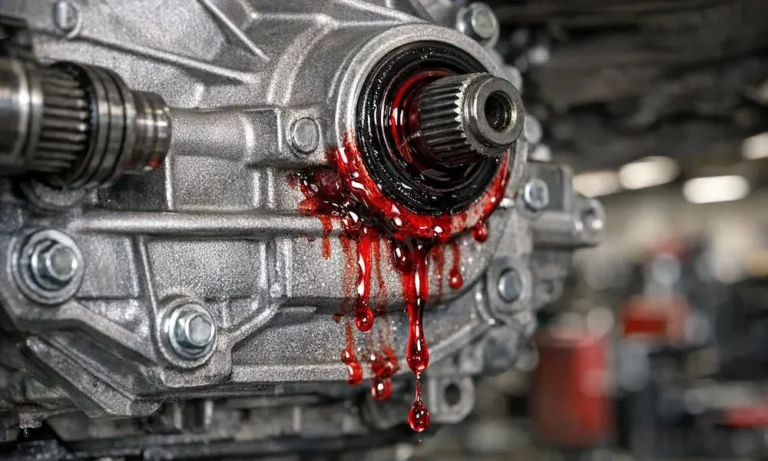
Automatic transmission fluid is bright red or pink when fresh. That’s not an accident — manufacturers add a red dye so you can’t confuse it with engine oil. As the fluid ages, it darkens from red to brown to black. If it looks burnt and smells like it too, that’s a sign of serious overheating inside the transmission.
Fresh transmission fluid has a slightly sweet or tart smell. Burnt fluid smells like scorched petroleum. Manual transmission fluid is different — it’s usually clear, amber, or honey-colored without the red dye.
The puddle location matters too. Transmission fluid typically shows up under the center or mid-front of the vehicle.
Here’s a quick comparison to help you figure out what you’re dealing with:
| Fluid | Color | Consistency | Smell | Location |
|---|---|---|---|---|
| ATF (Automatic) | Bright Red / Pink | Thin, oily, slick | Sweet or tart | Center / mid-front |
| MTF (Manual) | Clear / Amber | Viscous, oily | Petroleum | Center |
| Engine Oil | Golden / Amber | Thick, slippery | Cooking oil | Under engine |
| Coolant | Green / Orange / Pink | Watery, slimy | Syrupy sweet | Front / radiator |
| Brake Fluid | Clear / Yellow | Very slippery | Alcohol / fishy | Near wheels |
| Power Steering Fluid | Red / Clear | Oily | Burnt | Front / left side |
Why Does a Transmission Leak When Parked — But Not While Driving?
This one confuses a lot of people. The car drives fine, but you come back to a puddle. Here’s why.
When your engine runs, the transmission pump pushes fluid through the system under constant pressure. That active pressure actually masks minor seal failures. Shut the engine off, and two things happen that can make a small leak turn into a real mess.
Torque Converter Drain-Back
The torque converter holds a big volume of fluid. Internal check valves keep that fluid inside when the engine’s off. But if those valves wear out, the fluid slowly drains into the transmission pan over several hours — sometimes days.
When this happens, the fluid level in the pan rises above its normal operating height. Seals that are usually sitting above the fluid line suddenly get submerged. Even a slightly worn selector shaft seal or dipstick tube seal can’t hold back that extra gravitational pressure. Fluid seeps out — and you wake up to a puddle.
This is why your car might not leak right after a drive, but leave a significant puddle after sitting for two days.
Thermal Contraction and Seal Gaps
Here’s another thing working against you. While driving, heat causes rubber seals to expand and press tightly against metal surfaces. Park the car, and everything cools down. Aged or heat-damaged seals contract — sometimes enough to open a gap that wasn’t there at operating temperature.
That’s why older vehicles often have what mechanics call a “cold leak.” The seals just don’t snap back like they used to.
The Most Common Sources of a Transmission Fluid Leak When Parked
There are several places a leak can originate, and the location tells you a lot about the severity and the repair cost.
Transmission Pan and Gasket
The transmission pan sits at the very bottom of the unit and holds the fluid. It’s the most common leak source — and fortunately, often the cheapest to fix.
Three things go wrong here:
- Gasket failure: Heat and chemical exposure cause the gasket material to crack and harden over time. Once it can’t fill the microscopic gaps between pan and housing, fluid seeps through.
- Pan damage: Rocks and road debris hit the pan constantly. A dented or warped pan creates an uneven sealing surface. Aggressive prying during a previous service can bend the flange permanently.
- Loose or over-tightened bolts: Vibration loosens bolts over time. But if a mechanic over-tightened them during the last service, the gasket may be split or the aluminum threads stripped.
Shaft Seals
These are the dynamic seals that wrap around moving shafts where they exit the transmission housing. They fail more often than people expect.
- Output shaft seals: Where the driveshaft (RWD) or CV axles (FWD) connect to the transmission. Worn axle bearings let the shaft wobble, which destroys the seal lip fast.
- Input shaft / front pump seal: Deep inside the bell housing. A leak here often means fluid drips from the bottom of the bell housing. It’s serious — and it means the transmission has to come out.
- Selector shaft seal: The small seal around the gear shift shaft. Because it sits on the side of the housing, torque converter drain-back hits this one hard.
Cooling Lines
The transmission cooling circuit runs fluid to a heat exchanger to keep temperatures in check. Steel or aluminum lines can crack from vibration or corrode from the inside out. Rubber sections get hard and brittle with heat cycles. The fittings connecting lines to the transmission or radiator rely on O-rings that fail over time.
A pinhole leak in a cooling line might seem minor, but it drips constantly — and it adds up fast.
A Clogged Transmission Vent
Don’t overlook this one. Your transmission has a breather vent that lets air escape as fluid expands with heat. If dirt or road grime plugs that vent, pressure builds inside the housing. That internal pressure forces fluid out through the weakest seal — even when the car’s just sitting in your driveway. In bad cases, it can blow a seal out entirely.
What Happens If You Ignore a Transmission Fluid Leak?
Skipping the repair isn’t really an option. Here’s what a low fluid level does to your transmission:
As fluid drops, the transmission pump starts pulling in air. Air is compressible — fluid isn’t. So hydraulic pressure becomes inconsistent. That causes:
- Slipping gears: Engine revs climb, but the car doesn’t accelerate. Not enough pressure to hold the clutch packs together.
- Delayed engagement: A 2–3 second lag when you shift from Park to Drive or Reverse.
- Harsh shifting: The transmission slams or lurches between gears.
- Whining or grinding noises: Pump cavitation or metal-on-metal contact.
- Burning smell: Fluid oxidizing or friction material burning up.
Once metal contacts metal without a fluid film, wear accelerates exponentially. You’re generating heat, grinding components, and turning a $200 gasket repair into a $4,000 transmission replacement.
| Symptom | What You Notice | What’s Actually Happening |
|---|---|---|
| Delayed engagement | 2–3 second lag into Drive/Reverse | Pump not priming / aeration |
| Slipping gears | RPMs climb, speed doesn’t | Clutch pack pressure loss |
| Grinding / whining | Audible from under the car | Pump cavitation or bearing wear |
| Burning smell | From under hood while parked | Fluid oxidation or friction combustion |
| Warning lights | Trans Temp or Check Engine | Sensor detecting slip or heat |
How Mechanics Find a Transmission Fluid Leak When Parked
Fluid travels. Airflow while driving pushes it backward along the chassis, so the puddle on the ground isn’t always under the actual leak source. Professionals use a few proven methods to find the exact breach point.
Clean and stage the vehicle. A mechanic degrease the entire transmission, parks the car over clean white cardboard, and checks where the first fresh drop appears. Old residue gets wiped away so you can trace the fluid back to its highest and most forward exit point.
UV dye testing. For small or intermittent leaks, a fluorescent dye gets added to the transmission fluid. After driving or sitting for a period, a technician scans the transmission with a UV blacklight. The dye glows at the exact point of exit — even hairline cracks in the housing show up clearly. This is widely considered the most reliable leak detection method.
Pressure testing. If the leak is suspected in the front pump or torque converter area, a pressure test of the cooling circuit shows whether the breach only appears under operating pressure.
What Does a Transmission Fluid Leak Repair Cost?
Cost depends on two things: the part itself and how long it takes to access it.
Minor Repairs (No Transmission Removal)
These get done with the transmission still in the car:
| Repair | Estimated Total Cost |
|---|---|
| Drain plug / O-ring | $50 – $150 |
| Pan gasket + filter | $150 – $400 |
| Cooling line | $200 – $600 |
| Selector shaft seal | $150 – $400 |
| Output shaft seal | $250 – $700 |
Major Repairs (Transmission Must Come Out)
These are where costs jump significantly. Pulling a transmission takes 5–10 labor hours depending on the vehicle.
| Repair | Estimated Total Cost |
|---|---|
| Input shaft / torque converter seal | $600 – $1,200 |
| Rear main engine seal | $600 – $2,000 |
| Transmission housing replacement | $3,000 – $6,000 |
Catching a pan gasket leak early keeps you in that $150–$400 range. Letting it drain the system dry moves you into rebuild or replacement territory fast.
How to Prevent a Transmission Fluid Leak When Parked
The best strategy is keeping the system healthy before anything breaks.
Change your fluid regularly. Fresh transmission fluid contains seal conditioners — additives that keep rubber components soft and pliable. Once those additives deplete, seals harden and crack. Most experts recommend a fluid exchange every 30,000 to 60,000 miles, though some modern transmissions specify longer intervals. Check your owner’s manual.
Use the right fluid. Using the wrong formulation is a surprisingly common mistake. Incompatible fluid chemistry can cause seals to swell and tear — or shrink and harden. Stick to the manufacturer’s specified fluid type.
Keep your cooling system healthy. Heat is the primary driver of transmission seal failure. In many vehicles, the transmission cooler sits inside the radiator. A clogged or failing radiator means your transmission runs hot. Worse, a cracked radiator can mix engine coolant into the transmission fluid — that milky pink mixture destroys internal components almost instantly.
Know your towing limits. Heavy towing and aggressive driving in high heat generate enormous thermal load on your seals. If you tow frequently, consider an auxiliary transmission cooler. More frequent fluid checks are a smart move too.
Inspect your transmission vent. It’s a small thing, but a blocked vent creates internal pressure that blows fluid out of whatever seal is weakest. A quick visual inspection during routine maintenance can prevent a messy and expensive surprise.
A reddish puddle under a parked car isn’t something to wait out. The repair that costs a few hundred dollars today can easily become a repair that costs several thousand next month. Check your fluid level, identify the leak source early, and deal with it before the transmission tells you the decision was made for you.