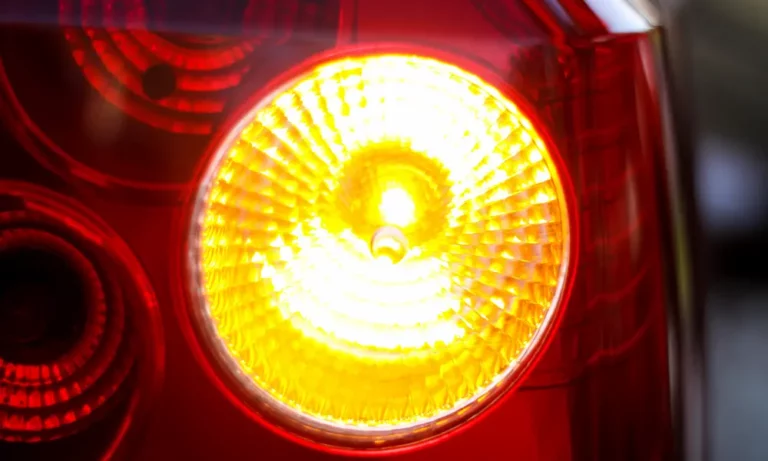
Your turn signal is blinking faster than normal, and it’s driving you crazy. That rapid clicking usually means something’s wrong — but not always what you’d expect. This post breaks down every real cause of turn signal blinking faster, plus the fixes, so you can stop guessing and start solving.
What “Hyperflashing” Actually Means
Turn signal blinking faster than normal has a proper name: hyperflashing. Under normal conditions, your turn signals blink between 60 and 120 times per minute. Hyperflashing kicks that rate well above that range.
Here’s the key thing to understand: your car does this on purpose. The rapid blink is a built-in warning system. It’s your vehicle telling you something’s off with the circuit — usually a dead bulb, a bad connection, or an electrical mismatch.
The cause depends on whether your car uses an old-school thermal relay, a modern solid-state relay, or a Body Control Module (BCM). Let’s work through each scenario.
The Real Reason a Burned-Out Bulb Causes Turn Signal Blinking Faster
Most people know a dead bulb triggers fast blinking. But do you know why? The answer is actually pretty cool.
How Older Thermal Relays Work
In older vehicles, a bimetallic thermal relay controls blink timing. Inside this relay, a metal strip bends when it heats up and snaps back when it cools. This open-and-close cycle creates the blinking rhythm.
Here’s where load matters. Two standard 21-watt bulbs create a specific electrical resistance. That resistance controls how fast current heats the strip. When one bulb burns out, resistance jumps. Less current flows. The strip heats up slower — and in some cases, not enough to trigger at all.
That’s why, on some older cars, a dead bulb means no blink at all. On others, the flash rate changes noticeably. Either way, the system flags the fault through changed behavior.
How Modern Electronic Relays Detect Faults
Newer vehicles use solid-state electronic relays with a smarter method. A tiny chip — like the U2043B warning flasher — monitors current through a shunt resistor. Two healthy 21-watt bulbs draw about 3.5 amperes at 12 volts.
If one bulb dies, current drops to around 1.75 amperes. The chip’s comparator detects this drop and immediately doubles the oscillator frequency. The result? Your turn signal blinks roughly 2.2 times faster, and the dashboard indicator flashes rapidly.
This isn’t a malfunction. It’s the system working exactly as designed.
Why LED Upgrades Trigger False Turn Signal Blinking Faster
Swapping halogen bulbs for LEDs is one of the most common reasons people suddenly experience turn signal blinking faster — even when nothing is actually broken.
LED bulbs use semiconductor junctions instead of heated filaments. They draw far less current — sometimes as little as 0.5 amperes. To your car’s flasher relay or BCM, that looks identical to a dead filament bulb.
The relay sees low current → thinks a bulb failed → triggers hyperflash mode.
Your exterior lights are working perfectly. Your car just doesn’t know that yet.
Is Hyperflashing Illegal?
This is worth addressing directly. A rapid-blinking turn signal isn’t strictly illegal in most U.S. states. But there’s a catch.
Federal Motor Vehicle Safety Standard (FMVSS) 108, enforced by the National Highway Traffic Safety Administration (NHTSA), requires that your dashboard turn signal indicator flash at the same rate as your exterior lights. If your dash light flashes rapidly while your exterior lights blink normally, that’s a compliance violation.
A real-world example: In 2023, Daimler Truck North America issued a voluntary recall for certain Western Star 57X trucks because the instrument cluster turn indicator flashed faster than the actual exterior turn signals. That mismatch violated FMVSS 108. Technicians had to reprogram the lighting control software to sync the rates.
General Motors faced a similar situation with Chevrolet Malibu and Buick Regal models. These vehicles had two light sources per front turn signal. When one failed, the remaining bulb still lit up — so the dash gave no warning. NHTSA ruled that was a direct violation of FMVSS 108, and GM had to update production software to flag single-source failures.
Bottom line: if a cop pulls you over and notices your dash is blinking fast while a physical bulb is dead, you’re getting a citation for defective lighting.
How to Diagnose Turn Signal Blinking Faster: Step by Step
Don’t start throwing parts at this. Work through it systematically.
Step 1: Walk around the car with signals active. Check every light — front, rear, and side repeaters. Small fender or mirror repeaters are frequently overlooked and often the culprit.
Step 2: Inspect the socket on any dead bulb. Look for water damage, green or white corrosion, or black carbon marks. Clean contacts with electrical contact cleaner and a soft brush. Finish with dielectric grease to keep moisture out.
Step 3: Check the ground circuit. Trace the ground wire from the bulb housing to its chassis connection. Look for fraying, loose screws, or rust on the grounding tab. Clean rusted contacts to bare metal. A bad ground is sneaky — it mimics a dead bulb electrically.
Step 4: Test system voltage. Use a digital multimeter at the socket and battery. You want to see roughly 12.6 volts with the engine off, or 13.8–14.4 volts with it running. A weak battery or failing alternator can disrupt flasher relay timing and cause intermittent hyperflashing.
Repair Cost Breakdown
Here’s what you’re looking at, depending on what’s wrong:
| Issue | DIY Cost (USD) | Pro Repair Cost (USD) | Complexity |
|---|---|---|---|
| Burned-out bulb | $25–$50 | $45–$100 | Low |
| Corroded bulb socket | $0 (cleaning) | $60–$150 | Low–Moderate |
| Bad turn signal relay | $9–$110 | $180–$250 | Moderate |
| Dirty combination switch | Not recommended | $245–$272 | High |
| Weak battery | $100–$160 | $45–$250 (labor) | Moderate |
| Failing alternator | $100–$350 | $350–$400 | High |
| Damaged wiring harness | Not recommended | $1,000–$1,500 | Very High |
Three Ways to Fix LED-Caused Turn Signal Blinking Faster
Once you’ve confirmed LEDs are triggering false hyperflashing, you’ve got three solid options.
Option 1: Install Load Resistors
Parallel load resistors wire across each LED bulb and draw extra current to mimic an incandescent bulb. This fools the relay into seeing a “normal” load.
Big safety warning here. These 50-watt aluminum resistors get extremely hot — surface temperatures can exceed 155°C (311°F). You must bolt them directly to a metal surface on the vehicle frame. Never use tape or zip ties. Never let them touch plastic, rubber, or wiring. Contact with flammable materials is a genuine fire risk.
Cost: $5–$20 per pair.
Option 2: Replace the Flasher Relay
On older vehicles with a plug-in flasher unit, swap it for an LED-compatible solid-state relay calibrated for low current draw. These units handle loads as low as 0.5 amperes without triggering fault mode.
This won’t work on modern vehicles where flash timing lives inside a non-serviceable BCM.
Cost: $10–$50.
Option 3: Reprogram the Body Control Module
For newer vehicles, software is the cleanest fix. You modify the BCM parameters to either disable bulb outage detection or adjust the current threshold to accept LED draw levels.
Ford owners can use FORScan. Dodge/RAM owners can use AlfaOBD. This approach carries very low technical risk but requires the right software and some patience.
Cost: Varies based on tool and licensing fees.
Vehicle-Specific Fixes for Turn Signal Blinking Faster
Different makes handle this differently. Here’s a quick reference:
| Make | Root Cause | Best Fix |
|---|---|---|
| Toyota | DRL harness integration, ground issues | Install DRL harness correctly, move ground wire to negative battery terminal |
| Honda, Nissan, Infiniti, Subaru | LED tail light circuit incompatibility | Install 10-ohm load resistors on affected circuit |
| GMC/Chevrolet Silverado, Sierra | BCM CANBUS monitoring | 12V battery reset (disconnect 30 min); replace factory resistor on 2014–2018 models |
| Ford F-150, Super Duty | Stored BCM error codes | Clear codes with OBD scanner; use FORScan to switch lighting profile from halogen to LED |
| Dodge RAM, Charger | CANBUS resistance thresholds | Battery reset + 10-ohm resistors, or AlfaOBD to reprogram module |
One More Cause You Probably Haven’t Considered
Some premium LED turn signal bulbs have a built-in Intelligent Temperature Control System (ITCS). If you leave your signals running for an extended period — think long traffic lights or extended hazard use — the bulb’s internal temperature climbs.
To protect the semiconductor from burning out, the ITCS deliberately triggers hyperflashing as a thermal warning. It’s telling you: turn off the signal and let the bulb cool down. Once the temperature drops, normal blink speed returns.
So if your LEDs are new, properly installed, and the hyperflashing comes and goes randomly, check whether your bulbs have ITCS built in. That may be the entire explanation.
The Short Version
Turn signal blinking faster almost always points to one of four things: a dead or dying bulb, a corroded socket or bad ground, an LED mismatch with your relay or BCM, or a thermal protection system doing its job. Start with the cheapest and easiest fix first — a bulb inspection costs you nothing. Work up from there before considering relay swaps or software reprogramming.