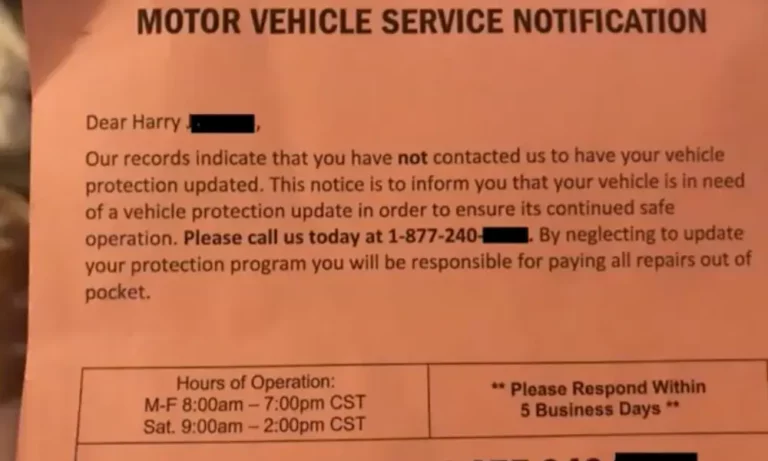
You just pulled a letter out of your mailbox stamped “Private & Confidential.” It’s from something called the “Vehicle Services Division,” and it knows your car’s make, model, and VIN. Before you panic or pick up the phone, read this. It could save you hundreds of dollars.
What Is a Vehicle Services Division Letter?
A Vehicle Services Division letter looks official. It uses government-style fonts, barcodes, and reference numbers. But in most cases, it’s a marketing piece designed to sell you a third-party vehicle service contract.
These letters work because names like “Vehicle Services Division” actually exist in real state governments:
| State | Real Department Name | What It Actually Does |
|---|---|---|
| Illinois | Vehicle Services Department (Secretary of State) | Handles titling and registration |
| Tennessee | Taxpayer and Vehicle Services Division (Dept. of Revenue) | Manages vehicle licensing |
| Montana | Motor Vehicle Division (Dept. of Justice) | Driver licensing and registration |
| Oregon | Driver and Motor Vehicle Services Division (DOT) | Issues titles and plates |
| Private Solicitor | “Vehicle Services Division” | Sells service contracts |
By borrowing this language, private companies create what researchers call “semantic overlap.” Your brain sees “Vehicle Services Division” and thinks: government. That’s exactly the point.
Why These Letters Feel So Convincing
These mailers don’t happen by accident. Every detail serves a purpose.
The Physical Design Is Deliberate
- Perforated edges mimic tax forms and legal documents
- Barcodes and Customer ID numbers suggest you’re in a centralized database
- “Final Notice” or “Final Attempt to Notify” stamps create urgency
- No return address on the envelope forces you to open it before you can toss it
That last one is clever. Most people filter junk mail by the return address. No address means you have to open it to find out who sent it. By then, you’re already reading their pitch.
The “Voucher” Trick
Many of these letters include what looks like a check or a “Registration Fee Voucher” for $199 or $299. It feels like money you already own. Ignore the letter, and you “lose” it.
Here’s the truth: legitimate state agencies don’t mail you unsolicited discount vouchers. Real government correspondence moves money from you to the state, not the other way around.
The Language Plays on Fear
These letters deliberately blur two different things:
- A manufacturer’s warranty — built into your car’s purchase price, from the automaker
- A vehicle service contract — an optional, third-party product you pay extra for
They’ll say your “factory warranty has expired” (true for most cars) and then jump straight to “you’re now financially liable for all repairs.” That’s a giant leap designed to scare you into calling their toll-free number before you think it through.
How They Got Your Information
This question trips people up. The letter knows your VIN, your address, and when you bought your car. That feels like government-level access. But there are several non-government routes this data travels.
The Driver’s Privacy Protection Act Has Gaps
The federal Driver’s Privacy Protection Act (DPPA) limits what state DMVs can share. But “market research” exemptions have historically allowed data brokers to purchase bulk registration lists. Those brokers then sell segmented lists to automotive marketing firms.
Your Data Travels Further Than You Think
| Data Source | What’s Captured | How It Gets Out |
|---|---|---|
| State DMV | VIN, plate, owner address | Sale to data brokers under “market research” rules |
| Auto dealership | Purchase date, contact info | Shared with “partner” companies via sales contract clauses |
| Quote comparison websites | Make, model, desired coverage | Sold directly as leads to service contract sellers |
| Public records | Title transfers, lien status | Harvested from publicly accessible titling data |
That “free quote” website you visited? It may have sold your details to a dozen companies the same day. Reddit users in the r/Scams community have traced multiple “Vehicle Services Division” letters back to information entered on third-party automotive sites.
Spotting the Real Thing: Illinois VSD 954.1
Illinois actually has a legitimate government form called the VSD 954.1. It’s an official “Request for Insurance Verification” from the Secretary of State’s office. Scammers have studied this format closely.
Here’s how the real form differs from the fake:
| Feature | Legitimate Illinois VSD 954.1 | Deceptive “Vehicle Services” Letter |
|---|---|---|
| Issuer | Secretary of State (named official) | “Vehicle Services Division” (no address) |
| What you do | Contact your insurance agent or visit ILIVS.com | Call a toll-free number to “activate coverage” |
| Money involved | $100 reinstatement fee if suspended | Down payment on a service contract |
| Legal authority | Cites Illinois Vehicle Code 625 ILCS 5/7-601 | No legal code cited |
| Goal | Verify your insurance for state compliance | Sell you a commercial product |
The real VSD 954.1 names the sitting Secretary of State, cites specific state law, and directs you to a verifiable government portal. The fake version just wants you to call a sales rep.
What Montana Is Doing Differently
Montana’s Motor Vehicle Division (MVD) offers a useful case study in how states fight back. Montana has launched the Montana Mobile ID, a secure digital wallet for identity verification that reduces reliance on physical mail entirely.
Montana officials have also been direct: the MVD does not send text messages asking for payment. Any text with a payment link is a scam, full stop.
For legitimate registration renewals, Montana uses a Blue Postcard system sent by county treasurer offices. The card includes your VIN and title number and points you to mvdmt.gov for renewal. Simple, traceable, and official.
How to Check If a Letter Is Legitimate
Don’t call the number on the letter. Here’s what to do instead:
- Check your owner’s manual — it shows your actual warranty terms and expiration date
- Call your dealership directly — use the number from Google, not the letter, and ask them to verify warranty status by VIN
- Use your state’s official portal — Illinois residents can check insurance status at ILIVS.com; Montana residents can go to mvdmt.gov
- Look for a physical address — real government letters have one; scam letters usually don’t
- Search the sender’s name on the BBB Scam Tracker before engaging
And if you get a “Final Notice” with a voucher inside? That “Final Notice” is rarely final. These companies send multiple letters to the same address.
Where to Report a Vehicle Services Division Letter
If you’ve received a suspicious letter, report it. You’re helping build the case that eventually shuts these operations down.
| Agency | What They Handle | Where to Report |
|---|---|---|
| FTC | Federal deceptive marketing | reportfraud.ftc.gov |
| U.S. Postal Inspection Service | Mail fraud | uspis.gov |
| BBB | Business reputation and complaints | bbb.org/scamtracker |
| Illinois Attorney General | State-level fraud and mediation | illinoisattorneygeneral.gov |
| Montana Attorney General | Consumer protection | dojmt.gov/ocp |
The U.S. Postal Inspection Service tip is worth remembering: take a suspicious mailer to your local post office and ask them to trace the presorted mail permit. Even without a return address, inspectors can identify who paid for the mailing.
How to Stop Getting These Letters
You can reduce the volume of Vehicle Services Division mail without much effort:
- Opt out via DMAchoice — this removes you from commercial mailing lists across entire categories of businesses
- Be careful with your VIN online — don’t post it publicly on forums or enter it on unverified quote sites
- Read your dealership’s paperwork — look for clauses that allow them to share your data with “affiliates” and ask them to remove you
The data pipeline that feeds these mailers depends on your information moving freely between brokers, dealerships, and marketing firms. Tightening that flow reduces how often your mailbox becomes a target.
The Bottom Line on Vehicle Services Division Letters
These letters are sophisticated. They use real department names, real document formats, and real vehicle data to sell you something you may not need. A BBB profile for one company operating as “Vehicle Services Division and Home Warranty Division” in St. Charles, Missouri shows complaints from people who received “Final Notice” letters for vehicles they never owned.
The rule is simple: a government agency will never ask you to call a toll-free number to “activate” your vehicle coverage. If a letter does that, it’s selling something.