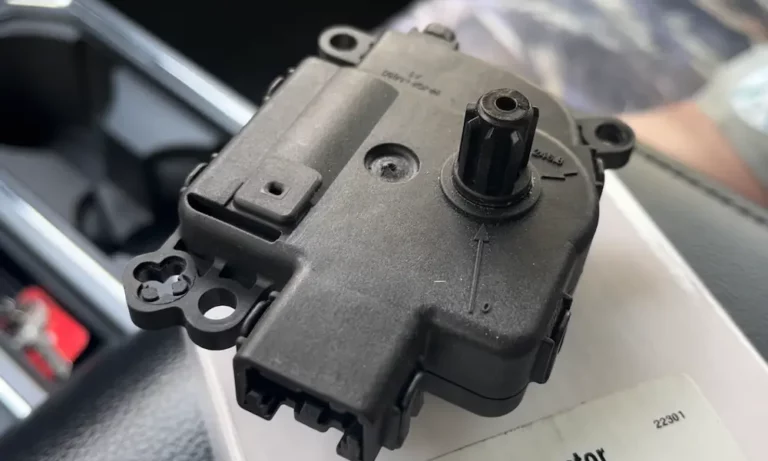
Your car’s climate control feels off — one side blows hot, the other cold, or you hear a clicking noise behind the dashboard. Something’s wrong, and that something might be your blend door actuator. This post breaks down exactly what it does, how it fails, and what you can do about it.
What Does a Blend Door Actuator Do?
The blend door actuator controls the temperature of the air inside your car. It moves a small flap — called the blend door — inside your HVAC system. That flap decides how much warm air from the heater core mixes with cool air from the AC evaporator.
Think of it as a mixing valve. Turn your temperature dial up, and the actuator pushes the blend door toward the heater core. Turn it down, and it moves the other way, letting more cold air through. The result? The exact cabin temperature you set.
Without it, you’d get either full heat or full cold — no in-between.
The actuator itself is a small electric motor with a gear system inside. It connects directly to the blend door and takes commands from your car’s HVAC control module. It’s essentially a closed-loop electromechanical servo — a fancy way of saying it moves to a position, checks where it landed, and adjusts if needed.
Blend Door Actuator vs. Other HVAC Actuators
Your car likely has more than one actuator behind the dash. They all look similar, but they do different jobs.
| Actuator Type | What It Does | How It Moves |
|---|---|---|
| Blend Door Actuator | Mixes hot and cold air to control temperature | Variable — moves to any position |
| Mode Door Actuator | Directs air to vents, floor, or defrost | Clicks between set positions |
| Recirculation Actuator | Switches between fresh air and cabin air | Either open or closed |
Replacing the wrong one is a common and costly mistake. If your temperature’s fine but the airflow direction is wrong, that’s a mode door problem — not a blend door issue. GPD Tech Tips has a solid breakdown of how to tell them apart before you start pulling things apart.
How the Blend Door Actuator Works
Here’s the basic flow:
- You set a temperature on the climate control panel
- The HVAC control module figures out the target blend door position
- It sends a signal to the actuator
- The actuator’s small DC motor turns, moving gears that rotate the blend door
- A position sensor (usually a potentiometer) tells the module where the door actually landed
- The module adjusts if needed
That position sensor is key. It acts like a volume knob — the voltage it sends back changes depending on the door’s angle. The control module reads that voltage and confirms the door is where it should be.
Newer vehicles use “smart actuators” that run on a digital communication line called a LIN bus. Instead of needing five or six dedicated wires, these actuators share a single bus wire and handle their own positioning logic internally. Ersa Electronics explains how this shift to distributed control has made HVAC wiring much cleaner — and diagnostics much richer.
What Sensors Feed the System?
The blend door actuator doesn’t just respond to your temperature dial. The HVAC module pulls in data from several sensors before deciding where to send the actuator:
- Cabin temperature sensors — measure the air inside the car
- Ambient temperature sensors — read the outside air temp
- Sunload sensors — detect solar radiation hitting the cabin. On a bright day, these photodiode sensors can push the blend door toward cold even before the cabin heats up
- Evaporator temperature sensors — prevent the AC core from freezing by limiting cold airflow when temps drop too low
This sensor fusion keeps your cabin comfortable without you having to constantly adjust the controls.
Signs Your Blend Door Actuator Is Failing
Blend door actuators are tough, but they don’t last forever. Here’s what to watch for:
Clicking or Knocking Behind the Dashboard
This is the most common symptom — and the most obvious. You’ll hear a repetitive clicking or tapping sound from behind the instrument panel, especially when you first start the car or change the temperature.
What’s happening: the plastic gears inside the actuator have stripped or cracked. The motor keeps spinning, but the gears can’t grip. Every missed tooth makes that clicking sound. Car Parts describes it as a “plastic machine gun” — once you’ve heard it, you won’t forget it.
Temperature Won’t Change (or Stuck on One Extreme)
If your car only blows hot air or only blows cold, the blend door may be jammed in one position. This can happen when:
- The actuator’s output shaft breaks
- The foam seal on the blend door becomes sticky and glues the door shut
- The motor burns out trying to break the seal free
Hot on One Side, Cold on the Other
Got dual-zone climate control? If the driver’s side and passenger side are delivering different temperatures when they should match, one of the zone actuators has likely failed.
Temperature Fluctuates on Its Own
If the air temperature keeps shifting without you touching anything, the position sensor inside the actuator may be wearing out. Frequent tiny adjustments can wear a groove into the sensor’s resistive surface, creating a dead zone where the signal gets noisy. The control module can’t find a stable reading, so it keeps hunting — and you feel the temperature swing.
Diagnostic Quick Reference
| Symptom | Likely Cause |
|---|---|
| Clicking behind dash | Stripped plastic gears |
| Only hot or only cold air | Stuck blend door or failed motor |
| Hot driver side, cold passenger side | Failed zone actuator |
| Temperature drifts without input | Worn position sensor |
| Actuator moves but temp doesn’t change | Broken shaft or door disconnect |
How Technicians Diagnose It
A good technician won’t just swap parts. They’ll use a scan tool to pull live data from the HVAC module and compare two values:
- Commanded position — where the module wants the door
- Actual position — where the actuator says it is
If actual doesn’t follow commanded, the fault is in the actuator or its wiring. If they match perfectly but the temperature doesn’t change, the door itself is physically disconnected from the actuator. That changes what needs to be replaced. Xtool’s blend door guide walks through this diagnostic process clearly.
The Calibration Step Everyone Forgets
Replace a blend door actuator and call it done? Not quite. The HVAC module needs to learn the range of the new actuator — a process called calibration or “relearn.”
Here’s what happens during calibration: the module drives the actuator all the way in one direction until the motor stalls, records that as one end of the range, then drives it the other way and records the other end. Everything in between gets mapped to your temperature scale.
Skip this step, and the module might keep pushing the actuator past its physical stops. That destroys the new gears fast. This is one of the leading causes of premature actuator failure after replacement.
How to Calibrate by Brand
| Brand | Typical Method |
|---|---|
| General Motors | Pull HVAC fuse, cycle ignition, wait 60 seconds |
| Ford | Battery disconnect or button sequence (Defrost + Recirc) |
| Toyota / Lexus | Often automatic after power loss |
| Most brands | Bidirectional scan tool “Reset” command (most reliable) |
How Long Do Blend Door Actuators Last?
Quality actuators are rated for 50,000 to 100,000 full-range cycles. In automatic climate systems, the blend door is in near-constant micro-motion — adjusting for sunload, outside temp, and cabin changes throughout every drive. That adds up.
Several things shorten actuator life:
- Heat exposure — dashboard actuators sit in an oven-like environment in summer
- Constant micro-adjustments — automatic climate systems work the actuator harder than manual ones
- Outgassing from plastics — chemicals released by dashboard materials can degrade the actuator’s lubricants and gear material over time
- Improper calibration — repeatedly hitting the mechanical stops at full motor power cracks gears fast
The good news: replacement actuators are generally inexpensive, typically running $20–$80 for the part. Labor is the bigger cost, since most actuators sit deep behind the dashboard.
What’s Changing in Newer Vehicles
Two big shifts are underway in blend door actuator technology.
Brushless motors are replacing the traditional brushed DC motors in higher-end systems. They’re more efficient — 85–93% vs. 75–80% — and last significantly longer since they eliminate the brushes and commutator that wear out first. In electric vehicles, that efficiency difference matters directly for driving range.
EV thermal management has raised the stakes for the whole HVAC system. In electric vehicles, the blend door actuator isn’t just about passenger comfort anymore. It’s part of a broader heat management system that also handles battery temperature and motor cooling. A failing actuator in an EV can affect range and battery health — not just whether you’re comfortable on your commute.
The blend door actuator might be one of the smaller parts in your car, but it quietly does a lot. When it works, you never think about it. When it doesn’t — you’ll definitely notice.