Your keyless car might be a prime target — and you’d never know until it’s gone. Thieves don’t need your keys anymore. They need a $100 device and 60 seconds. This post breaks down exactly which keyless cars are most stolen right now, how thieves pull it off, and what actually stops them. Stick around — the theft frequency numbers are genuinely alarming.
Two Ways to Measure Which Keyless Cars Are Most Stolen
Not all theft statistics tell the same story. You need to understand both before deciding how worried to be.
Raw volume counts how many of a specific model get stolen each year. It’s tracked by the National Insurance Crime Bureau. Popular cars naturally appear here simply because millions of them exist on the road.
Relative claim frequency is the smarter metric. The Highway Loss Data Institute (HLDI) scores every vehicle against a baseline of 100. A score of 500 means that car is stolen five times more often than average — adjusted for how many are actually on the road.
Think of it this way: a score of 6,000 doesn’t mean thieves stole 6,000 of them. It means that specific car is 60 times more likely to be stolen than any random vehicle sitting in your neighborhood.
High-Performance Muscle Cars: Stolen at Jaw-Dropping Rates
When you look at HLDI’s relative frequency data, American muscle cars don’t just top the list — they absolutely obliterate it.
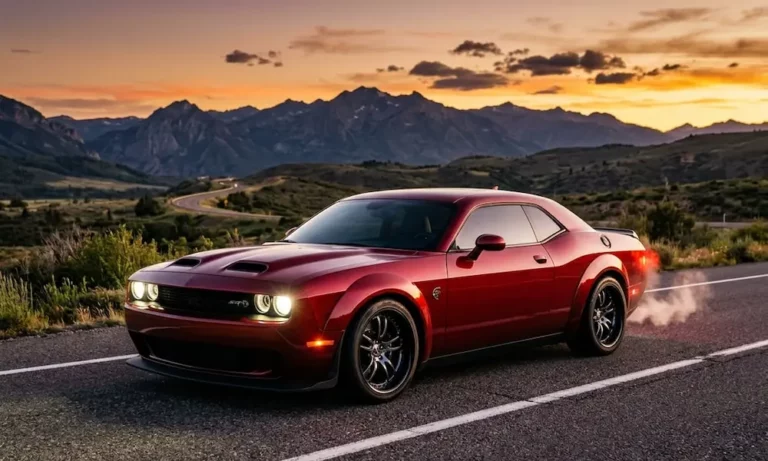
The Dodge Charger SRT Hellcat posted a relative claim frequency of 6,128 for 2020-2022 models. That’s not a typo. It’s more than 60 times the national average. Thieves want the supercharged V8, the illegal street takeover appeal, and the powertrain parts that fetch serious money. The standard Dodge Charger HEMI isn’t far behind at 2,197. The Dodge Challenger shares the same electronic vulnerabilities and consistently lands in the top five.
General Motors isn’t immune either. The Chevrolet Camaro ZL1 recently topped HLDI charts for 2022-2024 models with a score of 3,949 — nearly 39 times the average. The standard Camaro comes in at 1,287, still 13 times more likely to be stolen than your neighbor’s sedan.
The common thread? Desirable powertrains, weak OBD-II port protections, and criminal networks that have specifically mapped these vulnerabilities.
Luxury Cars and SUVs Thieves Actively Hunt
Organized theft rings don’t steal randomly. They target specific models because specific exploits exist. Here’s what the data shows for luxury vehicles.
The Acura TLX AWD ranks second overall in relative frequency at 2,138 — a number that shocked Acura owners. Both the AWD and FWD variants appear in the top ten, pointing to a systemic issue across the model’s electronic architecture.
The Infiniti Q50 has appeared on most-stolen lists since the 2014 model year. Recent data puts it at 878 — nearly nine times the national average. Insurance researchers attribute this to persistent vulnerabilities in its remote keyless communication protocols.
In the SUV segment, the Land Rover Range Rover scores 611 despite manufacturer interventions. Range Rovers remain prime relay attack targets because thieves can capture the key fob signal straight through the walls of your home. BMW’s X7, X6, and the Mercedes-Benz G-Class and S-Class also register elevated theft frequencies.
| Vehicle Make and Model | Type | Relative Claim Frequency (100 = Average) |
|---|---|---|
| Dodge Charger SRT Hellcat (2020-22) | Large Car | 6,128 |
| Chevrolet Camaro ZL1 (2022-24) | Large Sports Car | 3,949 |
| Dodge Charger HEMI (2020-22) | Large Car | 2,197 |
| Acura TLX AWD (2022-24) | Large Luxury Car | 2,138 |
| Chevrolet Camaro (2022-24) | Large Sports Car | 1,287 |
| GMC Sierra 2500 Crew Cab 4WD (2022-24) | Very Large Pickup | 1,023 |
| Infiniti Q50 (2020-22) | Midsize Luxury Car | 878 |
| GMC Sierra 3500 Crew Cab 4WD (2022-24) | Very Large Pickup | 742 |
| Chevrolet Silverado 3500 Crew Cab 4WD (2022-24) | Very Large Pickup | 662 |
| Land Rover Range Rover 4WD (2020-22) | Large Luxury SUV | 611 |
Heavy-Duty Pickup Trucks: High-Value, High-Risk
Pickup trucks sit at nearly double the all-vehicle average theft rate. Heavy-duty crew cab models with four-wheel drive are relentlessly targeted, and average claim severities often exceed $66,000 per incident.
The GMC Sierra 2500 Crew Cab 4WD holds a relative frequency over 1,000 — ten times the national average. The Sierra 3500 and Chevrolet Silverado 3500 follow at six to seven times average. Ram 1500 and Ram 3500 crew cabs from Stellantis consistently occupy the top tier too.
These trucks go missing for three reasons: enormous export value in international black markets, high domestic resale for individual parts, and keyless ignition systems that specialized relay hardware or diagnostic programming tools can bypass in under a minute.
The Volume Leaders: What Gets Stolen Most Often Nationwide
Raw volume data tells a different story. According to the NICB’s 2025 report, total vehicle thefts dropped 23% in the first half of 2025 — but hundreds of thousands of vehicles still vanish annually.
The Hyundai Elantra led all models with 21,732 thefts. The reason? Base-model Hyundai and Kia vehicles were missing standard electronic engine immobilizers, a fact that went viral on social media and sparked a national theft wave. The Honda Accord followed with 17,797 thefts, and the Hyundai Sonata with 17,687.
The good news: Hyundai and Kia’s free software upgrades — which turned the factory alarm into an ignition kill switch — started producing real results. Theft claims for both brands are declining steadily. Vandalism claims remain high though, suggesting thieves still try, they just fail more often now.
| Vehicle Make and Model | 2025 Total Theft Volume |
|---|---|
| Hyundai Elantra | 21,732 |
| Honda Accord | 17,797 |
| Hyundai Sonata | 17,687 |
| Chevrolet Silverado 1500 | 16,764 |
| Honda Civic | 12,725 |
| Kia Optima | 11,521 |
| Ford F-150 | 10,102 |
| Toyota Camry | 9,833 |
| Honda CR-V | 9,809 |
| Nissan Altima | 8,445 |
How Thieves Actually Steal Keyless Cars
Understanding the methods explains why certain vehicles get targeted so aggressively. There are four main attack vectors — and each one is frightening in its simplicity.
The Relay Attack
Your keyless car constantly broadcasts a short-range radio signal searching for your fob. When the fob responds, the doors unlock. Thieves exploit this with two people and two radio amplifiers.
One thief stands near your front door or window — low-frequency signals pass straight through walls. They capture your fob’s signal from the hallway table inside and relay it to a partner standing next to your car. The car thinks the key is inches away. It unlocks silently, the thief gets in, pushes start, and drives off. The factory alarm never triggers because the car believes a legitimate entry occurred.
Once the car is running, it won’t shut off even when the fob signal disappears. The thief can drive straight to a shipping container or chop shop.
OBD-II Key Cloning
If relay attacks don’t work, thieves head for your OBD-II port. This federally mandated diagnostic port sits under your dashboard and directly accesses your car’s internal computers.
A thief breaks in quietly, plugs in a key programming tool — legally sold online — and commands the vehicle to forget all existing fobs. They program their own blank key in minutes. Their new key is mathematically genuine. The car starts without complaint. This is the primary method driving theft spikes for the Camaro, Sierra, and Silverado.
CAN Bus Injection (Headlight Hacking)
This is the fastest-growing method. Instead of breaking into the cabin, thieves target exterior wiring harnesses — usually behind the headlights or wheel arch liners.
They pull back the trim, unplug the factory headlight, and connect a device disguised as something innocent like a Bluetooth speaker. It floods the car’s CAN bus network with spoofed messages impersonating the key receiver. Doors unlock, immobilizer disables, engine starts. Your Faraday bag does nothing against this attack because no key signal is involved. Toyota RAV4, Lexus RX/NX, and Range Rover owners face this most aggressively.
RF Hub Brute-Forcing (Dodge-Specific)
Stellantis muscle cars face a unique vulnerability. Thieves target the Radio Frequency Hub Module — the computer managing keyless entry and ignition authorization — and either brute-force its configuration or physically swap it with a pre-paired module. The owner’s keys die instantly. The thief’s key works perfectly. This specific exploit drives the historic theft frequencies seen on Dodge Chargers and Challengers.
What Manufacturers Are Actually Doing About It
The pressure from insurers, law enforcement, and angry owners forced automakers to respond. Some fixes genuinely work. Others are partial solutions at best.
Dodge/Stellantis rolled out a Key Programming Lockdown that permanently prevents new fobs from being programmed via OBD-II. They also added an Enhanced Security Mode — a PIN entered on the infotainment screen. Get it wrong, and the engine is electronically limited to less than three horsepower. Thieves can start the car. They just can’t drive it anywhere useful.
General Motors issued Customer Satisfaction Program N242447610 targeting the Camaro’s Body Control Module. The update forces multi-minute delays into key relearning processes. Sophisticated aftermarket programmers can sometimes still bypass these timers, so it’s a partial fix in an ongoing arms race.
Ford offers the SecuriCode keypad entry system plus patented relay attack prevention technology that uses the fob’s motion sensors to detect when it’s stationary. If the fob hasn’t moved, it stops broadcasting — neutralizing relay attacks entirely.
Hyundai and Kia rolled out one of the largest security campaigns in automotive history. Their free software upgrade turned the factory alarm into an ignition kill switch, producing measurable, sustained theft reductions that show clearly in 2025 data.
The Safest Keyless Cars: Electric Vehicles Lead by a Mile
Here’s the surprise: electric vehicles are almost never stolen. The HLDI data puts the Tesla Model 3 at a relative frequency of just 1 — one percent of the national average.
Why? Three reasons stacked together:
- Persistent GPS tracking broadcasts location to the owner’s app and Tesla’s servers the moment theft occurs
- Charging infrastructure requirements create a logistical nightmare — you can’t refuel anonymously at any corner station
- PIN-to-drive on the infotainment screen stops anyone who manages a relay entry from actually driving away
Volvo’s XC90 and XC40 also rank near the bottom of theft charts, thanks to robust data encryption, deeply integrated telematics, and rapid software patching that makes them unattractive to organized rings.
| Vehicle Make and Model | Type | Relative Claim Frequency |
|---|---|---|
| Tesla Model 3 AWD (2022-24) | Midsize Luxury Car (Electric) | 1 |
| Tesla Model Y AWD (2022-24) | Midsize Luxury SUV (Electric) | 2 |
| Toyota RAV4 Prime AWD (2022-24) | Small SUV (Plug-in Hybrid) | 5 |
| Tesla Model S AWD (2022-24) | Large Luxury Car (Electric) | 5 |
| Volvo XC90 AWD (2022-24) | Midsize Luxury SUV | 6 |
| Volvo XC40 AWD (2022-24) | Small Luxury SUV | 7 |
| Ford Mustang Mach-E (2022-24) | Midsize SUV (Electric) | 8 |
Practical Steps to Protect Your Keyless Car Right Now
You don’t need to wait for your manufacturer to patch a vulnerability. Layered protection works, and you can start today.
Block the signal first. Store your key fob in a Faraday pouch when you’re home. Test it monthly — quality degrades over time. Simply keeping fobs away from front doors and exterior walls also meaningfully weakens what thieves can capture. Some vehicles let you disable passive keyless entry entirely through infotainment settings, forcing manual fob button presses and killing relay vulnerability completely.
Add physical barriers. A steering wheel lock is old-school but effective. Electronic theft requires silence and speed — anything noisy and time-consuming pushes thieves to easier targets. For the OBD port, install a locking OBD cap. For maximum protection, use an OBD relocation harness that moves the functional port inside a locked glovebox while leaving a dummy port where thieves expect it.
If you own a Toyota RAV4 or Lexus, custom steel shields bolted behind the wheel arch liners physically block access to headlight wiring harnesses — cutting off the CAN injection entry point entirely.
Go aftermarket digital. Devices like the Ghost immobilizer and IGLA system integrate directly with the CAN bus. They prevent the engine from starting until you press a specific sequence of factory buttons — steering wheel controls, window switches, cruise control. No key signal involved. Relay attacks, OBD cloning, and CAN injection all fail because the thief doesn’t know your button sequence.
Add a hidden, battery-powered GPS tracker as a backup. Thieves know how to use the OBD port to disable factory telematics. An independent tracker on a separate network survives that move and dramatically improves recovery odds if everything else fails.
The reality is stark: criminal networks adapt in weeks while manufacturers update in years. On the list of which keyless cars are most stolen, your best defense isn’t hoping your automaker patches a hole — it’s stacking enough layers that thieves move on to an easier target down the street.