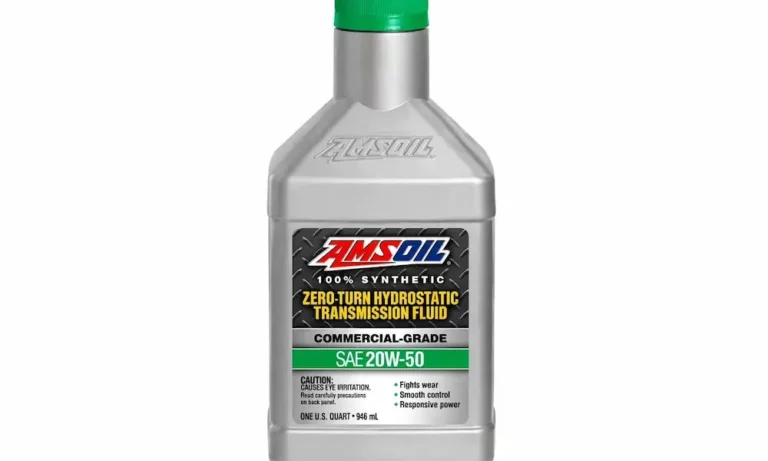
Finding the right 20W-50 hydraulic oil equivalent can feel like decoding a foreign language. SAE grades, ISO numbers, additive packages — it’s a lot. This guide cuts through the noise and tells you exactly what works, what doesn’t, and why your choice matters more than you think. Stick around, because the wrong oil can quietly destroy a very expensive pump.
Why 20W-50 Shows Up in Hydraulic Systems
Most people associate 20W-50 with car engines, not hydraulic drives. So why does your zero-turn mower or commercial outdoor power equipment call for it?
The answer comes down to how hydrostatic transmissions work. These are closed-loop, high-speed hydraulic circuits that power both propulsion and steering. The pistons and valve plates inside the pump have tolerances measured in ten-thousandths of an inch. The oil doesn’t just lubricate — it acts as a seal.
When the system heats up past 180°F, a thin oil leaks past those internal gaps. You feel it as sluggish steering or a loss of drive power. The “50” in 20W-50 keeps the oil thick enough at high temperatures to hold that seal. That’s why brands like Scag, Exmark, and Ferris specify it by name.
SAE vs. ISO: The Root of the Confusion
There are two main systems for rating oil viscosity in the U.S., and they don’t speak the same language.
The SAE system was built for engines and transmissions. A multigrade like 20W-50 gives you two ratings: cold-start flow (the “20W”) and hot operating thickness (the “50”). It achieves this range using viscosity index improvers — polymer molecules that expand with heat to keep the oil from thinning too fast.
The ISO Viscosity Grade system works differently. It measures kinematic viscosity at a fixed 40°C (104°F) and assigns a single number. ISO oils are typically monogrades — they don’t have the same polymer-heavy additive stack as multigrade motor oils. That makes a direct one-to-one swap tricky.
The 20W-50 Hydraulic Oil Equivalent in ISO Terms
Here’s where it gets interesting. Because 20W-50 is a multigrade, it doesn’t sit neatly in one ISO bracket. It shifts as it warms up.
At 40°C, SAE 20W aligns with ISO VG 68. That makes ISO 68 anti-wear (AW) hydraulic fluid the closest cold-start equivalent. It’s a common choice for medium-duty hydraulic systems and machine shop equipment.
But once the system reaches operating temperature, ISO 68 thins out faster than 20W-50. For high-pressure hydrostatic pumps running hot, you’d need to look at ISO VG 100 or ISO VG 150 to match the “50” weight protection.
| SAE Grade | Nearest ISO VG Equivalent | Best Use Case |
|---|---|---|
| SAE 20W | ISO VG 46 / 68 | Temperate climate hydraulics, machine tools |
| SAE 30 | ISO VG 100 | Heavy-duty industrial pumps, compressors |
| SAE 40 | ISO VG 150 | High-load gearboxes, extreme heat |
| SAE 50 | ISO VG 220 | Heavy gear sets, very high temperatures |
The bottom line: ISO 68 is your best 20W-50 hydraulic oil equivalent for general use, but it won’t fully replicate the high-temp protection of a true multigrade in a hydrostatic drive.
Why Standard Motor Oil Isn’t a Great Substitute
You might be thinking — 20W-50 motor oil is cheap and everywhere. Why not just use that?
Two reasons: zinc levels and shear stability.
Modern automotive oils meeting API SN or SP standards have had their zinc and phosphorus content reduced. That’s fine for cars with catalytic converters. It’s not fine for hydrostatic pumps that rely on high zinc levels to form a protective layer under extreme pressure. Low-zinc oil in a hydrostatic system leads to metal-to-metal contact, scuffing, and eventually pump failure.
Then there’s mechanical shear. As oil gets forced through a high-speed pump, it physically tears apart the polymer chains that give multigrade oil its viscosity range. A 20W-50 motor oil that’s been sheared can end up performing like a 20W-20 — way too thin when it matters most. Dedicated hydrostatic fluids use more robust polymers that hold up over hundreds of hours.
What the Major Brands Actually Specify
It’s worth knowing what the equipment manufacturers themselves recommend, because using the wrong fluid can void your warranty.
Scag Power Equipment is one of the most specific. Their technical bulletins call for Scag 20W-50 Hydraulic Drive System Oil across their commercial mower lineup.
| Scag Model | Approved Oil | Capacity | Service Interval |
|---|---|---|---|
| Turf Tiger (STT/STTII) | Scag 20W-50 | 3.6 quarts | 500 hours |
| Cheetah (SCZ/SCZII) | Scag 20W-50 | 5.0–10.0 quarts | 400–500 hours |
| Liberty Z (SZL) | Scag 20W-50 | 5.0 quarts | 400 hours |
| Freedom Z (SFZ) | Scag 20W-50 | 5.0 quarts | 400 hours |
| Patriot (SPZ) | Scag 20W-50 | 5.0 quarts | 500 hours |
Exmark uses their own Premium Hydro Oil (part number 109-9828), which is functionally equivalent to a high-quality 20W-50 but engineered for better shear stability. Toro runs a similar product called Hypr-Oil 500.
Tuff Torq, which supplies transaxles to John Deere, Husqvarna, and Simplicity, leans toward 5W-50 synthetic. The “5W” rating gives much better cold-flow for machines used in winter. They’ve historically listed 20W-50 as an acceptable substitute in warmer climates.
Synthetic vs. Conventional: Which One’s Worth It
This debate comes up constantly, and the answer depends on how hard you’re running your equipment.
Synthetic 20W-50 (Group IV or V base oils) offers a higher viscosity index, better thermal stability, and lower volatility. It resists varnish buildup on precision valve components and holds its viscosity longer under shear stress. For commercial operators running 8-hour days in Florida heat, it’s not even a close call.
| Attribute | Conventional 20W-50 | Full Synthetic 20W-50 / 5W-50 |
|---|---|---|
| Base Oil Type | Refined Mineral (Group II/III) | Chemically Synthesized (Group IV/V) |
| Cold Flow | Poor in freezing temps | Excellent year-round |
| Shear Stability | Moderate | High |
| Oxidation Resistance | Low to moderate | Very high |
| Cost Per Quart | $5–$8 | $12–$20 |
| Best For | Residential, light-duty | Commercial, high-heat, year-round |
If a synthetic fluid lets you stretch your service interval from 200 hours to 500 hours, the math works out in your favor — especially when you factor in labor and downtime.
Climate Matters More Than You Think
The U.S. covers a lot of ground, and the “right” 20W-50 hydraulic oil equivalent isn’t the same in Minnesota as it is in Arizona.
In hot southern states, heat is the enemy. 20W-50 is the standard because it maintains the thickest possible film at high ambient temperatures. Some operators running heavy industrial machinery in extreme heat even move to ISO 100 or ISO 150 when cold-start performance isn’t a concern.
In cold northern states, the problem flips. 20W-50 can get so thick at 40°F that the pump can’t pull oil from the reservoir — a condition called pump starvation. It runs dry for seconds or minutes until the oil warms up, and that’s when wear happens. Operators in these regions do better with 5W-50 synthetic or ISO 46 or 68 hydraulic fluid, which flows freely in the cold.
How to Tell Your Fluid Has Gone Bad
You don’t need a lab to know your hydrostatic fluid is done. Your eyes and ears will tell you.
Fresh 20W-50 is amber and clear. If it’s dark brown or black, it’s oxidized and full of wear particles. A burnt smell means it’s exceeded its thermal limits. Milky or cloudy oil means water contamination — common in humid climates or on machines that get pressure-washed regularly. Water destroys the lubricating film, causes rust on precision steel parts, and makes the oil foam.
On the operational side, watch for:
- Performance that fades as the machine heats up (sluggish after 30 minutes of work)
- Slow response or “creep” in the steering levers
- A high-pitched whine or growling when you push the levers hard
That last one often points to cavitation — air bubbles imploding inside the pump and pitting the metal surfaces. In many cases, draining the old fluid and refilling with a quality 20W-50 synthetic clears it up immediately.
Don’t Forget the Filter
Changing the oil without swapping the filter is one of the most common maintenance mistakes. Modern hydrostatic systems use high-efficiency filters — often rated at 10 or 20 microns — to catch the metal particles that naturally accumulate during operation. A clogged filter starves the pump just as effectively as the wrong oil.
Most manufacturers recommend changing the filter every time you change the oil. Some even suggest a mid-interval filter-only change on long service schedules. It’s cheap insurance on a pump that can cost hundreds to replace.