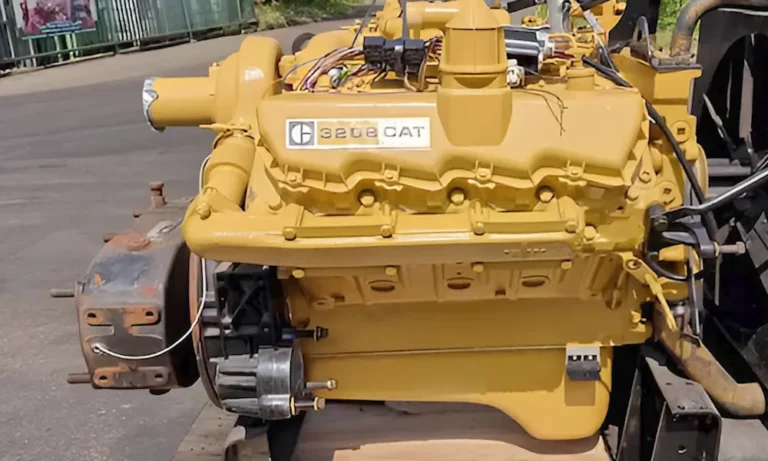
Looking for reliable information about the Caterpillar 3208 diesel engine? Whether you’re maintaining one, considering a purchase, or just curious about this legendary V8 workhorse, you’ve come to the right place. We’ve compiled all the essential specs and technical details you need to understand this versatile powerplant that’s been serving multiple industries since 1975.
What Makes the 3208 Cat Engine Unique?
The Caterpillar 3208 stands out as a remarkable V8 diesel engine with a production run spanning over two decades. It’s known for its mechanical simplicity and reliability across marine, industrial, and transportation applications.
This four-stroke diesel features a V8 configuration with a 114.3mm (4.5 inch) bore and 127mm (5.0 inch) stroke. All versions maintain the same 10.4-liter (636 cubic inch) displacement regardless of configuration. The engine rotates counterclockwise when viewed from the flywheel end and follows a firing order of 1-2-7-3-4-5-6-8, carefully engineered to optimize power delivery and minimize vibration.
One of the 3208’s defining characteristics is its mechanical simplicity, with a flat tappet design using pushrods instead of the electronic complexity found in modern engines. This makes it incredibly accessible for maintenance and troubleshooting in the field.
3208 Cat Engine Power Specifications
The 3208 was offered in multiple power configurations to suit diverse applications:
| Configuration | Power Range | Common Applications |
|---|---|---|
| Naturally Aspirated | 100-210 hp | Agricultural, Small Marine |
| Turbocharged | 225-375 hp | Medium Marine, Industrial |
| Turbocharged Aftercooled | Up to 435 hp | Large Marine, Heavy Equipment |
For marine applications, the naturally aspirated versions typically delivered 210-250 horsepower at 2800 RPM, with the most common rating being 210 hp. The turbocharged variants significantly expanded the power envelope, with marine ratings spanning from 225-435 horsepower.
Industrial and truck applications saw power outputs ranging from approximately 200 to 435 horsepower across the production span. The 3208 was also popular in generator sets, with ratings of 200-300 kW common for standby power generation.
Engine Configuration Options
The 3208 Cat engine was available in three distinct induction configurations:
- Naturally Aspirated (DINA): The simplest configuration, ideal for applications where moderate power and maximum mechanical simplicity were priorities.
- Turbocharged: Featured a single turbocharger mounted on the rear of the block, driven by exhaust gases from both exhaust manifolds for increased power output.
- Turbocharged Aftercooled (DITA): The most sophisticated configuration, incorporating both turbocharging and air-to-air aftercooling for maximum power and efficiency. This setup was particularly popular in marine applications requiring peak performance.
Compression ratios varied depending on the configuration. Naturally aspirated versions typically operated at 16.5:1 compression ratio, while turbocharged models used a 15.5:1 ratio to accommodate the increased cylinder pressures from forced induction. Some specialized variants operated with compression ratios ranging from 15.5:1 up to 18.2:1.
Physical Dimensions and Weight
The 3208 Cat engine’s size and weight vary significantly between configurations:
| Configuration | Width | Height | Length | Weight |
|---|---|---|---|---|
| Naturally Aspirated | 1086mm (42.7″) | 921mm (36.2″) | 917mm (36.1″) | 722kg (1,592 lbs) |
| Turbocharged | – | – | – | 772kg (1,702 lbs) |
| Turbocharged Aftercooled | 1271mm (50.0″) | 1019mm (40.1″) | 963mm (37.9″) | 899kg (1,982 lbs) |
The substantial weight reflects the engine’s all-cast-iron construction, including cast iron heads, block, and turbocharger housing. This robust construction contributes to the engine’s durability but makes it heavier than comparable modern designs with aluminum components.
Fuel System Details
The 3208 uses a traditional mechanical fuel injection system—a defining characteristic that represents the pre-electronic era of diesel engine technology. The system employs a high-pressure fuel pump with individual fuel lines running to nozzles positioned between the intake and exhaust valves of each cylinder.
Fuel consumption varies with power output and operating conditions. For reference, the 375 horsepower marine version at 2800 RPM consumes approximately 90.7 liters per hour. The naturally aspirated 210 horsepower version uses significantly less fuel, reflecting its lower power output.
The engine was designed to operate on standard diesel fuel with a gravity of 35° API at 16°C (60°F), having a lower heating value of 42,780 kJ/kg (18,390 Btu/lb) when used at 29°C (85°F).
Cooling and Lubrication Systems
The cooling system capacity varies between naturally aspirated and turbocharged configurations:
- Naturally aspirated engines (DINA): 47.3 liters (12.5 US gallons) for engine-only cooling
- Turbocharged aftercooled versions (DITA): 56.0 liters (14.8 US gallons)
For marine applications, the cooling system typically includes both raw water and fresh water circuits. The raw water system draws seawater through the engine’s heat exchanger, while the fresh water circuit circulates coolant through the engine block and heads—protecting internal components from corrosive seawater.
The lubrication system capacity also varies by configuration:
- Naturally aspirated versions: 12.0 liters (3.2 US gallons) for complete oil change
- Turbocharged aftercooled versions: 15.0 liters (4.0 US gallons)
The standard oil change interval is 250 hours across all configurations, reflecting the mechanical design and operational demands of the engine.
Valve Train Specs and Adjustment
The 3208 Cat engine uses a pushrod-actuated valve train with adjustable rocker arms. Proper valve adjustment is critical for optimal performance:
- Intake valve lash: 0.015 inches (0.381 mm)
- Exhaust valve lash: 0.025 inches (0.635 mm) to 0.030 inches (0.762 mm)
Valve lash adjustment is recommended every 1,500-2,000 hours of operation. The adjustment procedure follows the engine’s firing order of 1-2-7-3-4-5-6-8, with specific positioning requirements for each cylinder at top dead center during the compression stroke. The locknut torque specification for the rocker arm adjustment is 24 ± 5 foot-pounds (32.5 ± 6.8 Newton-meters).
Maintenance Schedule
The 3208 follows a comprehensive maintenance schedule based on operating hours:
| Service Item | Interval |
|---|---|
| Oil and filter changes | Every 250 hours |
| Fuel filters | Every 500 hours |
| Air filters | Inspect every 500 hours, replace when dirty |
| Coolant changes | Every 1,000 hours |
| Injector inspection/cleaning | Every 2,000 hours |
| Valve adjustment | Every 1,500 hours |
| Turbocharger inspection | Every 2,000-3,000 hours (turbocharged versions) |
| Raw water pump impeller | Every 500-1,000 hours (marine applications) |
| Complete engine overhaul | 10,000-12,000 hours |
Adhering to this schedule helps ensure the engine’s longevity and reliable operation throughout its service life.
Common Applications
The Caterpillar 3208 found widespread use across multiple industries throughout its production run from the late 1970s through the early 1990s:
Marine Applications
The engine powered numerous vessel types including:
- Grand Banks trawlers (models 42 and 46)
- Hatteras yachts (42 LRC and 48 LRC)
- Ocean Alexander trawlers (43 and 48)
- Mainship trawlers (34 and 40)
- Chris-Craft yachts
- Jefferson yachts
- Bertram yachts
- Viking convertibles
Industrial and Transportation Applications
- Generator sets (200-300 kW ratings common)
- Medium-duty trucks
- School buses
- Heavy equipment
- Agricultural machinery
The engine’s mechanical simplicity and robust construction made it particularly suitable for continuous-duty applications where electronic complexity could be problematic.
Performance Characteristics
Performance curves demonstrate the engine’s torque and power delivery across the operating range. The 375 horsepower turbocharged marine version produces peak power at 2800 RPM with maximum torque occurring at lower engine speeds, typical of diesel engine characteristics.
The naturally aspirated 210 horsepower version shows more linear power delivery, suitable for applications requiring steady-state operation. Fuel consumption follows predictable patterns, with specific fuel consumption improving at higher loads within the engine’s optimal operating range.
Turbocharged versions demonstrate better fuel economy under load compared to naturally aspirated variants, reflecting the efficiency gains from forced induction.
Common Issues and Troubleshooting
Despite its reputation for reliability, the 3208 Cat engine has several known issues to watch for:
Starting Problems
Hard starting often relates to:
- Fuel system contamination
- Air in fuel lines
- Degraded glow plug performance in cold weather
- Faulty fuel lift pump
Overheating Issues
Temperature problems frequently stem from:
- Clogged heat exchangers
- Failed water pump impellers
- Low coolant levels
- Restricted radiators or heat exchangers
- Faulty thermostats
Power Loss
Reduced power typically indicates:
- Fuel system restrictions
- Dirty air filters
- Valve train problems
- Turbocharger issues (in turbocharged versions)
- Improper valve lash adjustment
The engine’s parent bore design (without removable cylinder liners) represents a potential weakness, as cylinder damage requires significant block machining or replacement. Additionally, coolant crossover tubes between cylinder heads and the front structure can fail, causing coolant leaks that may require major disassembly to repair.
Parts Availability and Legacy
Despite production ending in 1999, the 3208 Cat engine maintains strong aftermarket support due to its large installed base. Parts availability remains excellent through Caterpillar dealers and third-party suppliers worldwide, with complete rebuild kits, replacement components, and technical support readily accessible.
The engine’s mechanical design provides advantages for field service and repair, with straightforward diagnostic procedures that don’t require sophisticated electronic test equipment. This simplicity, combined with robust construction and proven reliability, explains the continued popularity of the 3208 in applications where electronic complexity is undesirable.
Making the Most of Your 3208 Cat Engine
To maximize the service life of your 3208 Cat engine:
- Follow the maintenance schedule religiously – Nothing extends engine life like proper maintenance.
- Use quality filters and fluids – The 3208’s mechanical systems depend on clean oil, fuel, and coolant.
- Monitor operating temperatures – Preventing overheating is crucial for long-term reliability.
- Address issues promptly – Small problems quickly become major failures if ignored.
- Consider a rebuild at 10,000-12,000 hours – A professional rebuild can restore like-new performance.
The Caterpillar 3208 represents a significant achievement in diesel engine design, balancing power output, reliability, and serviceability in a package that served diverse industries for over two decades. Its specifications reflect careful engineering compromises that prioritized durability and maintainability while delivering adequate performance for its intended applications.
Despite newer technologies superseding it, the 3208 remains a viable powerplant choice where its characteristics align with operational requirements—a testament to its excellent design and engineering.