
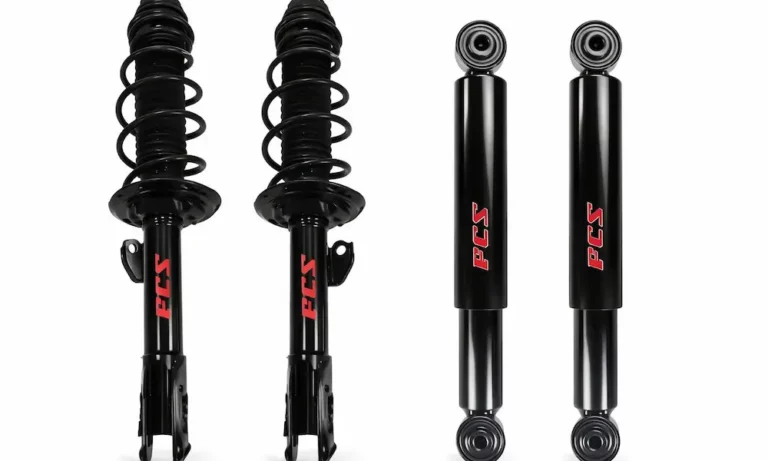
Replacing your shocks or struts is stressful enough. Then you hit RockAuto, spot FCS at half the price of KYB, and suddenly you’re down a Reddit rabbit hole at midnight. Are FCS shocks actually good, or are you just buying headaches? This post breaks it all down — the manufacturing, the real-world performance, and exactly who should (and shouldn’t) buy them.
What Makes FCS Different From Most Aftermarket Brands
Most budget aftermarket brands don’t make anything. They slap a logo on parts sourced from whoever offers the lowest price that week.
FCS doesn’t work that way. They’re a vertically integrated primary manufacturer — meaning they design, engineer, and build their own shocks and struts in-house. That’s a big deal. It means consistent quality control that pure-play distributors simply can’t match.
Their production base is Yangzhou Focus Shock Absorber Co., Ltd., a 75,000+ square meter facility in Jiangsu Province, China. The factory employs around 800 professionals and cranks out 10 million shock absorbers per year across 9,000+ product categories, covering over 95% of vehicles on the road.
In 2017, the company dropped $23 million into a new factory expansion. That’s not the behavior of a brand cutting corners.
They Actually Supply OE Companies
Here’s something most people don’t know: FCS designs and produces shocks for OE manufacturers worldwide. Their Yangzhou facility holds IATF16949 certification — the same rigorous standard required to supply original equipment to car brands. That’s not a certificate you hang on the wall for fun. It means their quality management meets factory-level standards.
What’s Inside an FCS Shock Absorber
The “is it good?” question really comes down to what’s inside the unit. Here’s a breakdown of FCS’s key components and why they matter:
| Component | What FCS Uses | Why It Matters |
|---|---|---|
| Piston Rod | Mirror-finished, hard-chrome | Reduces friction, protects seals from premature wear |
| Main Seals | Freudenberg NOK | Industry-leading seal brand; resists temperature extremes |
| Hydraulic Fluid | Premium Fuchs / Japanese Oil | Maintains consistent damping, prevents fluid fade |
| Valve System | Velocity Proportional Valving | Adjusts stiffness based on impact speed automatically |
| Mounting Brackets | Reinforced steel | Built to handle rough roads without cracking |
| Boots & Bumpers | Molded urethane rubber | Protects the rod from debris and harsh hits |
The use of Freudenberg NOK seals and premium Fuchs hydraulic oil is genuinely impressive for a budget-tier brand. These components typically show up in premium-priced shocks.
Velocity Proportional Valving: What It Actually Does
This isn’t just marketing speak. Velocity Proportional Valving means the shock adjusts its damping resistance based on how fast the impact hits.
- Slow bumps (speed bumps, gentle road waves) → shock stays soft → comfortable ride
- Fast impacts (potholes, sharp dips) → shock stiffens up → protects your chassis
It’s a multi-stage hydraulic system that controls fluid flow between the inner and outer tubes. The result? A shock that doesn’t have to choose between comfort and control — it does both, depending on what the road throws at it.
FCS Complete Strut Assemblies: Their Biggest Advantage
FCS leads the North American aftermarket in complete strut assemblies. A complete assembly bundles the strut, coil spring, bearing plate, boot kit, bumper, and isolators into one ready-to-install unit.
Why does that matter? Because most people replacing struts only swap the damper — and leave behind a coil spring that’s already toast.
Why Old Springs Are a Hidden Problem
After 80,000 miles, a suspension spring has gone through trillions of compression cycles. That kind of wear causes real problems:
- Ride height drops — sagged springs lower the chassis, throw off your camber and caster, and cause uneven tire wear
- Spring breakage — corroded coatings make old springs prone to cracking, especially in northern climates
- Mismatched performance — a fresh damper paired with a worn spring means neither component works as intended
FCS complete assemblies solve all three problems at once. No spring compressor needed, faster install time, and every component — spring, bearing plate, isolators — is brand new.
How FCS Holds Up in the Real World
Real-world feedback on FCS is mostly positive, with some consistent patterns worth knowing before you buy.
Where FCS Performs Well
- Daily drivers and economy cars: Honda Civic owners, Toyota Camry owners, and similar commuter car drivers consistently report smooth installs and a noticeable improvement over worn-out OE parts
- Trucks and fleet vehicles: Silverado and similar truck owners praise the firm, restored handling and the precise fit
- Budget-conscious shops: Professional mechanics frequently use FCS as their go-to economy option for price-sensitive customers — which says a lot about the brand’s reliability on the job
Where FCS Falls Short
Ride height after install: One of the most common complaints is that the vehicle sits higher than expected. Here’s why this usually isn’t actually a problem:
- New springs haven’t settled yet — they typically compress slightly over the first few thousand miles
- Most owners are comparing new ride height to 10 years’ worth of spring sag, which isn’t a fair comparison
- Cross-application parts (one strut covering both 4-cylinder and 6-cylinder variants) may sit slightly higher on lighter engines
Noise during break-in: Some users report squeaking or clunking right after installation. In most cases, this fades within a few hundred miles as the components seat properly.
Luxury and performance cars: For a BMW, Mercedes, or any vehicle where damping refinement matters, FCS doesn’t quite match the performance of Bilstein or Sachs. The ride can feel stiff and lack the nuanced control premium brands provide.
FCS vs. The Competition
Here’s how FCS stacks up against the other major aftermarket players:
| Brand | Tier | Strength | Weakness |
|---|---|---|---|
| FCS | Value / Economy | Vertical integration, widest complete assembly coverage | Can feel stiff on luxury vehicles |
| KYB | Premium | Exceptional durability, OE-level Japanese engineering | Often 2x the price of FCS |
| Monroe | Mid-Tier | Established name, comfort-focused OESpectrum line | Quality has declined significantly in recent years |
| Gabriel | Budget / Mid-Tier | Good for trucks, HD options available | Mixed reviews across vehicle types |
FCS vs. KYB: The Real Trade-Off
KYB is the benchmark for performance, especially on Asian imports. They last longer and deliver a more controlled, responsive ride. But they’re often significantly more expensive.
For autocross drivers or anyone who wants sharp, connected road feel? Pay the extra money for KYB. For a 130,000-mile Accord you drive to work every day? FCS gives you the same safe, functional ride for a lot less cash.
FCS vs. Monroe: The Surprising Verdict
Monroe used to dominate the North American market. Not anymore. Professional mechanics on forums like r/MechanicAdvice consistently report that Monroe’s quality has dropped badly over the past decade since Tenneco/DRIV took over. Meanwhile, FCS — because it controls its own manufacturing — maintains consistent quality. Several mechanics now prefer FCS over Monroe for everyday installs. That’s a meaningful shift.
FCS for Fleets and Air Suspension
FCS has moved into two specialized areas worth knowing about.
Heavy-Duty Fleet Shocks
Their HD Fleet line targets delivery vans, work trucks, and any vehicle carrying constant payloads. These shocks handle the five most common signs of HD shock failure — excessive bouncing, poor handling under load, uneven tire wear, diving under braking, and body roll — at a price point that keeps fleet maintenance budgets manageable.
Air-to-Passive Conversion Kits
This is genuinely clever. For luxury SUVs like the Cadillac Escalade or GMC Yukon, replacing a failed electronic air suspension system at a dealer can cost thousands per corner. FCS offers conversion kits that replace active air suspension with passive coil-over systems, cutting maintenance costs by up to 65%. It’s a smart solution for anyone who wants to keep driving an older luxury vehicle without selling a kidney to fix it.
The Warranty: What You’re Actually Covered For
FCS offers a Limited Lifetime Warranty for the original purchaser — but read the fine print before you assume you’re covered for everything.
What the warranty excludes:
- Commercial or racing use
- Normal wear and tear
- Labor costs to remove the defective unit
- Return shipping costs
If you’re buying through RockAuto, the warranty runs through the retailer’s platform. Some customers have reported frustration with paying return shipping on heavy strut assemblies — so factor that in when you’re comparing prices.
Get the Most Out of FCS Shocks: Installation Tips
Even the best shock fails early if you install it wrong. Follow these steps.
Always Get an Alignment After Installation
Replacing shocks changes your suspension geometry. Skipping a professional alignment after install leads to rapid tire wear and handling issues — and people often blame the part instead of the missing alignment. Don’t skip this step.
Critical Mistakes to Avoid
- Using an impact wrench on the top nut — this spins the internal piston rod at high speed and destroys the seals
- Over or under-torquing mounting hardware — check the specs for your specific application
- Ignoring worn related parts — new struts won’t fix noise or handling problems caused by worn ball joints or control arm bushings
FCS recommends inspecting your shocks every 50,000 miles, though well-maintained units can reach 100,000 miles. Watch for classic signs of wear like excessive bounce after a bump, nose-diving under braking, and fluid leaks on the shock body.
So, Are FCS Shocks Good?
Here’s the straight answer: yes, for most vehicles and most drivers, FCS shocks are genuinely good.
They’re built by a primary manufacturer with OE-level quality certifications. They use quality internal components — Freudenberg NOK seals, Fuchs hydraulic oil, chrome-finished rods — that you’d expect to find in more expensive brands. Their complete strut assemblies solve a real problem that bare-strut replacements ignore. And mechanics who work on dozens of cars a week trust them enough to recommend them.
They’re not the right call for a performance-focused build or a luxury sedan where ride quality is everything. For those applications, budget up to KYB or Bilstein and don’t look back.
But for your daily driver, your commuter car, your work truck, or any high-mileage vehicle that just needs safe, reliable suspension? FCS hits the mark cleanly — at a price that makes the decision easy.


