You just dropped serious cash on a ceramic coating for your car. Now you’re wondering if adding a layer of wax might give you even more protection or shine. It’s a fair question—after all, more protection is better, right? Not quite. The answer might surprise you, and it’ll save you from making a costly mistake that could mess up your investment.
The Short Answer: Yes, But You Shouldn’t
Sure, you can physically apply wax over ceramic coating. Your applicator won’t catch fire, and nothing will explode. But here’s the thing: applying wax over a ceramic coating is like putting a screen protector over your phone’s screen after you’ve already installed a tempered glass protector. It’s pointless, and it actually makes things worse.
The real question isn’t whether you can do it. It’s whether you should. And the answer from material science experts and professional detailers is a resounding no.
Why Wax and Ceramic Coating Don’t Play Nice
Think of it like mixing oil and water—they just don’t bond. Here’s the science without the headache:
Your ceramic coating is made from silicon dioxide (SiO₂), an inorganic compound that creates a super-slick, glass-like surface. It’s engineered at the molecular level to repel pretty much everything—water, dirt, oils, and yes, even wax.
Traditional car wax? That’s an organic compound, usually carnauba or synthetic polymers. It’s basically a bunch of natural oils and greases. When you try to slap that oily, sticky substance onto a surface that’s literally designed to repel oils, you’re fighting chemistry itself.
The coating’s low surface energy means it won’t give the wax anything to grab onto. The wax can’t bond properly, so it just sits there like an unwelcome guest at a party.
What Happens When You Wax Your Ceramic Coating
Let’s talk about the actual consequences. This isn’t just theory—it’s what happens in the real world.
Your Hydrophobic Properties Disappear
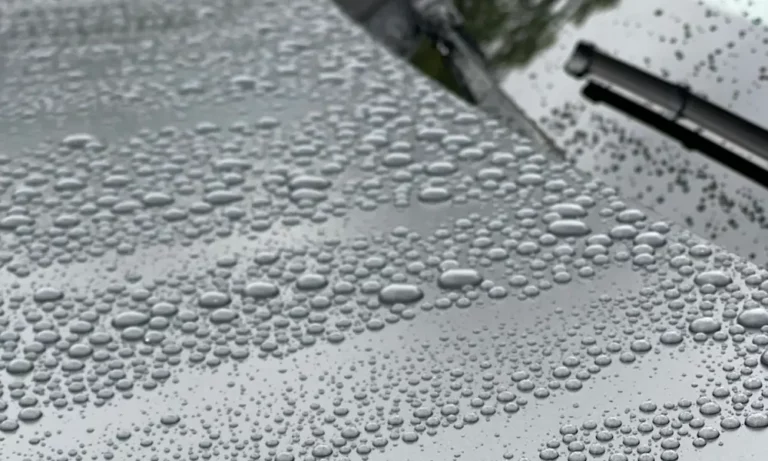
Remember those satisfying water beads that roll right off your car? That’s the ceramic coating’s nano-structure at work. When you apply wax, it clogs that structure. The oils fill in the microscopic texture that creates the water-repelling magic.
One Reddit user learned this the hard way: “I noticed the water wasn’t beading anymore. So thus, the waxing.” They were trying to fix the problem by applying the exact thing that caused it. The coating hadn’t failed—it was just masked by contamination.
Your Car Gets Dirtier, Faster
Here’s the irony: you apply wax thinking you’re adding protection, but you’re actually making your car attract more dirt. Wax contains natural oils and greases that are inherently sticky. They grab onto dust, pollen, tree sap, and road grime like a magnet.
Your ceramic coating was keeping your car cleaner for longer. Now you’ve turned it into a dirt collector.
You Might Get a Hazy, Cloudy Mess
The ceramic coating’s slick surface doesn’t let wax cure properly. Instead of a smooth, even layer, you often end up with streaks, splotches, and a cloudy film that dulls your paint’s clarity.
One detailer posted: “Been hazy since I did wax last fall. Dealer did ceramic coat before hand. How to fix?” The wax couldn’t bond to the coating, so it created a persistent haze that wouldn’t wash off.
You Could Void Your Warranty
If you paid for a professional ceramic coating installation, read your warranty terms. Many explicitly forbid applying wax or over-the-counter products. VIP Surface Concepts warns that using these products “can actually damage the coating… as well as VOID warranties.”
You could be out thousands of dollars because you tried to add “extra protection.”
The Confusing World of “Ceramic Wax”
Now you’re probably thinking: “Wait, I’ve seen products called ‘ceramic wax.’ What’s the deal?”
This is where the terminology gets messy. The detailing industry has created massive confusion by slapping the word “wax” on products that aren’t traditional wax at all.
When Turtle Wax says their products are “safe to use” on ceramic coatings, they’re talking about their “Hybrid Solutions” line—products infused with SiO₂. These aren’t the same as your dad’s paste wax sitting in the garage.
Here’s a breakdown to clear things up:
| Product Type | What It Actually Is | Safe for Ceramic? |
|---|---|---|
| Traditional Carnauba Wax | Organic oils from palm trees | No—clogs and degrades coating |
| Synthetic Sealant | Polymer-based (no SiO₂) | Not recommended—poor bonding |
| “Ceramic Wax” Hybrid | Polymers + SiO₂ | Yes—chemically compatible |
| Ceramic Topper/Spray | Pure SiO₂ formula | Ideal—designed for this |
The “debate” isn’t really a debate. It’s a vocabulary problem. One side says “don’t wax” (meaning traditional wax). The other says “ceramic wax is fine” (meaning SiO₂-infused products). Both are right.
The Right Way to Maintain Your Ceramic Coating
Your ceramic coating isn’t a “set it and forget it” deal. It needs maintenance. But you’re not waxing anymore—you’re using a smarter system.
Wash It the Right Way
The most important step is regular washing. Do it weekly or bi-weekly to prevent contamination from building up and masking your coating’s properties.
Here’s what you need to know:
Use the two-bucket method. One bucket for soapy water, one for rinsing your mitt. This prevents scratching your coating with dirt particles.
Skip the automatic car wash with brushes. Those spinning mops will scratch your coating faster than you can say “swirl marks.”
Use a pH-neutral soap with no wax, gloss enhancers, or additives. Products like CarPro Reset or Gyeon Q²M Bathe are designed to clean without leaving residue. Using a “wash and wax” product will clog your coating just like applying paste wax does.
If your coating’s water beading has already disappeared, start with a “reset wash” using a slightly alkaline or acidic soap designed to strip contamination without harming the coating.
Use a Ceramic Topper Instead
This is your new “waxing” step. A ceramic topper is a spray-on maintenance product that’s chemically compatible with your coating.
These SiO₂-based sprays (like CarPro Reload, Gyeon Q²M Cure, or Meguiar’s Hybrid Ceramic Detailer) are designed to bond with your coating’s surface. They act as a sacrificial layer that refreshes your coating’s gloss and hydrophobic properties.
Apply them every few months, often as a drying aid right after washing. They’re quick, easy, and they actually work with your coating instead of against it.
How to Fix It If You Already Waxed
Don’t panic. You haven’t ruined your coating. The good news is that ceramic coatings are chemically resistant, while traditional wax is weak and easily removed.
Here’s your fix:
Step 1: Strip Wash
Wash your car with a wax-stripping shampoo like Chemical Guys Clean Slate or CarPro Reset. These break down and dissolve the oily wax layer. In a pinch, a small amount of dish soap (like Dawn) works because its degreasers will strip the wax oils.
Step 2: IPA Wipe-Down
After the strip wash, wipe down your paint with isopropyl alcohol (IPA) diluted 15-70% with water. This removes any final traces of wax residue.
Step 3: Watch the Magic Return
Once the wax is gone, your coating’s original properties will come roaring back. The sharp gloss and water beading will return immediately. You’ll realize the coating never failed—it was just buried under incompatible wax.
The Bottom Line: Don’t Fight Chemistry
Can you wax over ceramic coating? Technically, yes. Should you? Absolutely not.
You paid good money for a high-tech, chemically-engineered surface protection system. Don’t sabotage it with a product from a previous era of car care. Traditional wax doesn’t enhance your ceramic coating—it masks it, clogs it, and makes your car dirtier.
The “wash and wax” routine is dead. Welcome to the ceramic era, where your maintenance routine is actually simpler and more effective. Wash regularly with a pure, pH-neutral soap. Apply a SiO₂ topper every few months. That’s it.
Your ceramic coating is already giving you the protection and gloss you’re looking for. Stop trying to fix what isn’t broken. Let the chemistry do its job.