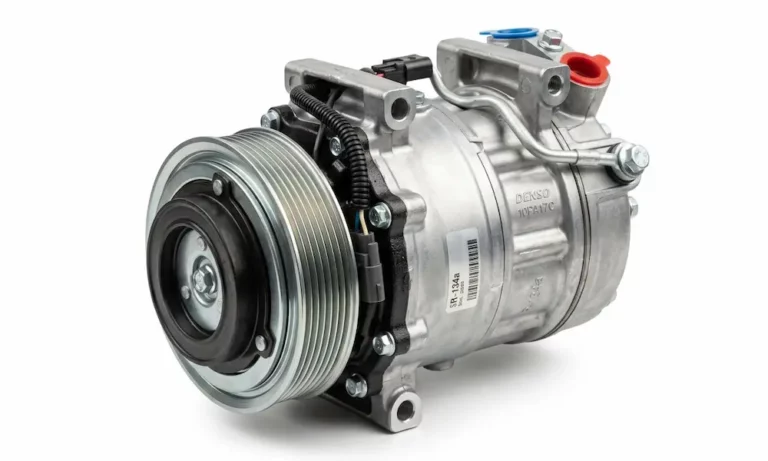
Your car’s AC is blowing warm air, and the compressor isn’t doing anything. It’s hot, you’re frustrated, and you don’t know where to start. This post breaks down every reason your car A/C compressor is not turning on — from a blown fuse to a seized pump — so you can diagnose it fast and fix it right.
What the Compressor Actually Does
Think of the compressor as the heart of your AC system. It pressurizes the refrigerant gas, which allows it to release heat at the condenser and cool your cabin at the evaporator.
No compressor action means no cooling. Simple as that.
In most cars, a belt-driven electromagnetic clutch connects the engine to the compressor. When the AC button gets pressed, the control module sends a signal, the clutch snaps on, and the compressor spins.
When that clutch doesn’t engage? You get hot air and silence.
The Electromagnetic Clutch: First Thing to Check
Stand in front of your car with the engine running and the AC cranked to max. Watch the center of the compressor. You’ll see the outer pulley spinning constantly. The question is whether the center plate — the clutch — is spinning with it.
If the clutch plate is stationary while the pulley spins freely, your compressor isn’t engaging. That’s your starting point.
How the Clutch Works
When the control module closes the AC relay, current flows into a field coil inside the clutch assembly. That coil generates a magnetic field that yanks the clutch plate against the spinning pulley. The plate locks on, the compressor shaft turns, and cooling begins.
If the field coil has an internal break — often from heat stress or vibration — it can’t generate the magnetic pull needed to grab the plate.
The Air Gap Problem
There’s a tiny gap between the clutch plate and the pulley when the system is off. Manufacturers specify this gap at 0.35 to 0.60 millimeters. Over time, friction surfaces wear down, and that gap grows.
Once the air gap exceeds the spec, the magnetic field isn’t strong enough to bridge it. This often shows up as an AC that works when the engine is cold but fails once things heat up — because heat increases coil resistance and expands metal, widening that gap further.
Technicians fix this by removing or adding shims behind the clutch plate to restore the correct clearance.
| Clutch Component | Function | Failure Result |
|---|---|---|
| Field Coil | Generates magnetic field | No clutch engagement |
| Clutch Plate | Transfers torque to compressor | Slipping or no spin |
| Pulley | Driven by accessory belt constantly | Bearing noise when AC is off |
| Shims | Sets air gap distance | Incorrect gap = weak engagement |
Pressure Sensors: The Most Common Culprit
Here’s a stat worth knowing: pressure sensor lockouts are the most common reason a car A/C compressor doesn’t turn on. The system protects itself by refusing to run the compressor in unsafe pressure conditions.
Low Pressure Lockout
Your compressor needs refrigerant to carry lubricating oil through its internals. If refrigerant leaks out — through a bad O-ring, a porous hose, or a cracked condenser — the pressure drops.
With insufficient refrigerant, there’s no oil delivery, and the compressor would destroy itself within minutes. So the low-pressure switch cuts the circuit before that happens. If pressure drops below roughly 25 PSI, the compressor shuts out automatically.
High Pressure Shutdown
Too much pressure is just as dangerous. If the condenser can’t shed heat — because the cooling fans failed or debris is blocking airflow — refrigerant can’t condense back into liquid. Pressure climbs fast.
At around 400 to 450 PSI, the high-pressure sensor triggers an emergency shutdown to prevent a burst hose or fitting.
| Pressure State | Likely Cause | System Response |
|---|---|---|
| Below 25 PSI | Refrigerant leak | Compressor locked out |
| 25–350 PSI | Normal operation | Compressor cycles on demand |
| Above 400 PSI | Fan failure or blocked condenser | Emergency shutdown |
Sensors That Block the Compressor (Even When Everything Seems Fine)
Modern vehicles tie the AC system into the broader engine management network. Several sensors — none of them directly part of the refrigeration loop — can block the compressor entirely.
Ambient Temperature Sensor
Your car’s AC won’t run when it’s too cold outside, typically below 60°F (15°C). That prevents the evaporator from freezing up and keeps the system efficient.
The ambient sensor sits behind the front grille. If it fails and reports -40°F to the control module, your car thinks it’s a winter blizzard outside — and blocks the compressor even on a scorching summer afternoon.
Evaporator Temperature Sensor
The evaporator core gets very cold during operation. Moisture from cabin air condenses on its fins. If it drops to 32°F (0°C), that moisture freezes, blocks airflow, and can damage the core.
The evaporator temperature sensor monitors this and cycles the compressor off before freezing occurs. A failed sensor stuck on a low reading will permanently disable the compressor, even when the evaporator is perfectly fine.
Engine Coolant Temperature Sensor
Running the AC adds real mechanical load to your engine. If the coolant temp sensor detects the engine approaching an overheat condition, the powertrain control module disables the compressor to reduce strain. This is why your AC sometimes cuts out in slow traffic on a hot day.
| Sensor | What It Monitors | What Happens When It Fails |
|---|---|---|
| Ambient Temp | Outside air temperature | Compressor locked out in warm weather |
| Evaporator Temp | Evaporator core temp | Rapid cycling or permanent lockout |
| Engine Coolant Temp | Engine heat | AC shuts off during heavy load |
| Throttle Position | Wide-open throttle events | AC drops during hard acceleration |
Electrical Faults: Fuses, Relays, and Wiring
The electrical path from your AC button to the compressor clutch passes through several critical checkpoints. Any break in that path leaves the compressor dead.
Start With the Fuse
A blown fuse is the simplest fix — and it’s the first thing a technician checks. Find the AC compressor fuse in your engine compartment’s fuse box. If it’s blown, replace it. If it blows again immediately, there’s a short circuit somewhere downstream.
Test the Relay
The compressor clutch draws too much current for a direct control signal, so a relay handles the heavy lifting. A low-current signal from the module triggers the relay, which then closes a high-current path from the battery to the clutch.
Relays fail. Their internal contacts burn, or the coil breaks.
To test one, pull the relay and jump terminals 30 and 87 with a short wire. If the clutch engages, the wiring from the relay to the compressor is fine. The fault is upstream — likely a sensor, the AC button, or the control module itself.
Check for Wiring Corrosion
Under-hood conditions are brutal — heat, vibration, road salt, and moisture. These create oxidation at electrical connectors that increases resistance and starves the clutch of voltage. Green corrosion at the compressor connector is a common culprit in intermittent failures. Unplug it, clean the pins, and retest.
Mechanical Failure: Seized Compressors and Contamination
Sometimes the compressor itself is the problem — and a seized unit won’t turn even with full power applied to the clutch.
Internal Seizure
When refrigerant leaks and no one fixes it, the oil stops circulating. Metal contacts metal. Components weld together internally. The result is a fully seized compressor.
You’ll know it’s seized when the accessory belt squeals or smokes as the engine tries to spin a locked pulley. At that point, the compressor needs replacement — there’s no repairing a seized unit.
Contamination and the Receiver-Drier
Moisture in the refrigerant reacts with the oil to form acids that corrode internal valves. That’s why every system includes a receiver-drier — a component packed with desiccant that absorbs moisture.
If the desiccant bag ruptures, or if the system gets left open during a repair, contamination follows. Debris can block the orifice tube or expansion valve, causing pressure imbalances that trigger the high-pressure shutoff. This is exactly why technicians replace the receiver-drier and expansion valve whenever they replace a compressor.
| Failure Mode | What Causes It | Signs You’ll Notice |
|---|---|---|
| Internal Seizure | No oil from refrigerant loss | Squealing belt, smoke, stalled engine |
| Valve Damage | Acid corrosion or metal debris | Compressor runs but produces no cooling |
| Bearing Failure | Wear over time | Grinding noise even when AC is off |
| Shaft Seal Leak | Seal degradation | Oily residue behind the clutch |
Variable Displacement Compressors: A Different Diagnosis
Many newer vehicles use variable displacement compressors that don’t have a traditional clutch. The pulley spins constantly with the engine. Instead of clicking on and off, a pulse-width modulated solenoid adjusts the internal pumping capacity from 1% to 100%.
When these fail, the compressor looks like it’s working — the pulley is spinning — but it produces no cooling. You can’t just watch the clutch. You need a scan tool to check the solenoid’s duty cycle or an oscilloscope to read the control signal.
If the solenoid fails or the module sends a 0% signal due to a sensor error, the compressor does nothing despite physically spinning. Traditional visual inspection won’t catch this.
Step-by-Step Diagnosis: Where to Start
Use this order to avoid chasing your tail.
Step 1 — Visual check. Engine running, AC on max. Watch the compressor. Pulley spinning, clutch plate stationary? Non-engagement confirmed. Listen for a click. No click at all points to electrical or sensor issues. A click followed by immediate shutoff usually means low refrigerant.
Step 2 — Check the pressure. Connect manifold gauges. Static pressure should roughly equal ambient temperature in °F. If gauges read near zero, the system is empty and the low-pressure lockout is doing its job. Refilling requires a proper recharge with the exact manufacturer-specified refrigerant weight.
Step 3 — Check fuse and relay. Pull the fuse first. Replace it if blown. Then test the relay by jumping terminals 30 and 87. Clutch engages? The compressor wiring is good. Look upstream: sensors, AC button, control module.
Step 4 — Measure voltage at the clutch connector. Voltage present but clutch won’t engage? The field coil is dead or the air gap is too wide. No voltage present? Trace back through the relay and sensor circuits with a multimeter.
Step 5 — Test suspect sensors. Most automotive temperature sensors are negative temperature coefficient thermistors — their resistance drops as temperature rises. An open circuit (infinite resistance) or short circuit (zero resistance) will usually set a diagnostic trouble code and lock out the compressor.
| Sensor | At 0°C | At 20°C–25°C |
|---|---|---|
| Evaporator Sensor | 5,000–7,000 Ohms | 2,000–3,000 Ohms |
| Ambient Sensor | — | ~10,000 Ohms |
| Coolant Sensor | — | 200–400 Ohms at 80°C |
Condenser and Cooling Fan Issues
A compressor that kicks on briefly and then shuts off — especially at idle — often points to condenser problems, not the compressor itself.
If the condenser fins are packed with leaves, bugs, or road grime, heat can’t escape. High-side pressure spikes quickly, and the high-pressure sensor shuts the compressor down to prevent damage.
Also check your cooling fans. When you turn the AC on, the control module should command the fans to high speed. If the fan motor is dead or the relay is bad, pressure builds fast at idle. A common giveaway: AC works fine at highway speed but shuts off when you stop. That’s airflow loss at idle — and it’s the fans’ fault, not the compressor.
Keep It Running: Maintenance That Prevents All of This
The best way to avoid a seized or locked-out compressor is consistent maintenance.
- Replace the cabin air filter regularly — restricted airflow raises evaporator pressure and stresses the system
- Clean the condenser of debris every season — a blocked condenser causes chronic high-pressure shutoffs
- Run the AC for a few minutes monthly, even in winter — this keeps the shaft seal lubricated and prevents the leaks that trigger low-pressure lockouts
- Check the accessory belt condition — a slipping belt can’t drive the compressor effectively
- Don’t ignore a slow refrigerant loss — a small leak today becomes a seized compressor next summer
A car A/C compressor not turning on is rarely a random event. It’s the system protecting itself — or something in the control chain breaking down. Work through the diagnosis in order, and you’ll find it.