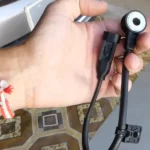
Got a check engine light and a Chevy P0141 code staring back at you? That little code could be costing you money every single day you ignore it. Read to the end — you’ll know exactly what’s wrong, what to check first, and what it’ll cost to fix it.
What Is the Chevy P0141 Code?
The Chevy P0141 code means your Engine Control Module (ECM) found a problem with the oxygen sensor heater circuit on Bank 1, Sensor 2. In plain English, the heating element inside your downstream oxygen sensor isn’t working the way it should.
Here’s the quick breakdown:
- Bank 1 = the side of your engine with cylinder #1 (driver’s side on V8 Silverados and Tahoes)
- Sensor 2 = the oxygen sensor after the catalytic converter
- Heater circuit = the internal wire that warms the sensor up fast so it can do its job
On inline engines like the Chevy Cruze or Malibu 1.4L/1.5L, Bank 1 is the only bank — so the entire engine counts.
The sensor needs heat to work. Without it, your ECM can’t verify your catalytic converter is doing its job. It’s like trying to test your smoke alarm with a dead battery.
Why Does the Heater Matter So Much?
Your oxygen sensor has to reach a specific operating temperature before it can generate a usable voltage signal. A cold sensor is basically useless.
Modern Chevy vehicles use a four-wire heated oxygen sensor (HO2S). The heater inside it gets the sensor up to operating temperature within seconds of startup — not after miles of driving. That’s a huge deal for emissions and fuel economy during cold starts.
When the heater fails, the ECM detects abnormal current flow. According to GM’s calibration parameters:
| Parameter | Minimum | Maximum | Fault Duration |
|---|---|---|---|
| Heater Current | 0.25 Amps | 1.375 Amps | 10 Seconds |
| Supply Voltage | 9.0 Volts | 16.0 Volts | Continuous |
If the current drops below 0.25 amps, the ECM sees an open circuit. Above 1.375 amps signals a short. Either way, you get the Chevy P0141 code.
Common Symptoms of a P0141 Code
You might not notice anything dramatic at first. But the effects add up fast.
Watch for these signs:
- Check engine light is on (obviously)
- Slightly worse fuel economy — up to 10–15% more fuel burned
- Failed emissions test — your readiness monitors won’t show “complete”
- Engine may run slightly rich (more fuel than needed)
- In severe cases, rough idle or hesitation
On a heavy Chevy Silverado doing highway miles, a 10–15% fuel efficiency drop hits your wallet hard every single week.
What Causes the Chevy P0141 Code?
There are four main culprits. Most of the time, it’s the sensor itself — but not always.
1. Dead Heater Element Inside the Sensor
This is the most common cause. The resistive heating element inside the sensor cracks after thousands of heat cycles. Think of it like a toaster coil that finally gives out. Most sensors have a service life of 60,000 to 100,000 miles, so high-mileage trucks and cars are prime candidates.
A healthy sensor reads 4 to 7 ohms of resistance when cold. An open (dead) element reads infinite resistance on your multimeter.
2. Damaged Wiring or Chafed Harness
The Sensor 2 harness runs underneath your vehicle — and that’s a rough neighborhood. On Chevy Silverado 4WD models, the Bank 1 Sensor 2 harness can rub against the front driveshaft if it falls out of its retaining clips. That chafing strips the insulation and causes shorts that blow fuses or damage the PCM driver.
3. Blown Fuse
Your O2 sensor heater runs through a dedicated 10-amp fuse in the underhood electrical center. Here’s where to find yours:
| Generation | Model Years | Relevant Fuses |
|---|---|---|
| GMT800 | 1999–2006 | O2 B (10A) |
| GMT900 | 2007–2013 | Fuses 11, 47 (10A) |
| K2XX | 2014–2018 | Fuses 46, 50 (10A) |
A blown fuse often means there’s a wiring short somewhere — so don’t just swap it without checking the harness.
4. Oil or Coolant Contamination
If your valve cover gasket or intake manifold seal leaks, oil can drip onto the sensor. The sensor “breathes” through its wiring harness to use outside air as a reference. Contaminants wick through the wire strands into the sensor body and poison the internal element, killing it from the inside.
How to Diagnose the Chevy P0141 Code Step by Step
You don’t need a shop to figure this out. Here’s a clear process to follow.
Step 1: Scan for Related Codes
Plug in an OBD-II scanner and check what else is stored. If you see both P0141 and P0161 (Bank 2 Sensor 2 Heater), the problem is likely a shared power source — like a blown fuse or faulty relay — rather than two dead sensors. Also check your freeze frame data to see if the fault triggered during a cold start or while driving.
Step 2: Check the Fuse First
Before touching the sensor, pull the relevant fuse and inspect it. Refer to the table above for your generation. On GMT900 trucks, a failing O2 heater relay in the underhood fuse box can also cause intermittent codes — try swapping it with an identical relay (like the horn relay) to test.
Step 3: Test Voltage at the Connector
Unplug the O2 sensor connector. With the key in the “Run” position, use a digital multimeter to probe the power wire on the harness side (usually pink or red/white on GM vehicles). You should see 12 volts. No voltage? Trace the circuit back to the fuse box.
Step 4: Measure Sensor Resistance
With the sensor unplugged, probe the two heater pins on the sensor side of the connector. Here’s how to read the results:
| Sensor Status | Resistance at 68°F | What It Means |
|---|---|---|
| Healthy | 4.0 – 7.0 Ohms | Element is fine — check wiring or PCM |
| Failed (Open) | Infinite (OL) | Broken element — replace the sensor |
| Failed (Short) | Under 2.0 Ohms | Short circuit — replace the sensor |
Step 5: Check for a Dead PCM Driver
If you’ve confirmed 12V at the connector and you’ve installed a new sensor but the code returns, the PCM’s internal heater driver may be fried. This happens when a shorted wire sends a current spike into the PCM transistor. Connect a test light between 12V and the PCM ground pin at the O2 sensor connector during a cold start. If it doesn’t pulse, the PCM driver is likely dead and you’ll need PCM replacement plus a security relearn using GM Tech2 or GDS2.
Chevy P0141 on Specific Models
Silverado and Tahoe (V8 Engines)
On the GM small-block V8 (4.8L, 5.3L, 6.0L, 6.2L), Bank 1 is the driver’s side. Sensor 2 sits on the driver’s side exhaust pipe, behind the catalytic converter. These trucks have an exposed exhaust system, which makes harness chafing and connector corrosion especially common. Always inspect the wiring clip routing near the front axle on 4WD models.
Cruze and Malibu (Turbo Engines)
On the 1.4L and 1.5L turbo engines, Sensor 2 sits further down the exhaust stream — often near the firewall or under the center of the car. Running rich from a failed O2 heater can cause carbon buildup on the turbo vanes over time, turning a $250 sensor job into a much more expensive turbo repair.
When replacing the sensor on these cars, use a 22mm O2 sensor socket and torque it to 31 lb-ft. Apply a small amount of copper anti-seize to the threads — but keep it off the sensor tip. The exhaust bungs on these smaller engines strip easily if you overtighten.
What Does It Cost to Fix Chevy P0141?
DIY cost: $50–$150 for an ACDelco or NTK sensor. Budget 30–60 minutes if the sensor isn’t seized.
Shop cost: According to RepairPal, expect to pay $326–$440 for a Silverado and $230–$312 for a Cruze. That includes diagnostics, parts, and labor.
Cost of doing nothing: Here’s where it gets ugly.
If you drive 15,000 miles a year and your fuel economy drops 10%, you’ll burn roughly 100 extra gallons of fuel. At current prices, that’s $350+ out of your pocket — just in gas. Add the risk of a catalytic converter failure (easily $1,500+), and the cheap sensor starts looking very smart.
In many states, an active check engine light also means you can’t pass your annual emissions inspection, which means fines or the cost of alternative transportation.
Don’t Use Cheap Aftermarket Sensors
This is worth emphasizing. GM’s PCM monitors heater resistance against very specific calibration values. If you install a “universal fit” sensor with the wrong resistance, the code will come right back — even though the sensor technically works.
| Part Number | Application | Cold Resistance |
|---|---|---|
| ACDelco 213-3237 | Silverado 5.3L (2009) | 5.1 Ohms |
| ACDelco 213-1527 | Silverado 6.0L (2003) | 15.8 Ohms |
| ACDelco 213-4229 | Cruze 1.4L (2014) | 9.0 Ohms |
A generic sensor rated at 10–20 ohms installed in a system calibrated for 5.1 ohms will trigger a “Heater Circuit Low” fault because the PCM won’t detect enough current flowing through the circuit. Stick with ACDelco, Denso, or NTK sensors that match your specific engine.
Quick Prevention Tips
You don’t have to wait for the light to come on.
- Check the harness routing at every oil change — especially on 4WD Silverados and Sierras
- Apply dielectric grease to the O2 sensor connector when replacing it — this blocks moisture and prevents the green corrosion that causes high-resistance faults
- Fix oil leaks early — a leaking valve cover gasket that drips onto your sensor will kill it faster than normal wear ever would
- Always use OEM-spec sensors — the $30 savings isn’t worth a return trip to the parts store
The Chevy P0141 code isn’t a “drive it and see” situation. It’s a relatively cheap fix that, if ignored, has a clear path to much more expensive damage. Check the fuse first, test the sensor second, and use the right part when you replace it.