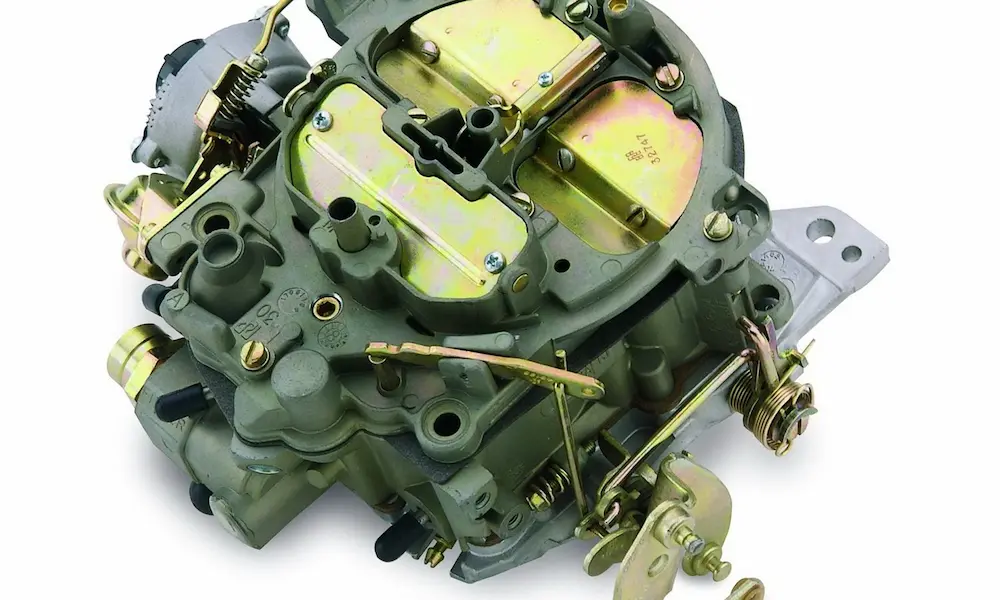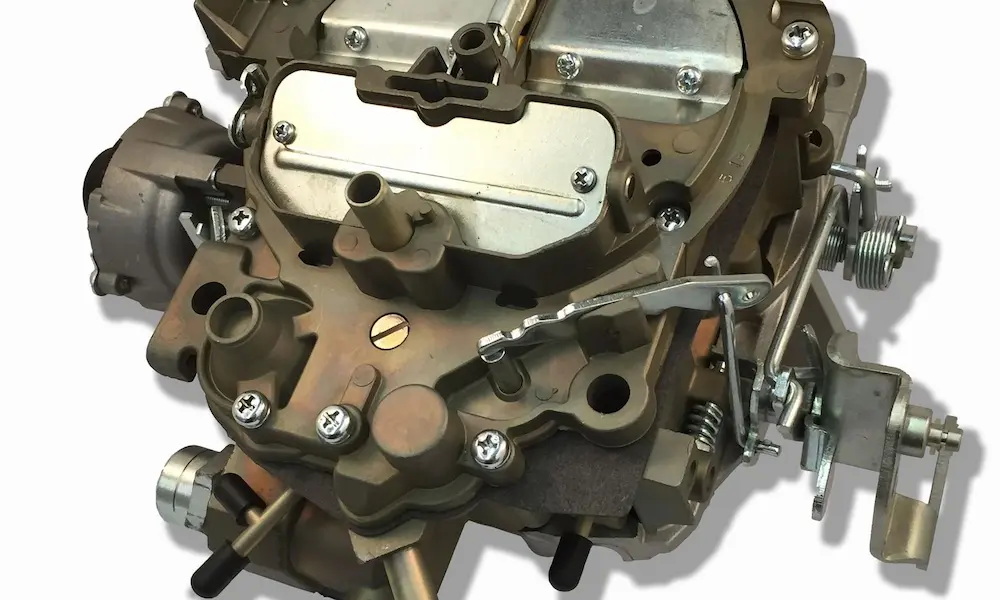
Got a Holley sitting on your bench with no paperwork? You’re probably staring at a maze of numbers, letters, and stampings that mean nothing yet. This guide breaks down exactly how Holley carburetor identification works — from List Numbers to date codes to model families. Stick around, because getting this wrong costs you real money.
Why Holley Carburetor Identification Actually Matters
Here’s the thing most people skip: there are two completely different types of numbers on a Holley carburetor, and they don’t mean the same thing.
Casting numbers are molded directly into the raw metal during manufacturing. They look like “6R” or “12R” followed by more digits. These numbers only identify the physical sub-component — the main body, throttle body, or fuel bowl. They tell you nothing about CFM rating, jetting, or what vehicle the carb fits.
List Numbers are what you actually need. Holley engraves these after final assembly, and they represent the complete bill of materials — jets, power valve, venturi size, and everything else. The List Number is your primary engineering index for sourcing any parts or rebuild kits.
Using a casting number to order a rebuild kit is a fast way to get the wrong parts delivered.
Where to Find the List Number on Your Holley
The location depends on which model you have.
Standard models (2300, 4150, 4160, 4165, 4175): Check the front face or right side of the choke tower. You’ll see a stamped number preceded by “LIST,” “R,” “L,” “0-,” or just the digits themselves. Marine carbs use five-digit List Numbers, which immediately separates them from standard automotive units with four-digit numbers.
Dominator / 4500 series: No choke tower here. Look on the top surface of the main body or the side of the throttle body.
Early “Teapot” 2140 and 4000 series: Flip it over and check the rear face of the mounting flange.
How to Read OEM Stampings From the Muscle Car Era
On original-equipment carbs installed at the factory, you’ll find a three-line stamp stack on the choke tower. Here’s what each line means:
- Top line: Vehicle manufacturer’s internal engineering part number
- Middle line: Holley List Number
- Bottom line: Production date code
The Holley Carb Hunter’s Guide notes that a classic GM application like a late-1960s Chevrolet big block shows a part number like 3886091-AN on that top line.
Ford engineering codes follow a specific decade-letter system. The letter C means 1960s, D means 1970s. So C3AE-9510-A means it was designed in 1963 for a passenger car. The “9510” is Ford’s universal carburetor designation, and the trailing letter shows the revision. One important detail from carbdoc.com: design codes represent when the part was engineered, not when it was built. A carb designed in 1963 might have been physically assembled in 1968.
Cracking the Holley Date Code System
Holley used two completely different date code formats depending on production era.
Pre-1973: Three-Digit Date Codes
Each digit tells you something specific:
- First digit: Last number of the calendar year (7 = 1967, 0 = 1970)
- Second digit: Month (1–9 = January–September, 0 = October, A = November, B = December)
- Third digit: Week of that month (1 through 5)
Post-1973: Four-Digit Julian Date Codes
Holley switched to a Julian format in 1973. This system also applies to all dealer service replacement carburetors after that year.
- First three digits: Julian day of the year (001 through 365)
- Fourth digit: Last digit of the assembly year
| Date Code Type | Example | Year | Month or Julian Day | Week |
|---|---|---|---|---|
| Three-Digit | 722 | 1967 | February | Second |
| Three-Digit | 4B2 | 1964 | December | Second |
| Three-Digit | 073 | 1970 | July | Third |
| Four-Digit | 0897 | 1977 | Day 089 (March 30) | N/A |
| Four-Digit | 1140 | 1980 | Day 114 (April 23) | N/A |
One catch: the single-digit year repeats every decade. A “8” could mean 1978, 1988, or 1998. You’ll need to look at physical clues — choke design, material finish, casting revisions — to nail down the exact decade.
Identifying Holley Model Families by Look and Design
When the stamps are worn or missing, you need to read the hardware itself.
Model 2300 — Two-Barrel Modular
This is essentially half of a four-barrel. It has one fuel bowl, one accelerator pump, and a single metering block with replaceable jets. Throttle bores measure 1.500 inches. Common applications include circle track racing (0-4412S, 500 CFM) and vintage two-barrel replacements (0-7448SA, 350 CFM).
Model 4150 — Performance Four-Barrel
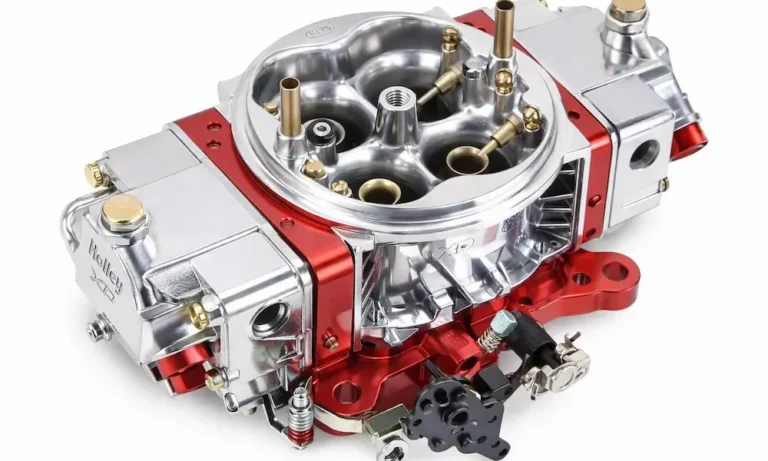
The 4150 is the classic square-bore four-barrel. Its defining feature is two metering blocks — one primary, one secondary — each with replaceable jets. This lets you tune both fuel circuits independently. Most 4150s are mechanical secondary “Double Pumpers” with accelerator pumps on both bowls. Some specialty 4150 units like the List 3310-1 actually pair that dual metering block design with a vacuum secondary instead.
Model 4160 — Street Four-Barrel
The 4160 looks nearly identical to the 4150 from a distance. The key difference? No secondary metering block. It uses a thin metering plate with fixed drilled orifices instead. Tuning the secondary means swapping the whole plate. The OnAllCylinders comparison explains this clearly: it’s a cost-effective design built for street use, not serious tuning. Almost all 4160s also use a vacuum secondary and a horizontal brass transfer tube feeding the secondary bowl from a single primary fuel inlet.
Models 4165 and 4175 — Spread-Bore Replacements
Both were designed to bolt directly onto Rochester Quadrajet and Carter Thermo-Quad intake manifolds. The giveaway is immediately obvious: tiny primary bores, massive secondary bores.
- 4165: Mechanical secondaries with dual accelerator pumps (spread-bore double pumper), primary metering block, no secondary metering block
- 4175: Vacuum secondaries, electric choke, primary metering block, secondary metering plate
Model 4500 — Dominator
This one you can’t miss. It’s massive. The Dominator features a square bolt pattern measuring 5.375 x 5.375 inches, no choke of any kind, and throttle bores from 2.00 to 2.350 inches. Secondary actuation runs through mechanical linkage mounted underneath the main body. It needs a 7.3125-inch air cleaner gasket versus the standard 5.125-inch unit every other Holley uses.
Reading Fuel Bowls and Boosters Without a Number
Physical hardware gives you strong identification clues even without visible stamps.
Cathedral vs. Side-Hung Fuel Bowls
- Cathedral bowls have an arched top with a center-mounted fuel inlet. The float pivots from the center of the fuel mass. This resists fuel slosh during hard acceleration and cornering. All 4150 and 4500 models use them.
- Side-hung bowls have a flat profile with an offset float pivot. They work perfectly for normal street driving but bog under hard lateral loads. Standard on most 4160 street carbs.
Booster Venturi Designs
| Booster Type | Design Feature | Best Application |
|---|---|---|
| Straight | Simple tube, no curve | Street/daily driving |
| Down-Leg | Curved exit, stronger vacuum signal | Performance and racing |
| Cross-Bar | Internal support bar across exit | Vintage/low-speed throttle response |
Quick Reference: List Numbers, CFM, and Applications
| List Number | Model | CFM | Secondary | Primary Jet | Application |
|---|---|---|---|---|---|
| 0-1850-2 | 4160 | 600 | Vacuum | 66 | Universal Performance |
| 0-2818-1 | 4150 | 600 | Vacuum | 65 | 1964–65 Corvette 327 |
| 0-3259-1 | 4150 | 725 | Vacuum | 68 | 1965–66 Shelby GT350 289 |
| 0-3310-1 | 4150 | 780 | Vacuum | 72 | 1965 Chevy Big Block 396/427 |
| 0-3124 | 4150 | 750 | Vacuum | 70 | Corvette/Aftermarket Performance |
The One Mistake That Kills a Rebuild
Installing a 4150-style secondary metering gasket on a 4160-style secondary metering plate blocks internal fuel passages. You’ll get severe bogging, possible flooding, or a fuel leak. This single mix-up is entirely avoidable when you confirm your List Number before ordering anything.
Always read the choke tower stamp first. Ignore casting marks for parts sourcing. Cross-reference the List Number against a verified application chart before you place a single order. That process works every single time — whether you’re rebuilding a numbers-matching Corvette carb or just getting a junkyard find back into service.