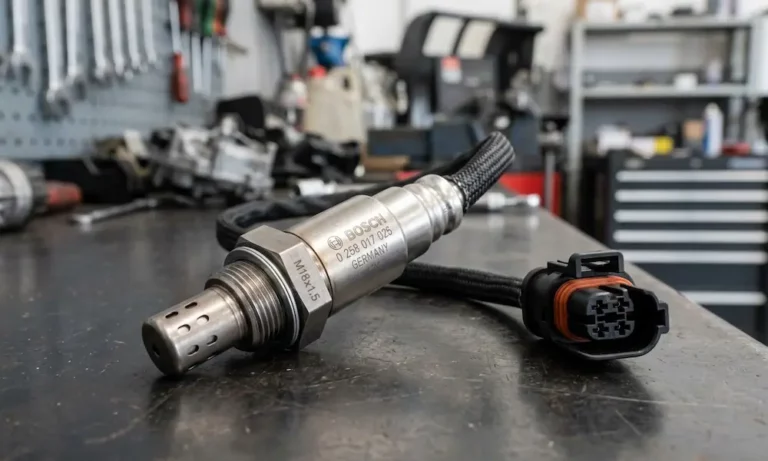
Your check engine light is on, your fuel economy has tanked, and a scan tool points to an oxygen sensor. Sound familiar? This guide walks you through exactly how to replace an O2 sensor — from reading the diagnostic code to completing the drive cycle. Stick around to the end, because the post-install steps are where most DIYers drop the ball.
What an O2 Sensor Actually Does
Your O2 sensor monitors unburned oxygen in your exhaust. It feeds that data to your engine control module (ECM), which then adjusts the fuel mixture in real time.
Most vehicles run two sensors per exhaust bank:
- Upstream (Sensor 1): Sits before the catalytic converter. Manages fuel trim.
- Downstream (Sensor 2): Sits after the catalytic converter. Monitors catalyst efficiency.
A failing sensor throws off your air-fuel ratio. That means wasted fuel, higher emissions, and a catalytic converter that wears out faster than it should.
Know Your Sensor Type Before You Buy Anything
Not all O2 sensors are the same. Grab the wrong one and you’ll be making a second trip to the parts store.
| Specification | Narrowband O2 Sensor | Wideband Air-Fuel Ratio Sensor |
|---|---|---|
| Output Type | Variable Voltage (0.1–0.9V) | Variable Amperage (Current) |
| Primary Goal | Stoichiometric Switching | Linear Ratio Measurement |
| Wire Count | 3 or 4 wires | 5 or 6 wires |
| Common Position | Upstream & Downstream | Primarily Upstream |
| Found On | Most standard vehicles | Modern/high-performance vehicles |
These two types use completely different signal systems. You can’t swap one for the other. Always confirm your replacement matches the original spec.
Read the Diagnostic Code First
Before you touch a wrench, plug in an OBD-II scanner and read the code. The code tells you exactly which sensor failed. Skipping this step means you might replace the wrong one.
Here’s how to decode the location:
| DTC Code | Sensor Location | Function |
|---|---|---|
| P0130 | Bank 1, Sensor 1 | Upstream fuel trim |
| P0136 | Bank 1, Sensor 2 | Catalytic converter monitoring |
| P0150 | Bank 2, Sensor 1 | Upstream fuel trim |
| P0171 | Bank 1 System Lean | Air/fuel mixture imbalance |
| P0175 | Bank 2 System Rich | Air/fuel mixture imbalance |
Bank 1 is always the side of the engine with Cylinder 1. On V6 and V8 engines, Bank 2 is the opposite side. On inline engines, there’s only one bank.
Pro tip: Use a scan tool that shows live sensor data. Confirm the suspect sensor is actually flat-lining before you pull it.
Tools You’ll Need
O2 sensors live in a brutal environment — heat, road salt, moisture. Standard sockets strip them fast. Get the right gear before you start.
| Tool | Why You Need It |
|---|---|
| Hydraulic floor jack + jack stands | Safe under-vehicle access |
| 22mm oxygen sensor socket (slotted) | Accommodates the wire harness |
| Box-end wrench (7/8 inch) | Better torque in tight spots |
| Penetrating oil (PB Blaster or equivalent) | Breaks down rust and corrosion |
| Thread chaser (18mm or 12mm) | Cleans bung threads before install |
| Torque wrench | Hits exact spec — no guessing |
| MAPP gas torch or induction heater | Frees seized sensors without damage |
| Safety goggles + nitrile gloves | Protects eyes from rust, skin from chemicals |
Walker Products’ installation guide recommends having all of these on hand before you start — not halfway through the job.
Safety Steps Before You Begin
Don’t skip this part.
- Let the exhaust cool for at least one hour. Exhaust components hit temperatures that cause instant third-degree burns.
- Work on a flat, concrete surface only. Jack stands sink in dirt and asphalt.
- Wear goggles. Rust flakes fall directly into your eyes when you’re working underneath.
- Keep the wire harness clear of exhaust manifolds and moving parts like CV axles.
How to Remove the Old O2 Sensor
Step 1: Disconnect the Electrical Connector
Follow the sensor’s wire to where it plugs into the vehicle harness. Press the locking tab and pull the connector apart. Use a flathead screwdriver if road grime has jammed the tab.
Don’t try to unscrew the sensor while it’s still connected. Rotating the sensor while plugged in twists and destroys the internal wiring — both in the sensor and your car’s harness.
Step 2: Apply Penetrating Oil
Spray penetrating oil around the base of the sensor where it threads into the exhaust. Let it soak for 10–15 minutes. For stubborn cases, lightly tap the hex head with a hammer to help the oil wick deeper into the threads.
Step 3: Break It Loose
Use the slotted 22mm sensor socket with a breaker bar. Apply steady, deliberate force — not a series of jerks. If the sensor won’t move, don’t keep cranking. You’ll snap it off in the bung, which turns a 30-minute job into a two-hour nightmare.
Step 4: Handle a Seized Sensor
If it’s truly stuck, heat is your best option. Using a MAPP gas torch, heat the metal surrounding the bung until it glows dull red. Apply a wax crayon to the heated threads — the wax melts and wicks in as a lubricant where oil would just burn off.
No open flame? Induction heating tools like the Mini-Ductor heat the metal using a magnetic field with zero open flame. This is the safer choice when you’re working near fuel or brake lines.
If the sensor snapped flush, you’ll need to drill it out, collapse the remaining ring with a chisel, then restore the threads with an 18mm x 1.5 pitch tap.
What the Old Sensor Tells You
Before tossing the old sensor, inspect the tip. It’s a cheap diagnostic window into your engine’s health.
| Sensor Tip Appearance | What It Suggests |
|---|---|
| Light tan or gray | Normal — healthy combustion |
| Heavy black soot | Running too rich — check injectors or air filter |
| White, chalky deposits | Silicon contamination from non-sensor-safe sealants |
| White, sandy coating | Coolant leak — possible head gasket failure |
| Dark brown, oily crust | Oil burning — check rings or valve seals |
One note on cleaning: don’t bother. The ceramic element is porous and absorbs contaminants. Carb cleaner can’t reach it through the steel shroud, and a wire brush damages the platinum coating. If it’s contaminated, replace it.
How to Install the New O2 Sensor
Step 1: Match the New Sensor
Hold the new sensor next to the old one. Confirm the connector type, wire count, and lead wire length match exactly. Also confirm you’ve got the right sensor type — wideband vs. narrowband.
Step 2: Apply Anti-Seize (If Needed)
Many replacement sensors come pre-coated with anti-seize on the threads. If yours doesn’t, apply a thin layer of oxygen sensor-safe anti-seize compound to the threads only. Keep it completely away from the sensing tip and the holes in the shroud. Oil or grease on the sensing element kills the sensor immediately.
Step 3: Thread It In By Hand First
Hand-thread the sensor into the bung for the first two turns. If you feel resistance early, stop. Back it out and run a thread chaser through the bung to clean the threads. Forcing a cross-threaded sensor strips the bung — and replacing an exhaust bung is significantly worse than replacing a sensor.
Step 4: Torque to Spec
| Thread Size | Torque Specification |
|---|---|
| 18mm (standard) | 26–33 ft-lbs (35–45 Nm) |
| 12mm (compact) | 13.2–17 ft-lbs (18–23 Nm) |
Use a torque wrench. Never use an impact wrench — the vibration shatters the ceramic element inside the housing.
Step 5: Route and Connect the Wiring
Run the sensor wire along the original factory path. Use high-temp zip ties to keep it at least one inch away from exhaust components and moving parts. Plug the connector in until it clicks.
Understanding your sensor’s wiring helps here. Standard four-wire sensors use a pair of white wires for the heater circuit, black for signal output, and gray for signal ground. Don’t use dielectric grease on the connector — it can block the reference air path that runs through the wire strands.
Clearing Codes and Running the Drive Cycle
Clear the Codes
Use an OBD-II scan tool to clear the diagnostic trouble codes. Make sure pending codes are cleared too, not just active ones. Disconnecting the battery for 15–30 minutes also works, but resets your clock, radio presets, and transmission shift memory.
Complete a Drive Cycle
Your car won’t pass an emissions test until its readiness monitors show “Complete.” Those monitors only run after a proper drive cycle. Here’s the sequence:
- Cold start: Let the car sit at least 8 hours. Start it and idle for 2 minutes to activate the heater circuits and enter closed-loop operation.
- City driving: Drive in stop-and-go conditions at 25–35 mph for about 15 minutes. Tests sensor response to throttle changes.
- Highway cruise: Hold a steady 55–60 mph for 10–15 minutes. This runs the catalyst monitor by letting the downstream sensor verify converter efficiency.
- Deceleration: Coast down from 60 mph to 20 mph without braking. Tests fuel cut-off response.
If the check engine light returns during the drive cycle, the sensor failure was likely a symptom — not the root cause. A vacuum leak, failing fuel pressure regulator, or dying catalytic converter can trigger the same codes even after a fresh sensor install.
How Long Should an O2 Sensor Last?
Most oxygen sensors last between 60,000 and 100,000 miles. Heated four-wire sensors generally outlast older unheated designs. Oil burning, coolant leaks, or contaminated fuel shortens that lifespan fast.
If your sensor fails before 60,000 miles, go back to the sensor tip inspection. An underlying engine issue is probably poisoning the sensor. Fix that first, or you’ll be back doing this job again in six months.