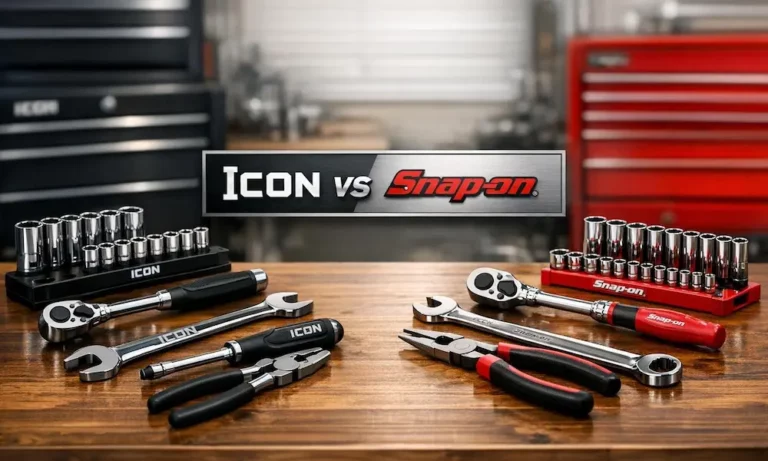
You’re staring at a $142 Snap-on ratchet and a $37.99 Icon sitting right next to it. Same job. Same warranty. One costs four times more. So what’s the real difference? This breakdown covers everything — steel, ratchet teeth, wrenches, warranties, and the money side nobody talks about enough. Stick around.
The Two Brands: A Quick Background
Snap-on has been around since 1920. Joseph Johnson and William Seidemann built it on one clever idea: ten sockets that snap onto five handles. That “5 do the work of 50” concept changed how mechanics worked forever.
Harbor Freight launched Icon around 2018 as its premium line for working professionals. It’s built on Taiwanese and Chinese manufacturing — not a dirty secret, just a different strategy. Taiwan, specifically, is a global powerhouse for high-end tool production with serious ISO credentials to back it up.
| Feature | Snap-on | Icon (Harbor Freight) |
|---|---|---|
| Founded | 1920 | ~2018 (HF since 1977) |
| HQ | Kenosha, WI | Calabasas, CA |
| Business Model | Mobile franchise vans | 1,500+ retail stores |
| Ownership | Public (NYSE: SNA) | Private |
Where Each Tool Gets Made
Snap-on manufactures across 15 U.S. facilities. Wrenches come out of Elizabethton, Tennessee. Sockets and pliers ship from Milwaukee. Power tools? Murphy, North Carolina. It’s a tightly coordinated domestic network — and yes, that costs money.
Icon sources most of its wrenches and sockets from Taiwan, with some components from China. Harbor Freight runs in-house testing labs to keep quality consistent. The result? Professional-spec tools at retail prices.
Neither approach is wrong. They’re just solving different problems.
The Steel Situation: Chrome Vanadium vs Proprietary Alloy
Here’s where things get genuinely interesting.
Snap-on uses a proprietary heat-treated alloy that’s engineered specifically for high-torque environments. It lets them make thinner, lighter tools without sacrificing strength. The exact formula is a trade secret, but the result is a tool that resists deformation across decades of daily industrial use.
Icon uses Chrome Vanadium steel — a legitimate, globally respected alloy known for toughness, impact resistance, and corrosion resistance. Some high-stress Icon components step up to Chrome Molybdenum, which performs even better under impact loads.
| Material | Snap-on Proprietary Alloy | Icon Chrome Vanadium |
|---|---|---|
| Torque Resistance | Exceptional — thin-wall design | Very good — slightly thicker profile |
| Corrosion Resistance | Premium nickel-chrome plating | Mirror-polished chrome |
| Long-term Wear | High resistance to metal fatigue | Slightly faster wear in industrial cycles |
| Weight-to-Strength | Optimized for slim profiles | Good, but often bulkier |
Real-world takeaway: Snap-on steel is better. But in head-to-head break tests, Icon ratchets have occasionally matched or exceeded Snap-on in raw torque before failure. The difference shows up more over years of daily hard use than in a single stress test.
Ratchets: Where the Icon vs Snap-on Debate Gets Loudest
This is the category everyone argues about — and for good reason.
Snap-on’s Dual 80 ratchets use 80 teeth and two pawls engaging simultaneously. That gives you a 4.5-degree arc swing — critical in tight spaces. The real magic, though, is the low back-drag. When you’re trying to loosen a fastener that keeps spinning, a ratchet with less back-drag keeps engagement. Snap-on’s Dual 80 is famously smooth here.
Icon’s G2 ratchets push back with a 90-tooth mechanism and a 4-degree arc swing. On paper, more teeth and tighter arc sounds like a win. In practice, some technicians report slightly higher back-drag and occasional “ghosting” — slipping on loose fasteners — especially without regular lubrication. The G2 also added a fully sealed head for better contaminant resistance.
| Spec | Snap-on Dual 80 | Icon G2 |
|---|---|---|
| Price (3/8-inch) | ~$142.00 | ~$37.99 |
| Tooth Count | 80 | 90 |
| Arc Swing | 4.5 degrees | 4.0 degrees |
| Head Dimensions | Identical | Identical |
| Handle Length | ~7-7/16 inches | ~7-5/8 inches |
The feel difference is real. Snap-on ratchets have a satisfying mechanical click and tactile precision that Icon doesn’t fully replicate. But whether that difference justifies $104 more per ratchet is a question only your wallet can answer.
Wrenches: Flank Drive vs Non-Slip Grip
Snap-on’s Flank Drive technology shifts contact away from a fastener’s corners onto its flat faces. More grip. Less rounding. It’s a genuinely smart design that shines on rusted or previously mangled hardware.
Icon’s non-slip grip geometry works the same principle. Independent testing by Royalty Auto Service showed Icon wrenches gripping and turning fasteners even after their corners were intentionally removed. That’s not a consolation prize — that’s genuinely impressive performance.
The practical difference? Snap-on wrenches are thinner. In a cramped modern engine bay, that slim beam profile matters. Some technicians report that Icon’s slightly thicker box ends can limit access in tight spots.
| Feature | Snap-on 13-Piece Metric Set | Icon 14-Piece Metric Set |
|---|---|---|
| Price | ~$685.00 | ~$119.99 |
| Size Range | 10mm–22mm | 6mm–19mm |
| Fastener Grip Tech | Flank Drive | Non-Slip Grip |
| Beam Profile | Contoured, thin | Standard, polished |
| Finish | Nickel-chrome plating | Mirror-polished chrome |
For $119.99, Icon gives you a full professional wrench set. You could buy nearly six of them for the price of one Snap-on set. Even if you account for Snap-on’s superior metallurgy, that math is hard to ignore.
Torque Wrenches: The Accuracy Surprise
Here’s a stat that raises eyebrows: head-to-head accuracy testing by Hagerty Media found that Icon torque wrenches can actually be more accurate out of the box than Snap-on equivalents across a 50 to 250 ft-lb range.
Icon showed a tighter spread between high and low readings in those tests.
The caveat? Long-term drift. After thousands of cycles, Snap-on’s internal mechanisms hold calibration more reliably. And Snap-on’s tool truck infrastructure supports certified periodic calibration — a non-negotiable requirement for fleet maintenance shops and many professional certifications.
For weekend work or general automotive use, Icon’s out-of-box accuracy is genuinely impressive. For certified shop environments, Snap-on’s calibration ecosystem still earns its cost.
Socket Sets: Mind the Gaps
One area where Icon shows a clear limitation is socket coverage. Snap-on provides a complete range. Icon trims less common sizes to hit a lower price point.
| Drive Type | Snap-on 3/8-inch | Icon 3/8-inch |
|---|---|---|
| SAE Sockets | 1/4 to 1-inch (full increments) | 1/4 to 7/8-inch (missing 9/32, 15/16, 1″) |
| Metric Sockets | 6mm–24mm (complete) | 8mm–19mm (missing 6, 7, 20–24mm) |
| Max Ratchet Length | 19.5-inch flex head | 14-inch flex head |
Working on European cars or heavy-duty vehicles? Those missing metric sizes will cost you jobs. Snap-on’s commitment to a complete catalog is one of its strongest practical arguments for professional daily use.
The Money Reality Nobody Wants to Talk About
Snap-on isn’t just a tool brand — it’s also a finance company. The weekly truck account lets you grab tools and pay in installments. Short-term purchases can be interest-free. Bigger items — cabinets, diagnostic equipment — go through Snap-on Credit at rates between 9.9% and 28.9% depending on your credit.
The result? Many young technicians start their careers carrying $20,000 to $50,000 in tool debt. That can take a decade to pay off.
Icon’s model is simple: walk into any of 1,500+ Harbor Freight stores, pay retail, and leave with tools. A complete professional starter kit from Icon runs under $5,500. No interest. No weekly payment anxiety.
| Factor | Snap-on | Icon |
|---|---|---|
| Purchase Method | Weekly franchise van | Retail store or online |
| Financing | Truck account / Snap-on Credit | Cash, card, HF card |
| Interest Risk | 9.9%–28.9% on larger items | None |
| Total Ownership Cost | High (premium + interest) | Low |
| Replacement Access | Wait for next truck visit | Walk-in same day |
Warranty: Which Is Actually Easier?
Both brands offer a lifetime warranty on hand tools. The difference is in how you use it.
Snap-on: You wait for the weekly truck. Hand over the broken tool, get a replacement from the franchisee’s stock. If they don’t have it, you wait another week. Straightforward if your dealer is reliable — frustrating if they’re not.
Icon: Walk into any Harbor Freight location, swap the broken tool if it’s in stock, and walk out. With 1,500+ stores, that’s a lot of coverage. The catch? Buying individual replacement sockets still involves calling customer support and waiting for shipping — less seamless than Snap-on’s one-for-one swap of individual pieces.
Snap-on also sells every socket and wrench individually. Need one 10mm to replace a lost one? Done, off the truck. Icon’s individual piece replacement process is improving but isn’t there yet.
The Hybrid Toolbox Strategy
Here’s what smart technicians are actually doing right now: they’re not choosing one brand. They’re building a hybrid toolbox.
- Snap-on for primary ratchets, specialty pliers, and diagnostic tools where precision and feel matter daily
- Icon for wrenches, standard socket sets, and storage where the value gap is hardest to justify paying past
This approach delivers a high-performance kit without the career-defining debt. And with YouTube and TikTok full of real-world performance comparisons, the old brand prestige argument is getting harder to sell. Modern technicians value financial independence as much as mechanical refinement — and there’s nothing wrong with that.
The icon vs snap-on debate doesn’t have a clean winner. It has a smart answer: know which tool earns its premium, and spend accordingly everywhere else.