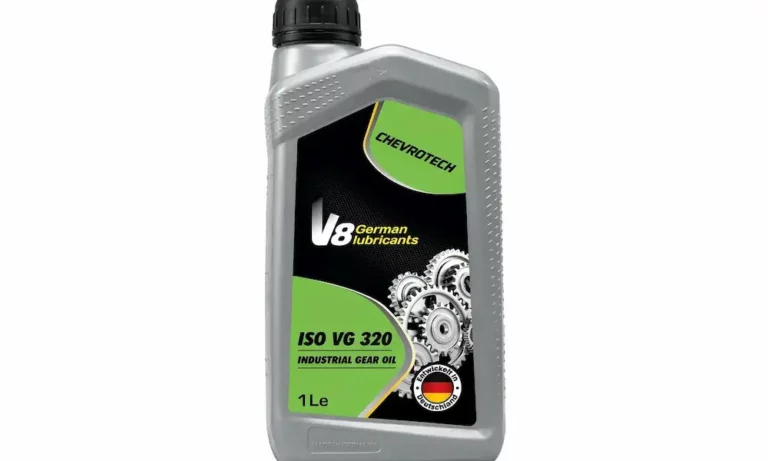
Got a gearbox that calls for ISO 320 gear oil but you’re staring at a shelf full of AGMA, SAE, and synthetic options? You’re in the right place. This guide breaks down every equivalent, explains the differences between mineral and synthetic formulations, and helps you pick the right product for your specific application. Read to the end — the compatibility warnings alone could save you a costly flush.
What Is ISO 320 Gear Oil?
ISO 320 is a viscosity grade defined by the ISO Viscosity Grade system, introduced in 1975 by the International Standards Organization alongside ASTM. It classifies lubricants by their kinematic viscosity at 40°C (104°F).
For a gear oil to qualify as ISO 320, its viscosity at 40°C must fall between 288 and 352 centistokes, with 320 cSt as the midpoint. That ±10% tolerance isn’t arbitrary — it gives engineers the confidence to calculate load-carrying capacity and heat dissipation with real precision.
This grade sits in the thick end of the industrial spectrum. It’s built for high-load, slow-speed applications where a robust lubricating film is the only thing standing between your gear teeth and metal-to-metal contact.
ISO 320 Gear Oil Equivalent: AGMA, SAE & Cross-Reference Chart
If your equipment manual lists an AGMA or SAE grade instead of ISO, here’s how they line up. Understanding the relationship between these classification systems is essential before you buy anything.
| ISO Grade | AGMA Grade | SAE Gear Grade | SAE Motor Grade | SUS at 100°F |
|---|---|---|---|---|
| ISO VG 320 | 6 or 6 EP | 140 | 60 | 1,600–1,700 |
A few things worth noting from this viscosity comparison chart:
- AGMA 6 and ISO 320 share identical viscosity ranges — they’re the same spec, different naming convention
- AGMA 6 EP means the oil contains extreme-pressure additives (sulfur/phosphorus compounds)
- AGMA 6 S indicates a synthetic base stock
- SAE 90 gear oil is NOT equivalent to ISO 320 — it aligns with ISO 220, which is significantly thinner
That last point trips up a lot of technicians moving between automotive and industrial settings. Using SAE 90 where ISO 320 is required means inadequate film thickness under load.
Mineral vs. Synthetic ISO 320: Which One Do You Need?
The base stock chemistry changes everything — service life, temperature range, and compatibility. Here’s the practical breakdown from performance comparison data:
| Factor | Mineral ISO 320 | Synthetic PAO ISO 320 | Synthetic PAG ISO 320 |
|---|---|---|---|
| Viscosity Index | 90–100 | 150–165 | 200–237 |
| Max Bulk Temp | 80°C | 120°C | 149°C |
| Drain Interval | 2,000–4,000 hrs | 8,000+ hrs | Up to 25,000 hrs |
| Cold Start | Moderate | Excellent | Excellent |
| Mineral Oil Compatibility | N/A | Generally compatible | Not compatible |
| Cost per Quart | $8–$15 | $15–$25 | Higher |
The Arrhenius rate rule explains why temperature matters so much here: every 10°C rise above 80°C doubles the oxidation rate of mineral oil, cutting its service life in half. If your gearbox runs hot, mineral oil is fighting a losing battle.
Top Mineral ISO 320 Gear Oil Products
Phillips 66 Extra Duty Gear Oil 320
A heavy-duty mineral EP oil built for enclosed gear drives under severe service. Its “clean gear” additive technology minimizes deposit formation — a real advantage in dusty or contaminated environments like mining sites.
Key specs from the Phillips 66 Extra Duty 320 datasheet:
- Flash point: 489°F (254°C)
- Pour point: 0°F (-18°C)
- Viscosity index: 94
- Four-ball weld load: 250 kgf (ASTM D2783)
- Timken OK load: 60 lbs
There’s also a mist-suppression variant — Extra Duty 320M — designed specifically for underground mining where oil fog is a safety hazard.
Chevron Meropa 320
One of the most widely used mineral gear oils in U.S. industry. The Chevron Meropa 320 stands out for its water demulsibility — it sheds water fast, which matters in paper mills and marine applications where moisture contamination is constant.
- Viscosity index: 95
- Timken OK load: 65 lbs
- FZG pass stage: 12 (ASTM D5182)
- Pour point: 0°F (-18°C)
That FZG Stage 12 rating means it passes the highest standard scuffing test, protecting gear tooth surfaces under severe stress.
Shell Omala S2 GX 320
The Shell Omala S2 GX 320 replaced the older S2 G with an improved additive package. It carries Siemens AG approval for Flender gearboxes and delivers up to 90% less bearing wear than standard test limits. It handles bulk oil temps up to 100°C and resists micropitting even when solid contaminants are present.
Mobilgear 600 XP 320
A balanced formulation from Mobil’s gear oil lineup that protects both gears and bearings simultaneously. Pour point of -24°C and strong seal compatibility make it a reliable choice for paper and steel industry applications where unplanned downtime is expensive.
Top Synthetic ISO 320 Gear Oil Products
PAO Synthetics: Best for Extreme Temperatures
PAO (Polyalphaolefin) synthetics are the most versatile option. They’re largely compatible with mineral oils and standard seals, which makes transitions easier.
Phillips 66 Syncon EP Plus 320
The Syncon EP Plus is a PAO-based EP oil built for extreme temperature gear drives. Its four-ball weld load of 315 kgf beats the mineral Extra Duty 320 by 65 kgf — a meaningful difference in mining and construction applications.
- Viscosity index: 156
- Pour point: -47°F (-44°C)
- Flash point: 480°F (249°C)
Chevron Meropa Synthetic EP 320
The Meropa Synthetic EP operates from -50°F to 300°F with a viscosity index of 165. Its low traction coefficient reduces internal fluid friction, which translates directly to lower energy consumption. It’s a go-to for wind turbines and remote gearboxes where extended drain intervals aren’t optional — they’re a necessity.
Shell Omala S4 GX 320
Approved by SEW and Flender, the Shell Omala S4 GX handles bulk temperatures up to 120°C — 40 degrees higher than the mineral threshold. It resists sludge formation and protects against shock loads in planetary drives, making it the preferred choice for cement kilns and mining equipment with long maintenance cycles.
PAG Synthetics: Best for Worm Gears
PAG (Polyalkylene Glycol) oils offer exceptional lubricity and thermal stability. They’re the primary choice for worm gear applications where sliding contact between a steel worm and bronze gear generates intense friction.
Phillips 66 Philsyn PG 320
The Philsyn PG 320 has a viscosity index of 237 — the highest of any product in this comparison. Its flash point hits 520°F (271°C) and pour point drops to -49°F (-45°C).
Critical warning: Philsyn PG is not compatible with petroleum oils. Mixing them creates sludge that can catastrophically interfere with lubrication. A complete flush and drain is mandatory before switching.
Shell Omala S4 WE 320
Specifically formulated for industrial worm drives, the Shell Omala S4 WE delivers up to 15% energy efficiency improvement over mineral oils. It reduces operating temperatures in rig testing and provides high micropitting resistance that extends bronze gear life. Works with nitrile and Viton seals.
How ISO 320 Gear Oil Is Tested
These aren’t marketing claims — they’re standardized lab tests that simulate real mechanical stress.
Four-Ball EP Test (ASTM D2783): Three steel balls are held in a cradle while a fourth rotates against them under increasing load. The “weld load” is where the film fails and the balls fuse. Mineral ISO 320 oils typically hit 250 kgf; PAO synthetics reach 315 kgf or higher.
FZG Scuffing Test (ASTM D5182): Gears run through 12 load stages at set speeds and temperatures. Stage 12 is the top rating and indicates excellent anti-scuff protection. Most premium ISO 320 oils — including Chevron Meropa and Shell Omala — achieve Stage 12.
Copper Corrosion Test (ASTM D130): A copper strip is immersed in the oil at high temperature. A “1a” result means no significant corrosion — critical for gearboxes with bronze or brass components. All major ISO 320 products covered here achieve 1a or 1b.
Industry Applications for ISO 320 Gear Oil
Different industries stress gear oil in different ways. Here’s where ISO 320 shows up most:
| Industry | Application | Recommended Type |
|---|---|---|
| Mining & Quarry | Crushers, conveyors, shovels | Mineral EP with mist suppression |
| Cement Manufacturing | Kilns, grinders | Synthetic PAO for heat resistance |
| Sugar Mills | Crushing equipment | Mineral or PAO EP |
| Wind Energy | Main gearboxes, yaw drives | PAO or PAG synthetic |
| Food & Pharma | Conveyors, mixers | NSF H1 certified food-grade |
| Paper & Steel | Enclosed gear drives | Mineral or PAO EP |
Food and pharmaceutical applications require NSF H1 certification — these oils are formulated for incidental food contact and are often certified Kosher, Halal, and Pareve.
Switching Oils: What You Need to Know Before You Drain
Mineral to PAO Synthetic
This transition is relatively straightforward since PAO and mineral oils are generally compatible. That said, do a complete drain and flush anyway. Residual mineral oil dilutes the synthetic’s performance benefits and carries old contaminants into the fresh charge.
Switching to PAG
This is where people get into trouble. PAG oils won’t mix with mineral or PAO oils — period. Any residue causes operational problems. The correct procedure:
- Drain the existing oil completely
- Flush the system with a small quantity of the new PAG oil under no-load conditions
- Drain the flush oil
- Fill with fresh PAG
- Replace seals that have had long-term mineral oil exposure — they may leak after the switch
Monitoring Oil Life
Track Total Acid Number (TAN) to know when your oil is done. As oxidation progresses, the oil becomes more acidic. A rising TAN reading is your signal to change before gear surfaces start taking damage.
Typical service intervals by oil type:
- Mineral: 2,000–4,000 operating hours
- Standard synthetic PAO: 8,000+ hours
- Premium PAG synthetic: Up to 25,000 hours in controlled environments
The ROI Case for Synthetic ISO 320
Synthetic oils cost more upfront — roughly $15–$25 per quart versus $8–$15 for mineral. But the total cost of ownership math often favors synthetic in demanding applications:
- 40% reduction in transmission and gear failures
- 25% extension in component life
- 15% improvement in energy efficiency
- 30–50% lower overall maintenance and repair costs
Longer drain intervals also mean less waste oil to dispose of — a real operational and environmental benefit when you’re running dozens of gearboxes across a plant floor.
The right ISO 320 gear oil equivalent comes down to three things: your operating temperature, your maintenance schedule, and your base stock compatibility requirements. Match those three factors and you’ll have the right product for the job.