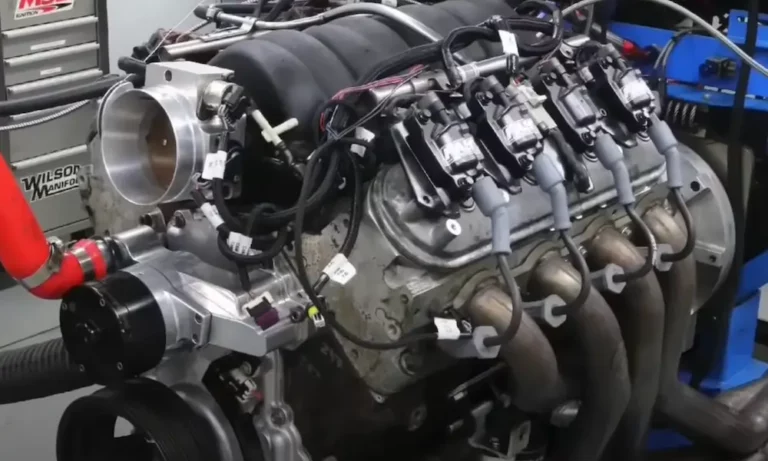
Picking the right V8 engine is trickier than most people think. The big block vs small block debate trips up a lot of enthusiasts — and the answer isn’t just about size. This guide breaks down exactly what separates these two engine families, how they perform differently, and which one actually fits your build. Stick around, because the answer might surprise you.
It’s Not About Displacement — It’s About Bore Spacing
Most people assume a big block just means a bigger engine. That’s not quite right.
The real difference comes down to bore center distance — the measurement between the centerlines of adjacent cylinder bores. A bigger gap between bores means more room for larger pistons and thicker cylinder walls.
Here’s the general rule of thumb:
- Big block: bore center distance over 4.5 inches
- Small block: bore center distance under 4.5 inches
Displacement is a secondary clue. Small blocks typically run 221 to 400 cubic inches. Big blocks usually start at 400 cubic inches and climb past 500. But even that line gets blurry. Oldsmobile built a 403 cubic inch V8 it called a small block. Chevrolet’s 396 is a big block through and through — because it sits in a physically larger, heavier block casting.
Size and Weight: The Numbers Don’t Lie
The physical dimensions tell the story fast:
| Engine Parameter | Small Block | Big Block |
|---|---|---|
| Bore Center Distance | Under 4.5 inches | Over 4.5 inches |
| Displacement | Mostly under 400 cu in | Mostly over 400 cu in |
| Typical Weight | 425–575 lbs | 600–750+ lbs |
| Torque Profile | Peak at mid-high RPM | Peak at low RPM |
| Valvetrain Design | Compact, often vertical | Large valves, often canted |
That extra 100 to 150 pounds in a big block isn’t wasted mass. Big blocks need it — thicker webbing, beefier main bearing caps, and larger crankshafts are necessary to handle the torque they produce.
A Quick History: How These Terms Were Born
Neither term showed up in early automotive catalogs. Both grew organically out of the 1950s horsepower race, when manufacturers realized they needed two distinct powerplants — one for lighter, sportier cars and one for heavy-duty work.
Chevy’s “Mighty Mouse” Small Block
In 1955, Chevrolet dropped the 265 cubic inch Turbo-Fire V8 into the Corvette and Bel Air. It was compact, light, and surprisingly potent. The engine community nicknamed it “Mighty Mouse” because it punched way above its weight class.
By 1957, the small block grew to 283 cubic inches and hit a massive milestone: one horsepower per cubic inch with Rochester mechanical fuel injection. That 4.4-inch bore spacing stayed locked in for nearly 50 years of production.
The “Rat” Motor Era
Chevy’s big blocks got their own nickname — Rat motors, a nod to contrast with the “Mouse” small blocks. The Mark IV series — 396, 427, and 454 — used canted-valve “porcupine” cylinder heads that flowed massive amounts of air. These engines defined the muscle car era and made big blocks synonymous with quarter-mile dominance.
Ford’s V8 Lineup: More Complex Than You Think
Ford didn’t follow a clean two-family path. Their V8 history involves multiple distinct architectures that don’t always fit the small block vs big block binary neatly.
| Ford Engine Family | Architecture | Bore Spacing | Typical Application |
|---|---|---|---|
| Windsor (289/302) | Small Block | 4.38 inches | Mustang, Falcon, F-150 |
| Cleveland (351C) | Medium Block | 4.38 inches | Mach 1, Pantera |
| FE Series (390/427) | Big Block | 4.63 inches | Thunderbird, Galaxy, Cobra |
| 385 Series (429/460) | Big Block | 4.90 inches | Lincoln, F-250, Boss 429 |
The Windsor Small Block
The Windsor family — named after the Ontario factory where they were built — includes the 221, 260, 289, 302, and 351W. The 351 Windsor sits at the top of this lineage, featuring a taller deck height to accommodate a longer stroke while keeping the small block bellhousing pattern.
The Cleveland’s Identity Crisis
The 351 Cleveland shares the Windsor’s 4.38-inch bore spacing but uses massive canted-valve heads with huge ports. Many builders call it a medium block. It powered the Boss 351 Mustang and earned a cult following for its airflow potential.
The 400 and 351M (Modified) sit in an odd middle ground — physically larger than other small blocks but grouped with them because of bore spacing. Classic blurred lines.
Ford’s True Big Blocks: FE and 385 Series
The FE series — 390, 427, and 428 — carried Ford through the 1960s muscle wars with a 4.63-inch bore spacing and over 600 pounds of cast iron muscle.
The 385 series followed in 1968 with 429 and 460 cubic inch displacements. Its 4.90-inch bore spacing made it the widest of Ford’s V8 families and the engine of choice for heavy luxury cars and work trucks through the 1970s.
Chrysler’s B, RB, and the Legendary Hemi
Chrysler’s engine lineup split cleanly into the LA small block series and the B/RB big block families.
| Chrysler Family | Architecture | Deck Height | Bore Spacing | Notable Feature |
|---|---|---|---|---|
| LA Series | Small Block | 9.12 inches | 4.46 inches | Lightweight, compact wedge |
| B Series | Big Block | 9.98 inches | 4.80 inches | Low-deck performance (383) |
| RB Series | Big Block | 10.725 inches | 4.80 inches | Long-stroke torque (440) |
| Gen II Hemi | Big Block | 10.725 inches | 4.80 inches | Hemispherical heads, 425+ HP |
The LA series used thin-wall casting techniques to drop about 50 pounds compared to earlier Chrysler V8s. The 340 became a high-revving monster in compact muscle cars like the Plymouth Duster.
The 440 RB topped Chrysler’s big block lineup with the optional “Six Pack” — three two-barrel carburetors producing up to 390 horsepower. Pure torque royalty.
And then there’s the 426 Hemi. It shares the RB’s bore spacing but deserves its own category entirely. The hemispherical combustion chambers allowed massive valves and a centered spark plug, creating airflow efficiency that was so dominant NASCAR initially banned it. That’s not a typo.
Torque vs RPM: The Real Performance Difference
Choosing between big block vs small block means choosing a performance philosophy.
Why Big Blocks Hit Hard Off the Line
Big blocks move air and fuel in large quantities. Their longer strokes act like a longer lever on the crankshaft — producing what gearheads call “stump-pulling” torque at low RPM. This made them the default choice for trucks, towing rigs, and drag cars.
The tradeoff? Heavy internal parts create serious rotational inertia. Most production big blocks top out effectively below 5,500 RPM. Each combustion event is enormous, but they don’t happen as frequently.
Why Small Blocks Rev and Handle Better
Small blocks use lighter pistons, shorter strokes, and leaner internals. Less rotating mass means the engine spins up fast. Many small blocks comfortably reach 6,500 to 7,500 RPM, generating peak horsepower through sheer combustion frequency.
That lighter overall weight also keeps the front end from getting nose-heavy. Cars like the Corvette and early Mustang used small blocks specifically to chase a near-50/50 weight distribution — a huge advantage for handling and braking.
The Real Cost of Running a Big Block
Budget matters. Here’s how the two engine families compare on the dollar-for-dollar scale.
| Modification Item | Small Block | Big Block |
|---|---|---|
| Parts Availability | Extremely high | High / Specialty |
| Average Part Cost | Lower ($) | Higher ($$) |
| Machine Shop Fees | Standard | Often higher |
| Drivetrain Upgrades | Standard | Heavy-duty required |
| Fuel Operating Cost | Moderate | High |
The Chevy small block is the most supported engine platform in automotive history — over 100 million units produced. That volume drives parts prices down. Performance parts for a small block Chevy typically run 20% to 50% cheaper than equivalent big block components.
Big block parts cost more for two reasons: they use more raw material, and lower production numbers mean manufacturers can’t cut costs the same way. Add in heavy-duty transmission and axle upgrades to handle all that torque, plus the fuel bill, and the operating costs climb fast.
Big Blocks and Heat: What Your Temperature Gauge Won’t Tell You
More displacement means more combustion events and more heat. Big blocks require larger water pumps and higher-capacity radiators to manage that thermal load.
One sneaky danger in high-performance builds: siamese cylinder bores. When there’s no water passage between adjacent cylinders, localized hot spots can develop. Your temperature gauge reads normal while a specific section of the cylinder head quietly overheats. Left unchecked, those hot spots crush head gaskets and cause catastrophic failure.
High-performance builds often run high-pressure radiator caps — 13 to 17 psi — to raise the coolant’s boiling point and prevent vapor pockets from forming before that damage starts.
The LS Engine Changed the Whole Argument
In 1997, GM introduced the LS engine family and quietly made the traditional big block obsolete for most applications. The LS7 in the Corvette Z06 displaced 427 cubic inches — a classically big block number — while weighing dramatically less and revving significantly higher.
GM phased out traditional big block production for passenger vehicles in 2009. Modern high-displacement small blocks now cover the full performance spectrum, from pickup trucks to supercars, with better efficiency and lighter weight.
Big blocks didn’t disappear though. The aftermarket kept them alive. Today’s crate engine market offers naturally aspirated big blocks displacing over 600 cubic inches and producing more than 1,000 horsepower — numbers that remain genuinely difficult to achieve with smaller architectures.
So Which One Should You Actually Choose?
Go small block if:
- You’re building a street car, restomod, or road racer
- Weight balance and throttle response matter to you
- You want lower build costs and endless parts availability
- You want a high-revving engine that rewards pushing
Go big block if:
- You need raw torque for drag racing or heavy towing
- You’re building a show car where visual impact counts
- You want that classic deep rumble and low-end grunt
- The budget supports heavy-duty drivetrain upgrades
The small block vs big block debate doesn’t have a universal winner. It has the right tool for the right job. Know your build goals, understand your budget, and the answer becomes obvious.