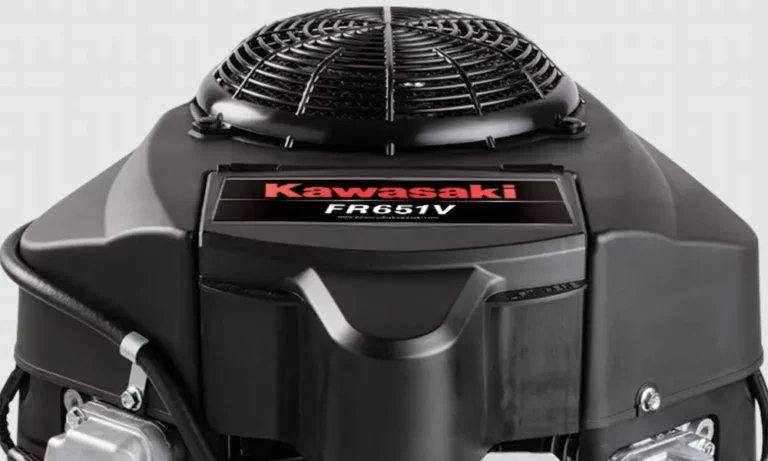
Getting the oil capacity wrong on your Kawasaki FR651V isn’t just an inconvenience — it can kill your engine. Whether you’re doing your first oil change or your fiftieth, this guide gives you the exact numbers, the right viscosity, and the maintenance steps to keep your mower running strong.
What’s the Kawasaki FR651V Oil Capacity?
Here’s the short answer: it depends on what you’re doing.
The FR651V is a 726cc, 90-degree V-twin engine with a full-pressure lubrication system. That pressurized design means oil fills not just the crankcase but also the filter housing and internal galleries. So when you drain and refill, the volume changes based on whether the filter comes out too.
| Service Type | Volume (Liters) | Volume (US Quarts) |
|---|---|---|
| Oil change only (filter stays in) | 1.8 L | 1.9 qts |
| Oil change + new filter | 2.1 L | 2.2 qts |
| Initial dry fill (factory spec) | 2.1–2.2 L | 2.2–2.3 qts |
The number you need to remember: 2.1 liters (2.2 quarts) when you replace the filter. That’s your standard full-service fill.
Why does the filter matter? Because the spin-on oil filter holds a measurable amount of oil. If you slap a new filter on and only pour in 1.8 liters, the oil level drops below safe territory once the pump primes the filter. On uneven ground or steep slopes, that can trigger intermittent pressure drops — exactly the situation you don’t want when you’re mowing a hillside.
The Dipstick Trap Most Owners Fall Into
Here’s where people mess up constantly. The FR651V dipstick reads accurately only when it’s NOT screwed in.
Follow these steps every time you check the oil:
- Park on a level surface. Let the engine sit for a few minutes so oil drains back to the sump.
- Pull the dipstick out and wipe it clean.
- Reinsert it until the cap touches the threads — do not twist or tighten it.
- Pull it back out and read the level. It should sit within the cross-hatched grid between the ADD and FULL marks.
If you screw the dipstick in, the reading comes out falsely high. You’ll think the engine is full when it’s actually 0.2 to 0.4 quarts short. Run it that way in the heat of summer and you’re asking for serious wear.
Which Oil Viscosity Does the FR651V Need?
The baseline recommendation for Kawasaki FR651V oil capacity maintenance is SAE 10W-40. It flows well during cold starts and holds film strength at operating temps. But the right viscosity really depends on where you live and what the thermometer says.
| Ambient Temperature | Recommended Viscosity |
|---|---|
| Below 0°C (32°F) | SAE 5W-20 |
| 0°C to 40°C (32°F to 104°F) | SAE 10W-30 or SAE 10W-40 |
| Above 40°C (104°F) | SAE 20W-50 |
| Consistent moderate climate | SAE 30 or SAE 40 |
In 2014, Kawasaki added SAE 20W-50 to its approved viscosity list specifically for high-temperature operation. Field data showed that thinner oils were breaking down faster in environments over 104°F, leading to increased consumption and weaker film protection on the crankshaft and rod bearings. If you’re mowing in the deep south during July, 20W-50 is a smart move.
Why Oil Chemistry Matters for This Engine
The FR651V uses a flat-tappet valvetrain, not the roller followers you’d find in modern car engines. Flat tappets need higher levels of Zinc Dialkyldithiophosphate (ZDDP) — an anti-wear additive — to prevent camshaft lobe and tappet face wear.
The problem? Modern automotive oils rated SM, SN, or SP have reduced ZDDP to protect vehicle catalytic converters. That reduction makes them a poor choice for the FR651V.
Stick to oils meeting API classifications SF through SL, or use Kawasaki’s KTECH engine oil, which is formulated specifically for air-cooled V-twins. It’s one of the simplest ways to protect an engine that’s already doing heavy work in tough conditions.
Kawasaki FR651V Maintenance Schedule: When to Change the Oil
The FR651V has a full-pressure lubrication system with a spin-on filter, which means maintenance intervals matter more than people think. Here’s the schedule to follow:
| Task | Frequency |
|---|---|
| Check oil level | Before every use |
| Change engine oil | Every 100 hours |
| Replace oil filter | Every 200 hours (pros recommend every 100) |
| Clean cooling fins and grass screen | Every 100 hours |
| Check valve clearance | Every 300 hours |
The Break-In Change You Can’t Skip
New FR651V engines need their first oil change at 8 to 10 hours of operation — not 100. During break-in, the piston rings seat against the cast-iron cylinder liners, creating tiny metallic particles and releasing machining residue into the oil. Leave that contaminated oil in the engine and you’re grinding those particles into the bearings and cylinder walls for the rest of the engine’s life.
Eight hours feels early. Do it anyway.
Should You Change the Filter Every 100 Hours?
Technically, Kawasaki’s documentation allows 200-hour filter intervals. Practically speaking, most experienced technicians swap the filter at every 100-hour oil change. The FR651V uses a single-stage air filter, which puts more contamination pressure on the oil system compared to dual-stage setups. In dusty mowing environments, a filter can get overwhelmed faster than the manual anticipates.
The cost of an extra filter is nothing compared to the cost of bearing damage.
How to Change the Oil on a Kawasaki FR651V
Before you pour anything in, know the torque specs. The FR651V’s crankcase is aluminum, and aluminum strips easily.
| Fastener | Torque |
|---|---|
| Oil drain plug | 7 Nm (5.2 ft-lbs) |
| Oil filter mounting | 8.8 Nm (78 in-lbs) |
| Spark plug | 22 Nm (16.2 ft-lbs) |
That drain plug torque — 7 Nm — is far lower than what most people expect from automotive experience. Car drain plugs typically want 25 to 40 Nm. Strip the threads on an aluminum crankcase and you’re looking at an expensive repair. Use a torque wrench. It takes 30 seconds.
Step-by-Step Oil Change Process
- Run the engine for 2 to 3 minutes to warm the oil. Warm oil drains faster and carries more suspended contaminants out with it.
- Shut the engine off. Let it cool for 5 minutes.
- Remove the drain plug with a torque wrench and let it drain completely.
- If you’re replacing the filter, remove it now. Pre-fill the new filter with fresh oil before installing.
- Reinstall the drain plug and torque it to exactly 7 Nm.
- Add 2.1 liters (2.2 quarts) if you changed the filter, or 1.8 liters (1.9 quarts) if the filter stayed in.
- Start the engine and let it run for 2 minutes. Shut it off and wait.
- Check the level using the dipstick — do not screw it in.
- Top off as needed to bring it into the cross-hatched grid zone.
What Your Oil Is Telling You
The condition of your oil is a direct window into engine health. Pull the dipstick and take a look before every oil change.
Normal: Dark brown or black oil. Carbon particles suspended in the lubricant — that’s expected.
Problem signs to watch for:
- Milky or gray oil — moisture contamination, possibly from short-cycle operation where the engine never fully warms up
- Sudden increase in consumption — could indicate a clogged air filter pulling vacuum on the crankcase breather and drawing oil into the combustion chamber
- Oil around the lower main seal or crankcase cover — this is a vertical-shaft engine, and leaks at those points mean pressurized oil loss
Checking oil before each mow costs you 60 seconds. Finding a seized engine costs you considerably more.
OEM Variants and How They Affect Maintenance
The FR651V gets installed in equipment from a wide range of manufacturers, and each OEM tunes the engine differently. Those RPM differences affect heat generation and maintenance frequency.
| Equipment Brand | Spec Model | Notes |
|---|---|---|
| Ariens | FR651V-S07 | No factory oil drain — requires external drain hose |
| Husqvarna | FR651V-S09 | Governed at 3,100 RPM |
| SCAG | FR651V-S27 | Governed at 3,650 RPM for high blade tip speed |
| Toro | FR651V-S06 | No oil drain; governed at 3,300 RPM |
| Bad Boy | FR651V-S17 | Standard residential ZT configuration |
| Cub Cadet (MTD) | FR651V-S04 | Governed at 3,400 RPM |
The SCAG variant running at 3,650 RPM generates meaningfully more heat than a Husqvarna running at 3,100 RPM. If you run a SCAG with this engine, you might want to check oil levels more frequently and clean those cooling fins on schedule. Heat breaks down oil faster than anything else.
Winter Storage: Protecting the Oil System During Off-Season
Follow these steps before putting the mower away for winter:
- Drain the fuel system if storage exceeds 30 days — ethanol gums up carburetors quickly
- Fog the cylinders — remove the spark plugs and add a few drops of clean engine oil into each cylinder
- Rotate the engine manually several times to distribute the oil across the cylinder walls and piston rings
- Stop rotating when you feel resistance — that’s the piston at Top Dead Center on the compression stroke, with both valves closed and the combustion chamber sealed from moisture
This prep means the next spring start happens with oil already on the cylinder walls instead of bare metal rubbing against cast iron.
Final Numbers to Keep on Your Phone
- Oil capacity with filter change: 2.1 liters / 2.2 quarts
- Oil capacity without filter change: 1.8 liters / 1.9 quarts
- Standard viscosity: SAE 10W-40
- High heat viscosity: SAE 20W-50
- First oil change: 8–10 hours
- Regular oil change interval: Every 100 hours
- Drain plug torque: 7 Nm — no more
Get those numbers right and the FR651V will run for thousands of hours without complaint. Get them wrong and you’ll find out exactly how expensive a 726cc rebuild can be.