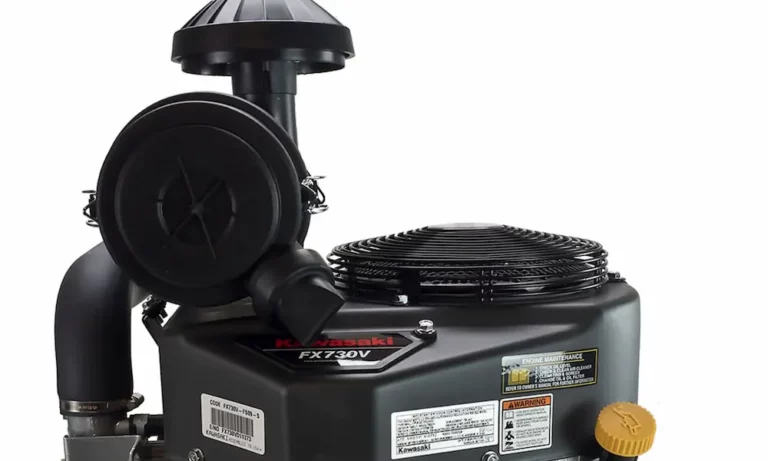
Got a Kawasaki FX730V and not sure how much oil it takes — or which type to use? You’re in the right place. Getting this wrong can kill a $1,500+ engine fast. This guide covers the exact Kawasaki FX730V oil capacity, the right oil type, how to check it correctly, and when to change it. Read through to the end — there’s a dipstick trick most people get wrong every single time.
The Kawasaki FX730V Oil Capacity Numbers You Actually Need
Here’s the straight answer: the Kawasaki FX730V oil capacity is 2.2 U.S. quarts (2.1 liters) when you’re doing a full oil and filter change. If you’re skipping the filter this time, drop that number to 1.9 U.S. quarts (1.8 liters).
That 0.3-quart difference? It’s the oil sitting inside the filter canister itself. Ignore that gap, and you’ll either overfill or underfill — neither is good.
| Service Type | U.S. Quarts | Liters |
|---|---|---|
| Oil Change WITH filter replacement | 2.2 qt | 2.1 L |
| Oil Change WITHOUT filter replacement | 1.9 qt | 1.8 L |
Why overfilling is a real problem: When you put in too much oil, the crankshaft starts whipping through the excess and aerates it — essentially turns it into foam. Foamy oil can’t lubricate properly. It also gets pushed through the breather system into your air intake, which causes oil smoke and spark plug fouling. Don’t go over the “Full” mark.
What Oil Does the Kawasaki FX730V Take?
The FX730V runs best on SAE 10W-40 detergent oil for most conditions. Kawasaki recommends their own KTECH oil, formulated specifically for high-heat air-cooled engines. But the key requirement is the API service classification — the oil needs to meet SL, SJ, SH, SG, or SF standards.
Here’s why that matters: air-cooled engines like this one run hotter than liquid-cooled motors. They need higher levels of zinc and phosphorus-based anti-wear additives to protect the overhead valve train. Many modern car oils have reduced those additives to protect catalytic converters — and the FX730V doesn’t have one, so it needs the full dose.
Choosing Oil for Your Climate
Don’t just grab any 10W-40 off the shelf without checking your local temps. Viscosity selection directly affects how well the oil protects the engine at startup and under load.
| Ambient Temperature | Recommended Viscosity |
|---|---|
| 104°F (40°C) and above | SAE 20W-50 |
| 32°F to 104°F (0°C to 40°C) | SAE 10W-40 or 10W-30 |
| Below 32°F (0°C) | SAE 5W-20 or 5W-30 |
In hot climates, thicker 20W-50 oil maintains a stronger protective film and reduces consumption caused by blow-by. In cold weather, thin 5W-20 or 5W-30 reaches the upper valve train fast enough at cold starts to prevent dry-start wear — which is when most engine damage actually happens.
How to Check the Oil Level Correctly (Most People Do This Wrong)
This is the part that trips up even experienced operators. The FX730V dipstick has a specific reading method — and if you ignore it, your reading will be wrong every single time.
The correct steps:
- Park on a level surface. Let the engine sit for a few minutes so oil drains back into the sump.
- Wipe the area around the oil filler cap clean — you don’t want debris dropping into the crankcase.
- Pull the dipstick out and wipe it clean with a lint-free cloth.
- Reinsert the dipstick until the cap rests on the threads — but don’t screw it in.
- Pull it back out and read the level. It should sit between “Add” and “Full.”
Why does this matter so much? If you screw the dipstick all the way in before reading, the gauge tip dips deeper into the sump. The oil level reads artificially high. You think you’re good. You’re actually running low. That mistake leads directly to engine damage from heat and friction — even when you thought you checked it.
Check the oil level before every single use. It takes 30 seconds and can save you thousands.
Kawasaki FX730V Oil Change Schedule: When to Do It
The FX730V is a commercial-grade engine built for heavy use. That means it needs a maintenance schedule that keeps up with the workload.
The Break-In Oil Change — Don’t Skip This
Change the oil after the first 8 hours of operation. No exceptions. During break-in, the piston rings are seating against the cast-iron cylinder liners, and that process creates microscopic metal particles. You need to flush those out before they grind through your crankshaft bearings or clog the oil pump.
Some sources suggest 25 hours for the first change — that’s wrong for this commercial engine. Stick to 8 hours.
Regular Maintenance Intervals
| Maintenance Task | Interval |
|---|---|
| Check oil level | Before every use |
| Change engine oil | Every 100 hours |
| Replace oil filter | Every 200 hours |
| Clean cooling fins | Every 100 hours |
| Clean/gap spark plugs | Every 100 hours |
| Replace air filter (paper element) | Every 200 hours / annually |
| Inspect valve clearance | Every 300 hours |
One note on the oil filter: the official spec says every 200 hours, but most commercial operators swap it every 100 hours with each oil change. That prevents the filter from reaching bypass mode — where it’s so clogged that unfiltered oil circulates straight through the engine. The extra filter cost is nothing compared to a seized engine.
How to Change the Oil: Torque Specs and Drain Plug Tips
Warm the engine up before draining — warm oil flows faster and carries more contaminants out with it. Then shut it off and get to work.
Torque specs you need to know:
| Fastener | Torque (ft-lbs) | Torque (N·m) |
|---|---|---|
| Oil drain plug | 23 ft-lbs | 31.2 N·m |
| Oil filter | 13 ft-lbs | 17.6 N·m |
| Spark plugs | 16 ft-lbs | 22 N·m |
The oil filter torque is debated — some docs say 23 ft-lbs, but most professionals use 13 ft-lbs. Over-torquing the filter crushes the gasket and can damage the mounting stud. At 13 ft-lbs, the seal holds and you can actually remove the filter next time without a fight.
The drain plug torque of 23 ft-lbs is non-negotiable. The FX730V’s 90-degree V-twin vibrates hard during operation. An undertightened drain plug will back itself out — and you won’t notice until there’s no oil left.
Why the Lubrication System Matters More Than You Think
The FX730V uses a full-pressure lubrication system — not splash lubrication. An oil pump forces lubricant through dedicated galleries to the main bearings, camshaft, and valve train. This keeps oil flowing to critical parts even when you’re mowing on steep slopes.
But this system depends completely on having the right oil volume and viscosity. The 2.2-quart capacity isn’t just a random number. Because the engine is air-cooled, oil also acts as a primary cooling agent — transferring heat away from the piston crowns and cylinder walls. Drop below the full mark, and the remaining oil cycles more frequently, absorbs more heat per pass, oxidizes faster, and loses its ability to protect.
Don’t Forget the Air Filter and Cooling Fins
The multi-stage canister air filter on the FX730V is a big reason this engine lasts longer than residential-grade alternatives. It blocks fine dust from reaching the combustion chamber — because dust that gets past the rings ends up in the oil and acts as an abrasive throughout the whole lubrication system.
Clean the primary element every 100 hours by tapping it to shake loose dust free. Never use compressed air — it punches microscopic holes in the paper and lets fine particles through.
Keep the cooling fins clear too. Clogged fins raise oil temperature, thin the oil out, and cause bearing failure — even when the oil level is perfect.
Storing the Engine? Prep the Lubrication System First
If the mower sits for 30+ days, do these three things before storage:
- Change the oil before storing — used oil contains combustion acids that corrode internal surfaces while the engine sits idle.
- Fog the cylinders — pull the spark plugs, add a drop or two of fresh oil directly into each cylinder, and reinstall the plugs. This protects the cylinder walls and rings from rust.
- Seal the valves — rotate the engine by hand until you feel resistance. That means both intake and exhaust valves are closed, blocking humid air from entering the combustion chamber.
Quick-Reference Specs for the Kawasaki FX730V
| Specification | Value |
|---|---|
| Displacement | 726 cc (44.3 cu. in.) |
| Engine Type | 4-Stroke Vertical Shaft V-Twin |
| Horsepower | 23.5 hp at 3,600 RPM |
| Oil capacity (with filter) | 2.2 U.S. quarts (2.1 L) |
| Oil capacity (without filter) | 1.9 U.S. quarts (1.8 L) |
| Recommended oil viscosity (normal) | SAE 10W-40 |
| Recommended oil viscosity (high heat) | SAE 20W-50 |
| Recommended oil viscosity (cold) | SAE 5W-20 / 5W-30 |
| API service classification | SL, SJ, SH, SG, SF |
| Initial oil change | First 8 hours of operation |
| Regular oil change interval | Every 100 hours |
| Oil filter interval | Every 200 hours (pro tip: do it at 100) |
| Drain plug torque | 23 ft-lbs (31.2 N·m) |
| Dipstick reading method | Rest on threads — do NOT screw in |
The Kawasaki FX730V oil capacity of 2.2 quarts isn’t just a spec to memorize — it’s the foundation of everything that keeps this engine alive. Get the volume right, pick the correct viscosity for your climate, change it at 8 hours and then every 100 hours after that, and check it the right way every single day. Do those four things consistently, and this engine will run for thousands of hours without complaint.