Lost your McGard wheel lock key? Don’t panic — you’ve got more options than you think. This guide walks you through every replacement route, from the easy online order to emergency field removal when you’re stranded with a flat. Read to the end, because the method that works for you depends entirely on what documentation you have.
What Makes McGard Keys Impossible to Duplicate at a Hardware Store
McGard wheel locks aren’t your average lug nuts. Each set ships with a unique, computer-generated pattern — one of a nearly infinite number of combinations. That’s what makes them great at stopping theft. It’s also why you can’t just pop into your local shop and get a copy cut.
Every key is precision-machined to match one specific lock. No blanks exist. No shortcuts work. Replacement keys come directly from McGard, and only after they verify your ownership details.
That said, the process is genuinely straightforward if you have your ID card. If you don’t? There are still solid options.
Find Your Registration Card First
Before you do anything else, hunt down your McGard Identification Registration Card.
Check these spots:
- Glove compartment
- Center console
- Spare tire tool kit
- Original wheel lock box (if you still have it)
The card holds two critical codes: your A-Kit Number and your B-ID Number. These are the only things you need to order a replacement key online. McGard also lets you register your card for free — which stores your info permanently in their database. So if you lose the card later, they can still pull your pattern.
If you bought the car used and the card’s nowhere to be found, skip ahead to the photo ID section. You still have options.
The 3 Ways to Order a McGard Wheel Lock Key Replacement
Online (Fastest)
Head to the McGard customer service portal. You’ll need:
- Your A-Kit Number and B-ID Number
- A major credit card
- Your shipping address
You can order up to two replacement keys per transaction. This route works for customers in the US, Canada, and Mexico. Most domestic orders ship via First Class Mail, arriving in 7–10 business days. Need it faster? McGard offers FedEx overnight and two-day options for urgent situations.
By Phone
Call McGard directly at 1-800-444-5847, Monday through Friday, 8am–5pm Eastern Time. Their team in Orchard Park, New York handles troubleshooting invalid codes, international orders, and anything else that doesn’t fit neatly into an online form.
This is your best bet if your registration number throws an error online or you’ve got a complicated situation with a second-hand vehicle.
By Mail
McGard still accepts paper orders. Fill out the original order form that came in the box and mail it with a check, money order, or credit card details to their New York headquarters. Note: they don’t accept COD payments. This channel also lets you return your ID card for registration at the same time.
International Customers: Who to Contact
McGard operates globally, so your replacement support doesn’t stop at the US border.
| Region | Phone | Location |
|---|---|---|
| United States (Global HQ) | 1-800-444-5847 | Orchard Park, NY |
| Germany / Europe | +49 (0)7133 90 19 0 | Nordheim, Germany |
| Japan / Asia-Pacific | +81 48 600 6070 | Saitama City, Japan |
| Singapore | +65 6246 8066 | Paya Lebar Road |
Each regional office follows the same registration and replacement procedures as the US headquarters — just with local shipping logistics.
No Registration Card? Use Photo Identification
This is where most people get stuck. You’ve lost the card, you bought the car used, and you have no idea what your pattern code is. Here’s what actually works.
Email a Photo of the Lock
Contact McGard customer service by email. European customers use [email protected]. Send a clear, high-resolution photo taken straight-on from the front of the lock, showing the full coding groove.
Include:
- Your vehicle’s make, model, and year
- Your full name, address, and daytime phone number
- The clearest photo you can take
McGard technicians manually compare your groove geometry against their database. The better your photo, the faster this works.
Tips for a usable photo:
- Clean the lock face with a soft wire brush
- Shoot in natural overhead light
- Avoid chrome reflections — they hide the groove details
The Styrofoam Impression Trick
When photos won’t cut it — maybe the lock face is damaged or the pattern is an older non-standard type — you can send a physical impression instead.
Use a styrofoam cup. Tear off small pieces and press them firmly into the locking bolt to create a negative mold of the groove. Mail several impressions to McGard headquarters. Specialists use these physical references to identify the correct key pattern. It’s slower, but it works when nothing else does.
What to Do If Your Car Is at a Dealership
If your vehicle came with factory-installed wheel locks, your dealership is often the fastest first stop. Many dealers keep master key sets covering every pattern used for that brand. A tech can find your pattern and either remove the locks or give you the code to order a replacement.
This is common for Ford, Honda, Toyota, and GM vehicles. Call ahead and ask if they have the master set before driving over.
Retail Options: What You Can (and Can’t) Buy in a Store
McGard products show up at AutoZone, Walmart, NAPA, Tire Rack, and eBay. But stores sell complete lock sets, not individual replacement keys. Keys have to be cut to order by the manufacturer — no exceptions.
Here’s a quick price snapshot for 2024–2025:
| Source | Product | Price Range (USD) |
|---|---|---|
| AutoZone | Wheel Lock Set (M12-1.25) | ~$35.99 |
| Walmart | 4-Pack Cone Seat Locks | $26.99–$28.01 |
| eBay | Genuine OEM Replacement Key | $25.00–$46.00 |
| McGard Direct | Standard Replacement Key | ~$15.00–$25.00 |
| Tire Rack | Long Shank Lock Set | ~$143.42 |
If price is a priority, ordering direct from McGard is typically the cheapest route for a single key.
Emergency Removal: When You’re Stuck With No Key
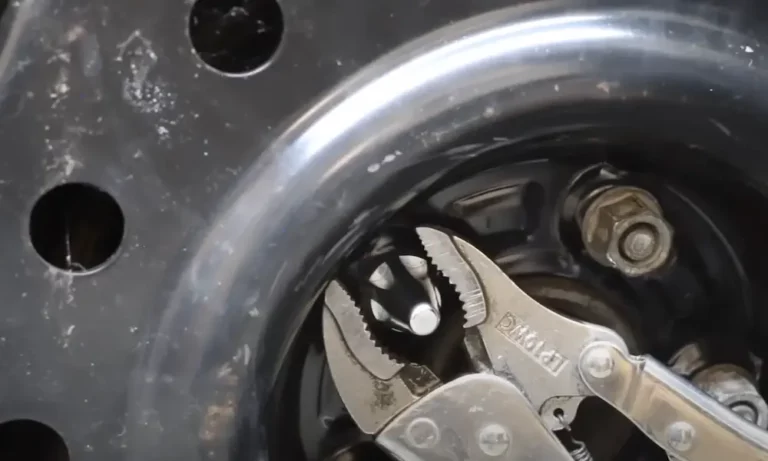
You’ve got a flat, your key is gone, and you need that wheel off now. Destructive removal is a last resort, but it works. Understand that the lock won’t survive this process.
The 12-Point Socket Method
Grab a 12-point socket — typically 19mm to 22mm — that’s slightly smaller than the outer diameter of the lock. Hammer it onto the face of the lock until it bites in. The hardened steel socket grips the lock’s surface.
Once it’s seated, use a breaker bar or impact wrench to turn it. High torque usually breaks it free. After removal, knock the lock out of the socket with a punch and hammer. Fair warning: this method often ruins the socket. If the socket slips before biting, it rounds the lock off and makes the next attempt harder.
The Welding Method
If you’re in a shop with a welder, weld a standard hex nut directly onto the face of the wheel lock. The heat breaks corrosion bonds, and the new nut gives a standard wrench a clean surface to grip. This is one of the most reliable shop methods for stubborn or seized locks.
Dealing With Spinning Collar Locks (SL Series)
The McGard Ultra High Security SL series has a rotating outer ring that spins freely when you try to grip it — that’s the whole point. Standard socket tricks won’t work until you neutralize the collar.
Options that work:
- Use an air hammer with a sharp bit to chip into the collar face, then vibrate or shatter it off
- Slice through the ring with a Dremel and a diamond cutting disc
- Drive a flathead screwdriver or wood screw into the gap between the collar and the inner nut to bind them together, then hammer a socket over the whole assembly
Once the collar is dealt with, the inner nut is less hardened and responds to standard extraction tools. Mechanics on Reddit and in professional forums have documented all three of these methods working in real shop environments.
Proper Installation Prevents the Key Replacement Headache
A lot of key failures and stuck locks trace back to bad installation habits. Here’s how McGard says to do it right.
Always start by hand. Thread the lock on by hand first. This prevents cross-threading, which can destroy both the lock and the wheel stud. Then use the key tool and a torque wrench — not an impact gun — to tighten to your vehicle’s spec.
Push in while you turn. Whether you’re tightening or loosening, keep firm inward pressure on the wrench toward the wheel. This keeps the key pattern fully engaged and stops it from slipping and rounding off the grooves.
Re-torque after 25–50 miles. The lock settles against the wheel during initial driving. Check torque again after your first 25 to 50 miles, especially after a tire rotation or new wheel install.
Skip the grease on threads. McGard explicitly advises against oil, grease, or anti-seize compounds on threads. They change the friction coefficient and cause over-tightening even with a torque wrench. Instead, spray threads once a year with a greaseless lubricant like LPS-1 to fight corrosion — especially if you live somewhere they salt the roads.
When a Locked-Up Nut Won’t Budge
If corrosion or over-torquing has frozen the lock, try this before reaching for destructive tools.
Over-tighten the other lug nuts first. Crank all the standard lug nuts on that wheel tighter than normal. This pulls the wheel harder against the hub, which can momentarily relieve the clamp load on the security lock. While that pressure is relieved, try the lock with a breaker bar and maximum inward pressure.
Use an impact gun on a seized lock. McGard generally discourages impact guns during installation, but the rapid vibration of an impact tool is sometimes the only thing that breaks a rust-seized lock free. Just never attach the key to a cable or lanyard when using an impact — the spinning motion can whip it back fast enough to cause serious injury.
If it still won’t move, loosen one or two standard lug nuts directly opposite the lock. Shifting stress distribution across the wheel sometimes provides just enough relief for the lock to turn.
Keep a Spare Key Somewhere Sensible
The single best way to avoid this entire situation? Order a second key now, while you have all your documentation in front of you. McGard lets you order up to two keys per transaction. Store one in your glove box and one somewhere off the vehicle — your home toolkit, for example.
It costs $15 to $25. A spare saves you days of downtime, a trip to a dealer, or worse, emergency roadside destruction of a $40 lock nut.
McGard also sells a dedicated key storage pouch for around $5. Small investment, big relief the next time your tires get rotated and you actually need that key.