Your car’s bouncing like a basketball, the front end dives hard when you brake, and you’re hearing clunks over every pothole. You need new shocks, but the parts counter just hit you with two options: Monroe or KYB. Same job, different price tags, and wildly different reviews online. Let’s cut through the noise and figure out which one actually makes sense for your specific situation.
What Makes Monroe and KYB So Different?
These brands don’t just slap different stickers on identical parts. They come from completely different engineering philosophies that change how your car feels on the road.
KYB builds what the factory built. As the world’s largest OE shock supplier, KYB makes the original shocks for Toyota, Honda, Subaru, and most Asian brands. When you buy a KYB Excel-G replacement, you’re getting something engineered from the original blueprints. They focus on restoring the handling your car had when it rolled off the assembly line.
Monroe fixes what broke on your worn-out car. Monroe knows their shocks get installed on vehicles with 75,000+ miles, worn bushings, and tired springs. Their philosophy is compensation, not replication. The OESpectrum line uses softer valving to mask the harshness that comes through a loosened, aging chassis. They’re engineered for comfort first.
This split creates the core monroe vs kayaba debate: Do you want your car to handle like it used to, or do you want it to ride smoother than it probably ever did?
How the Internal Design Creates Different Rides
Pop open a shock absorber and you’ll find a piston pushing oil through tiny valves. How those valves are designed determines everything about your ride quality.
Monroe’s Impact Control Valve
Monroe’s signature tech is the Impact Control Valve (ICV). When you hit a pothole hard, this internal bypass dumps hydraulic pressure fast, preventing the jolt from smacking you through the seat. The Low Speed Tunability system filters out road texture and vibration.
The result? Monroe shocks feel cushy and quiet. Your passenger’s coffee stays in the cup. But there’s a trade-off: that rapid pressure bleed can make the car feel “floaty” on the highway. When the valve opens to swallow a bump, it momentarily reduces tire contact with the road. Spirited drivers describe this as feeling “disconnected.”
KYB’s Three-Stage Dual Valving
KYB Excel-G shocks use a three-stage system with different resistance at different speeds:
- Stage 1 (Low Speed): Stiff valving controls body roll in corners and brake dive
- Stage 2 (Medium Speed): Manages normal road bumps
- Stage 3 (High Speed): Prevents bottoming out on big hits
The secret weapon is KYB’s Teflon-coated piston band. Cheap shocks let oil leak around the piston instead of forcing it through the valves. KYB’s seal ensures 100% of the oil goes through the valving stack, creating immediate, consistent damping. This is why new KYB shocks feel stiff initially—there’s zero hydraulic slop. It takes 500-1,000 miles for the Teflon to bed in and the ride to settle.
Complete Assemblies: Quick-Strut vs Strut-Plus
Most shops now replace the entire strut assembly—shock, spring, and mount together—rather than swapping just the shock cartridge. It’s faster and safer. But the monroe vs kayaba battle gets interesting here because their assembly strategies differ dramatically.
Monroe Quick-Strut: The Volume King
Monroe invented the loaded strut category with the Quick-Strut. A mechanic can swap one in 15 minutes with zero spring compressor risk. For high-volume shops, it’s a profit machine.
The catch? To manage inventory costs, Monroe uses spring rate consolidation. A single part number might cover both the 4-cylinder and V6 versions of your car. The spring has to be strong enough for the heavy engine, so when it’s installed on the lighter model, the car sits higher than stock. Owners call it the “4×4 look.”
Another persistent issue is the Monroe Clunk—a hollow popping sound over bumps or during turns. While Monroe blames improper installation, the sheer volume of complaints suggests the upper mount bearing has tighter tolerance requirements than competitors.
KYB Strut-Plus: Corner-Specific Precision
KYB’s Strut-Plus assemblies take a different approach. They use corner-specific part numbers. If your car originally had different springs on the left versus right side (common when engines or fuel tanks create weight imbalance), KYB replicates that. They don’t consolidate into universal fitments as aggressively.
The springs match OEM steel grade and coil count exactly. Users consistently report that KYB maintains proper ride height better than Monroe. However, expect the ride to feel stiff—even jarring—for the first 1,000 miles before the springs settle. Once they do, the height and handling stay consistent for 50,000+ miles.
Which Brand Wins for Your Specific Vehicle?
The “best” shock absorber changes completely depending on what’s bolted underneath your hood.
Asian Cars (Toyota, Honda, Subaru, Nissan)
Winner: KYB, no contest.
KYB is the OE supplier for nearly every Japanese vehicle. Installing Monroe on a Toyota Camry typically results in excessive body roll and a “floaty” disconnect from the road. The soft Monroe valving can’t control the Camry’s chassis dynamics the way the original KYB tuning did.
Subaru owners are especially vocal critics of Monroe. The brand’s horizontally opposed Boxer engines create a low center of gravity that the suspension is tuned to exploit. Monroe shocks eliminate the “planted” feel, introducing sway that genuinely unnerves drivers. Worse, Monroe’s spring consolidation often creates “saggy bum” syndrome where the rear sits lower than the front on Outbacks.
American Trucks (Ford F-150, Silverado, Ram)
Winner: Depends on what you do with it.
For daily driving an empty truck, Monroe’s compliant ride smooths out the jittery nature of an unloaded bed. It’s a popular budget fix.
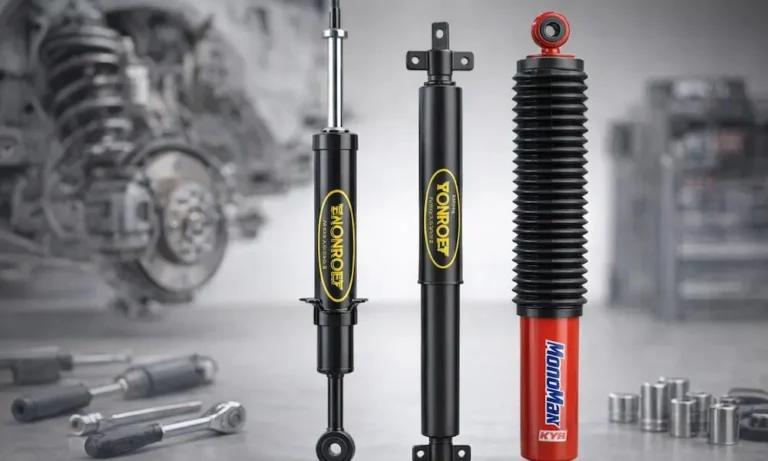
But if you tow or haul? KYB MonoMax or Gas-a-Just monotube shocks are essential. These use a floating piston design that prevents oil from aerating under heavy loads. Monroe’s twin-tube shocks are prone to “nose dive” under braking and excessive squat when towing, which is a genuine safety issue. Forum consensus among truck owners doing real work heavily favors KYB.
American Sedans (Older Domestic Models)
Winner: Monroe.
Older Buicks, Lincolns, and Impalas were engineered for a “boulevard ride”—soft, isolated, wafting. Monroe’s cushy valving restores exactly that character. KYB’s stiffness would ruin what these cars were supposed to feel like.
European Cars (BMW, VW, Audi, Mercedes)
Winner: Neither (but KYB if forced to choose).
German suspension tuning relies on stiff, responsive damping to maintain tire contact at Autobahn speeds. Monroe shocks are widely considered “store brand quality” in European car circles. They can’t keep up with the stiff springs, creating a bouncy, uncontrolled ride that “turns a BMW into a Buick.”
KYB Excel-G is viewed as a passable budget option—closer to OEM Sachs or Bilstein than Monroe. For standard commuter models, it’s acceptable. For sport-tuned cars (M-Sport, GTI), enthusiasts strongly recommend saving up for Bilstein B4 or B6 instead.
Breaking Down the Real Cost of Ownership
Initial price tags don’t tell the whole story. You need to factor in longevity and warranty utility.
The Price Gap
Monroe undercuts KYB significantly on upfront cost. For a 2015 Toyota Camry, expect to pay:
- Monroe Quick-Strut (4 corners): $260-$300 total
- KYB Strut-Plus (4 corners): $530-$600 total
KYB costs nearly double. For a 200,000-mile beater you’re planning to sell next year, Monroe’s value proposition is hard to argue with.
The Lifetime Warranty Trap
Both brands advertise “Lifetime Warranty,” but the fine print creates completely different outcomes.
Monroe’s warranty covers the entire strut assembly for as long as you own the vehicle. Sounds great, except users report high claim rates—replacing shocks every 1-2 years due to softening or noise. The warranty provides free parts, not free labor. If you’re paying a mechanic $300 every 18 months to install warranty replacements, that “free” warranty becomes an expensive subscription.
KYB’s warranty loophole is brutal. The lifetime coverage applies only to the hydraulic strut cartridge. The springs, mounts, boots, and hardware get just a 1-year warranty. If your KYB Strut-Plus spring snaps after 18 months (common in the Rust Belt), you’re buying a whole new unit. This is a massive deviation from Monroe’s full assembly coverage and catches people by surprise.
When Each Brand Makes Financial Sense
| Your Situation | Buy This | Why |
|---|---|---|
| Selling vehicle in <1 year | Monroe | Lowest upfront cost; good enough for sale |
| Keeping vehicle 5+ years | KYB | Won’t need replacement; lower total cost |
| DIY installation | KYB | Higher part cost offset by saved labor; don’t do job twice |
| Paying a shop | KYB | Labor is the expensive part; cheap parts that fail = wasted money |
| Rust Belt location | Monroe | Lifetime spring warranty beats KYB’s 1-year coverage |
What Drivers Actually Experience on the Road
The engineering specs matter, but so does what you feel through the seat of your pants.
The Break-In Reality
KYB: New shocks feel harsh—you’ll notice every crack in the pavement. This stiffness comes from the high-pressure gas charge and tight Teflon seal. The “break-in” period of 500-1,000 miles isn’t the metal changing; it’s the seal friction reducing and you adapting to the firmer baseline. Drivers who value steering feedback love it. Comfort-seekers hate it.
Monroe: Initial impressions are glowing—the ride feels like “a cloud.” But negative feedback spikes after 6-12 months. Users report the return of nose-dive during braking and excessive body roll. The valving oil appears to degrade faster than KYB. The cloud becomes a boat.
Noise Issues
The Monroe Clunk is real and widespread. It’s a metallic rattle over bumps or during turns. While sometimes caused by improper torquing during installation, the prevalence suggests lower tolerance for installation variance than KYB.
KYB occasionally gets “spring binding” complaints—a boing/ping sound while turning. Usually traced to worn rubber spring isolators or improper seating during assembly. Less common than Monroe’s clunk, but it happens.
How to Avoid Counterfeit Shocks
The rise of online marketplaces has brought a flood of counterfeit suspension parts into circulation.
Spotting Fake KYB
KYB has acknowledged counterfeits entering the market:
- Piston rod finish: Genuine KYB has a machined finish on top. Fakes have a pressed silver cap or rough paint
- Packaging: Real KYB uses heavy reinforced cardboard. Fakes arrive in flimsy boxes with low-res logos
- Performance: Counterfeits lack nitrogen gas charging and use standard hydraulic oil. They foam and fail within weeks
- QR codes: Some markets now include QR verification codes on packaging
Manufacturing Quality Variance
KYB has plants globally (Japan, US, Spain, Malaysia). Enthusiasts prize “Made in Japan” units over “Made in Malaysia,” though KYB maintains identical quality standards across facilities.
Monroe’s production has shifted heavily to China and Mexico for North America. This correlates with increased complaints about “quality fade” in recent years, particularly regarding rubber bushing longevity in Quick-Strut assemblies.
Durability Over the Long Haul
How do these shocks hold up after 30,000+ miles?
Monroe’s degradation curve: The pressure tube stays intact, but damping characteristics soften noticeably after 20,000-30,000 miles. Oil viscosity breaks down or internal valve disks fatigue. The bounciness you tried to eliminate returns. Additionally, Monroe coil springs corrode and snap faster than OEM or KYB springs in salt-heavy regions.
KYB’s durability profile: These units are renowned for seal integrity. Premature oil leaks are rare. Damping stays consistent for 50,000+ miles. However, the ride doesn’t soften over time. If it’s too harsh on day one, it’ll still be too harsh on day 1,000. The primary failure mode is upper mount bearing noise, not hydraulic failure.
Performance Comparison at a Glance
| Feature | KYB Excel-G | Monroe OESpectrum | Real-World Impact |
|---|---|---|---|
| Valving priority | Handling stability | Impact isolation | KYB = flat corners; Monroe = quiet bumps |
| Piston seal | Teflon band (tight) | PTFE band (standard) | KYB eliminates hydraulic slop |
| Low-speed damping | Firm | Soft | KYB reduces body roll; Monroe reduces road feel |
| Break-in period | 500-1,000 miles (stiff) | Immediate (soft) | KYB requires patience |
| Longevity | 50,000+ miles consistent | 20,000-30,000 miles before fade | KYB holds performance longer |
| Ride height accuracy | Excellent | Variable (consolidation) | KYB avoids “4×4 lift” issue |
Making the Right Call for Your Situation
Here’s the bottom line on monroe vs kayaba:
Choose Monroe if you’re:
- Fixing a beater you’ll sell within a year
- Prioritizing upfront cost over longevity
- Driving an older American sedan designed for soft ride
- In a rust-prone area (better spring warranty)
- Seeking maximum comfort over handling precision
Choose KYB if you’re:
- Keeping your car another 50,000+ miles
- Driving a Toyota, Honda, or Subaru
- Towing or hauling with a truck
- Doing your own installation (save labor costs)
- Valuing handling stability and steering feedback
The price difference between these brands is real, but so is the performance gap. If the budget allows, KYB delivers superior hydraulic consistency and longer service life. The stiffness is temporary; the durability isn’t.
But Monroe isn’t junk—it’s a legitimate solution for specific scenarios. If your car is old, your budget is tight, or you genuinely prefer a softer ride character, Monroe will restore safety and basic function. Just understand you’re likely installing it twice over the vehicle’s remaining life.
The monroe vs kayaba decision isn’t about finding the objectively “best” shock absorber. It’s about matching the engineering philosophy to your vehicle’s needs and your ownership timeline. Get that match right, and you’ll be happy with either choice.