
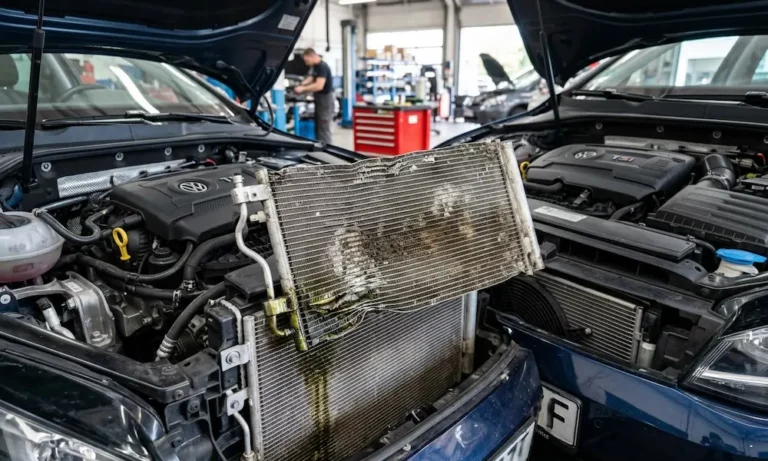
Your car’s AC is blowing warm air, making weird noises, or smelling like something’s burning. Sound familiar? These are classic symptoms of a bad condenser in a car — and ignoring them gets expensive fast. This guide breaks down every warning sign, what’s causing it, and how serious it really is. Read to the end before you spend a cent.
What Does the Car AC Condenser Actually Do?
Think of the condenser as your AC system’s radiator. It sits at the front of the car and releases the heat that the refrigerant absorbed from your cabin. Hot refrigerant gas enters, cooler liquid exits. That liquid then cycles back to the evaporator to absorb more heat and keep you comfortable.
When the condenser can’t do its job, the whole system falls apart. The refrigerant can’t cool down, the compressor strains under the pressure, and you end up sweating in traffic.
The Most Obvious Symptom: Weak or Warm Air From the Vents
This is usually the first thing drivers notice. The AC feels “off” — not quite cold enough, or outright blowing warm air.
Why the Air Feels Lukewarm
When the condenser is damaged or blocked, the refrigerant can’t fully convert from gas back to liquid. Without that transition, the evaporator can’t absorb heat from your cabin air. The result? Warm or room-temperature air blowing from your vents.
Highway vs. Stop-and-Go Performance
Here’s a telling pattern: the AC works fine on the highway but struggles in traffic. At speed, natural airflow through the condenser compensates for minor damage or blockages. Once you slow down or idle, the system relies entirely on cooling fans and the condenser’s surface area. If either is compromised, cooling performance drops fast.
Gradual Loss vs. Sudden Failure
How the cooling disappears tells you a lot:
- Gradual loss over weeks: Points to a slow refrigerant leak. A pinhole from a rock chip lets the refrigerant charge slowly drop until the system can’t cool at all.
- Sudden total failure: Usually a big rupture or a pressure spike that triggers the computer to shut the compressor down immediately.
| Cooling Loss Pattern | Likely Cause | Urgency |
|---|---|---|
| Slowly gets worse over weeks | Pinhole refrigerant leak | High — fix before charge is gone |
| Worse at idle, fine on highway | Blocked fins or fan issue | Medium — worsens over time |
| Sudden and complete | Major rupture or pressure spike | Critical — get it checked now |
| Intermittent cold then warm | Compressor short cycling | High — compressor is at risk |
Weird Noises When the AC Is Running
A failing condenser doesn’t just affect temperature. It often causes noises you haven’t heard before — and they’re worth paying attention to.
Whining, Buzzing, or Groaning From the Front of the Car
When the condenser is blocked internally or has restricted airflow, pressure builds on the high side of the system. The compressor has to work much harder to push refrigerant through. That strain shows up as a whining or buzzing sound when you switch the AC on. If you hear grinding or groaning, the compressor bearings are likely taking damage from running at high load — a serious problem.
Rattling From Road Debris
The condenser sits right at the front of the car. Pebbles, bugs, and road trash get lodged between the fins or between the condenser and radiator. These objects rattle against the metal and often change pitch with engine speed. Loose mounting brackets cause a similar deep drumming sound.
AC Noise Quick Reference
| Noise Type | What It Means |
|---|---|
| High-pitched whining | Excessive system pressure, compressor under strain |
| Persistent rattling | Debris lodged in condenser fins or loose mounts |
| Loud buzzing | Cooling fan struggling or obstructed |
| Intermittent hissing | Refrigerant escaping through a crack or seal |
| Grinding or groaning | Compressor bearing wear from prolonged high pressure |
Visual Signs You Can Spot Without Tools
You don’t need a pressure gauge to spot some of these issues. A quick look under the hood tells you a lot.
Bent or Crushed Fins
The aluminum fins on the condenser are incredibly thin. A rock chip or minor collision can bend, flatten, or crush sections of the fin array. Less fin surface = less heat rejection = warmer air. Over time, those bent sections also crack from vibration and thermal cycling, leading to refrigerant leaks.
Oily Dirt Buildup on the Condenser Surface
Refrigerant leaks are normally invisible — the gas evaporates instantly. But refrigerant carries oil with it, and that oil stays behind at the leak point. It’s sticky, so road grime clings to it. Look for a patch of heavy, greasy dirt that stands out from the rest of the condenser surface. That’s almost always a leak site.
Green Dye Stains Under UV Light
Many AC systems contain a fluorescent green tracer dye. Under normal daylight, it might look like a faint greenish stain. Under a UV light, it glows brilliantly, revealing even microscopic pinhole leaks that you’d never spot otherwise. A lot of shops use this method during routine AC inspections.
Burning Smell From Your Vents
A burning smell when the AC is running is one symptom of a bad condenser in a car you should never dismiss.
What’s Actually Burning?
The condenser itself isn’t combustible. The smell usually comes from plastic clips, rubber seals, or wire insulation near the condenser and compressor overheating because system pressures are dangerously high. The compressor’s magnetic clutch can also slip under excessive load, generating intense friction heat that smells like burning rubber. Left unchecked, this can create a genuine fire risk.
Burning vs. Other AC Smells
Not every AC smell points to the condenser. Here’s how to tell them apart:
- Musty or moldy smell: Bacteria on the evaporator core, not the condenser
- Sweet, syrupy smell: Coolant leak from the heater core or radiator
- Sharp chemical smell (like nail polish remover): Refrigerant gas entering the cabin through a leak
- Burning rubber or plastic smell: Condenser-related overheating — act quickly
The Compressor Short Cycling Problem
Short cycling means the AC compressor clicks on and off every few seconds instead of running in normal long cycles. It’s one of the most diagnostic symptoms of a bad condenser in a car.
Here’s what happens: the compressor turns on and immediately pushes refrigerant into a blocked or inefficient condenser. Pressure on the high side spikes instantly. A high-pressure safety switch detects the spike and cuts the compressor to prevent a blowout. Pressure drops slightly, the switch resets, and the cycle repeats — over and over. Every cycle wears down the compressor clutch faster. It’s a death spiral for your compressor if you don’t fix the condenser.
Your Engine Overheating When the AC Is On
This one catches people off guard. The engine temperature gauge climbs, but only when the AC is running — especially at idle. The condenser is the reason.
The condenser sits directly in front of the radiator. When it’s clogged with debris or failing, it radiates excess heat straight into the radiator. It also physically blocks airflow from reaching the radiator. At idle, there’s no natural ram air to push through — so both systems cook together. Once you get moving and airflow increases, the temperature drops back to normal. That pattern is a textbook symptom.
Alongside that, you might notice the cooling fans running at full blast constantly. The car’s computer sees the high AC system pressure and maxes out the fans trying to bring it down. The result is an unusually loud roar from the engine bay, even at low speeds.
Internal Blockage: The “Black Death” Problem
This is the worst-case scenario for condenser failure, and it happens more often than you’d expect.
When a compressor starts to fail internally, its components break down and shed fine metallic particles into the refrigerant stream. Those particles travel straight into the condenser’s narrow tubes and get trapped. Over time, this creates a permanent blockage. The contamination — a dark sludge of oil and metal fragments — is called “Black Death” in the trade.
Once this happens, the condenser can’t be flushed clean. The entire system needs replacing: condenser, compressor, and expansion valve. Catch a failing condenser early, and you might replace one part. Ignore it, and you’re replacing three or four.
Dashboard Warning Signs
Modern cars monitor the AC system electronically. A bad condenser often triggers alerts you can read from the driver’s seat.
- Check Engine Light: Can illuminate if refrigerant pressure sensors read outside the expected range or if the cooling fan circuit has a fault
- “Service AC” Warning: Found in many newer and luxury vehicles — appears when system performance drops below a set threshold
- Engine Temperature Alert: Triggered when the condenser’s failure causes the engine to run hotter than normal, especially with the AC on
How Mechanics Confirm a Bad Condenser
Symptom spotting gets you far, but a shop uses specific tests to confirm the diagnosis.
Pressure Testing
A set of manifold gauges measures both sides of the AC system while it runs:
- High-side pressure too high → condenser blockage or cooling fan failure
- High-side and low-side both low → refrigerant leak, possibly in the condenser
Temperature Delta Testing
A technician measures the temperature at the condenser’s inlet and outlet tubes. A healthy condenser shows a significant temperature drop from inlet to outlet. Little to no difference means it’s failing to reject heat. A frost-covered outlet with a hot inlet means severe internal blockage.
Leak Detection Methods
| Method | How It Works |
|---|---|
| UV Light + Tracer Dye | Glowing dye reveals exact leak point |
| Electronic Gas Sniffer | Detects refrigerant chemical signature in the air |
| Ultrasonic Detector | Listens for high-frequency sound of escaping gas |
| Nitrogen Pressure Test | Pressurize with nitrogen, apply soap solution, look for bubbles |
The Real Cost of Waiting
A condenser with damaged fins or a slow leak forces the compressor to work harder and longer. That increases fuel consumption and dramatically shortens the compressor’s lifespan — and the compressor is the most expensive part of the whole system to replace.
There’s also an environmental cost. Modern automotive refrigerants are powerful greenhouse gases. In many places, knowingly operating a car with a leaking AC system or topping off the refrigerant without fixing the leak is actually illegal.
A condenser replacement typically runs a few hundred dollars. A condenser plus a destroyed compressor plus contamination cleanup? You’re looking at a repair bill that can easily triple that figure.
Symptom Stages at a Glance
| Stage | What You Notice | Urgency |
|---|---|---|
| Stage 1 | AC not quite as cold at idle, no other symptoms | Moderate — book an inspection |
| Stage 2 | Oily stain on condenser, faint compressor whine, inconsistent cooling | High — don’t delay |
| Stage 3 | Warm air more often, fans running loud, faint burning smell | Very High — get it in immediately |
| Stage 4 | Compressor short cycling or not engaging, engine temp rising, warning lights | Critical — stop using AC now |
The symptoms of a bad condenser in a car follow a clear pattern from subtle to severe. The earlier you catch them, the cheaper and simpler the fix. A lukewarm vent, an oily stain, or a new noise when you hit the AC button — that’s your car telling you something before it turns into a much bigger problem.


