
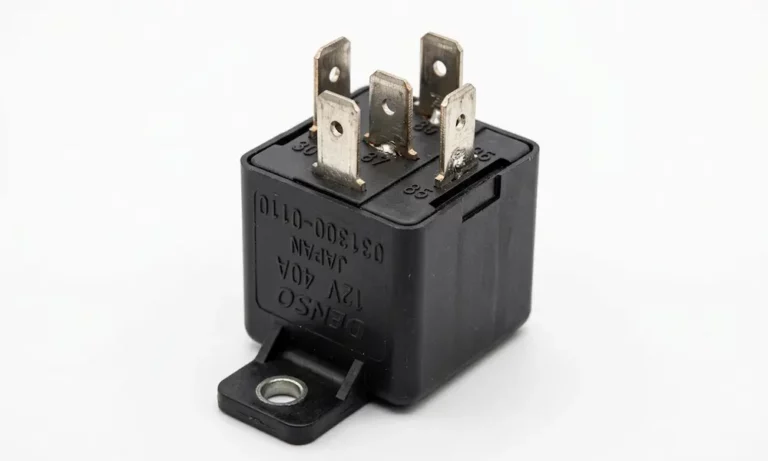
Your car won’t start. You turn the key and get… nothing. Or maybe a click. Or a grind. Before you panic and call a tow truck, the starter relay might be the culprit. It’s a small part, but it controls a massive amount of electrical power. This post walks you through every symptom of a bad starter relay, what each sound means, and how to tell the relay apart from other common failures.
What Does a Starter Relay Actually Do?
Think of the starter relay as a gatekeeper. Your ignition key sends a tiny low-amp signal. The relay catches that signal and uses it to switch on the heavy-duty current your starter motor needs. We’re talking hundreds of amps surging from the battery in an instant.
Your ignition switch can’t handle that kind of current safely. The relay handles it instead, keeping the high-power stuff tucked away in your engine bay while you deal with a simple key turn.
When the relay breaks down, the whole starting sequence falls apart.
Starter Relay vs. Starter Solenoid — Don’t Mix These Up
People confuse these two constantly. They’re both involved in starting your car, but they’re not the same thing.
| Feature | Starter Relay | Starter Solenoid |
|---|---|---|
| Location | Fuse box or firewall | Mounted on the starter motor |
| Current handled | Low to medium (20–40 amps) | High (200–300+ amps) |
| What it does | Switches electrical circuits only | Switches circuits and moves the drive gear |
| Physical size | Small cube, about 1 inch | Cylindrical, 2–3 inches long |
| Wiring | Thin gauge control wires | Heavy gauge battery cables |
The relay tells the solenoid to wake up. The solenoid does the heavy lifting. Both play different roles, and failing to separate them in your diagnosis leads to expensive mistakes.
Symptom #1: Complete Silence When You Turn the Key
Total silence is the most straightforward symptom of a bad starter relay. No clicks. No cranks. No sound at all.
Here’s what’s happening inside the relay: the coil that creates the magnetic field has failed. No magnetic field means the armature never moves. The contacts never close. The starter never gets power. The result is a completely dead response when you turn the ignition.
The key diagnostic trick here? Check your interior lights. If the headlights shine bright and the dashboard lights up normally while the engine stays silent, the battery isn’t your problem. A dead battery would drag those lights down. Bright accessories with a silent engine point directly at the relay or its control circuit.
Also check the fuse for the starter circuit. A blown fuse cuts power to the relay coil, producing the exact same symptom. It’s worth pulling the fuse panel cover and looking for any blackened or melted fuses before you go further.
Symptom #2: Rapid Clicking or Chattering
This one sounds like a machine gun under your hood. You turn the key and get a rapid, staccato click-click-click-click instead of a crank.
This chattering happens because the relay is getting just enough voltage to energize the coil and pull the armature closed. The moment the contacts touch and the starter tries to draw current, the voltage drops. The magnetic field weakens. The spring snaps the armature back open. Voltage recovers. The coil fires again. This cycle repeats dozens of times per second.
A weak battery is the most common cause of rapid clicking. But high internal resistance inside the relay can cause the same thing. If the relay’s contact points are oxidized or corroded, they create an unstable connection that fluctuates under load, even with a healthy battery.
Here’s how to tell the difference:
- Rapid clicking + dim headlights = likely a weak battery
- Rapid clicking + bright headlights = suspect the relay’s internal contacts
Symptom #3: One Click, Then Nothing
A single solid click is a completely different story from rapid chattering.
One heavy click from the engine bay typically means the relay worked fine. It sent the signal. The solenoid tried to throw the drive gear. But something went wrong after that — either inside the solenoid’s high-current contacts or inside the starter motor itself.
One faint click coming from the fuse box area is different. That quiet snap tells you the relay’s armature moved, but the contact points are so damaged that almost no electricity passed through. The starter never got the juice it needed.
Listen closely to where the sound originates:
- Faint click from the fuse box → bad relay contacts
- Solid thud from the engine → solenoid or starter motor issue
Symptom #4: The Engine Keeps Cranking After You Release the Key
This symptom isn’t just annoying — it’s a genuine emergency.
Inside the relay, every time the contacts open or close, a small electrical arc occurs. Over time, that arcing generates enough heat to melt the contact metal — usually a copper or silver alloy. When the contacts fuse together in the closed position, the relay gets stuck “on” permanently.
The starter motor keeps spinning. The engine starts and runs, but the starter stays engaged. You’ll hear a high-pitched whining or grinding as the running engine spins the starter motor at speeds it was never designed to handle.
This is dangerous. Continuous amperage draw will overheat the starter and the battery cables fast. The starter motor can disintegrate internally. The flywheel or flexplate can suffer serious mechanical damage.
If this happens, disconnect the battery immediately to cut the circuit. Don’t wait.
Symptom #5: Intermittent Starting — Works Sometimes, Fails Others
Intermittent failures are the most frustrating symptom of a bad starter relay. The car starts fine on Monday. On Tuesday it does nothing. Wednesday it starts again.
This inconsistency isn’t random. A few things drive it.
Pitting and Carbon Buildup on the Contacts
Every arc inside the relay leaves tiny craters and carbon deposits on the contact surfaces. When the armature falls onto a clean spot, the connection is solid and the car starts. When it lands on a dead spot covered in oxidation, the electricity can’t pass through properly. Sometimes cycling the ignition key a few times shifts the armature to a better landing zone. That’s a temporary workaround, not a fix.
Heat Soak
Here’s a classic scenario: the car starts perfectly in the morning but won’t start after a short stop at the grocery store.
That’s heat soak. After driving, the engine bay temperature spikes significantly. Electrical resistance increases with heat. A relay with partially degraded components might have just enough conductivity when cold, but once everything’s hot, the coil can’t generate a strong enough magnetic field to close the contacts.
Moisture and Contamination
Cracked relay housings or degraded seals let in road salt, moisture, and oil vapors. Moisture can corrode the return spring, causing the contacts to stick closed. Dust can physically block the armature’s movement, creating a buzzing sound as the relay struggles to move. Oil from a leaking valve cover can coat the contacts and block current flow entirely.
How to Tell the Relay Apart From Other Failures
The symptoms of a bad starter relay overlap heavily with other starting system problems. Use this table to narrow things down.
| Variable | Bad Starter Relay | Dead/Weak Battery | Bad Starter Motor | Bad Ignition Switch |
|---|---|---|---|---|
| Interior lights | Bright and steady | Dim or flickering | Bright and steady | May be intermittent |
| Response to jump start | Usually no change | Starts immediately | Usually no change | No change |
| Sound when key turns | Silence or faint click | Rapid clicking | Single heavy click | Total silence |
| Dashboard state | Normal | May reset or dim | Normal | May fail to turn on |
| Intermittency | Common, heat-related | Rare, usually degrades | Common, tapping may help | Common, jiggling key may help |
Also keep the neutral safety switch in mind. On automatic transmissions, this switch prevents starting unless the shifter is in Park or Neutral. A failed neutral safety switch perfectly mimics a dead relay. Try starting in Neutral if Park isn’t working. On manual transmissions, a faulty clutch safety switch produces the same result if the pedal isn’t being read correctly.
A failing ignition switch also looks identical to relay failure. Watch for other electrical gremlins like the instrument cluster not lighting up, or the car stalling unexpectedly while driving. Those point away from the relay.
How to Test the Starter Relay Yourself
The Swap Test
This is the fastest method. Check the fuse box diagram on the underside of the lid. Manufacturers often use identical relays for multiple systems — horn, AC compressor, cooling fan. Find a matching relay with the same part number and pin layout, swap it into the starter relay slot, and try to start the car. If it starts, your original relay is done.
The Jumper Wire Test
Identify the two high-current pins in the relay socket (typically labeled 30 and 87). With the ignition in the “On” position, use a heavy-gauge wire to bridge those two terminals. If the engine cranks immediately, the battery, solenoid, and starter motor are all fine. The relay or its control circuit is the problem. Do this carefully — bridging high-current terminals creates sparks, and the car can move if it’s not in Park or Neutral.
Multimeter Testing
A digital multimeter gives you the most precise picture.
- Coil test: Set the meter to ohms and check resistance across the control pins (85 and 86). A working coil shows a steady resistance reading. “OL” or infinity means the coil wire is broken — the relay can’t create a magnetic field.
- Contact test: While energizing the relay with an external 12-volt source, measure resistance across the power pins (30 and 87). It should read below 5 ohms. High or fluctuating resistance means the contacts are too corroded to carry the current.
- Voltage drop test: With the relay installed and under load during a start attempt, measure voltage at the input pin versus the output pin. A drop of more than 0.2 volts across the relay indicates the contacts are degrading and robbing the starter of power.
Start with the swap test. It takes two minutes and costs nothing. If that’s inconclusive, move to the multimeter. By the time you’ve worked through these steps, you’ll know exactly where the fault sits — and whether it’s a $15 relay or something more involved.

