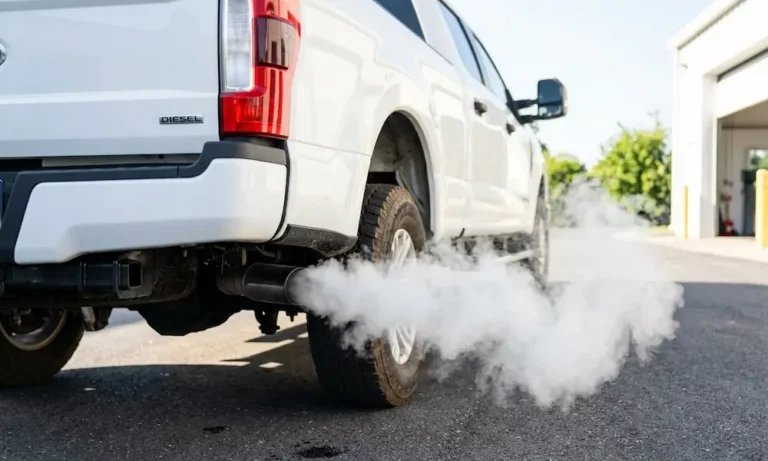
Got a cloud of white smoke puffing from your diesel’s tailpipe? That’s your engine sending an SOS. It could be something simple like morning condensation, or it could signal a serious internal problem. Either way, you need to know the difference fast. This guide breaks down every cause, how to diagnose it, and what happens if you ignore it. Keep reading.
Is White Smoke From Your Diesel Always Bad?
Not always. Sometimes it’s completely normal.
On cold mornings, moisture in the exhaust system condenses. When you start the engine, that moisture gets pushed out as white vapor. It looks alarming, but if it disappears within 60 seconds, you’re fine.
Here’s how to tell normal vapor from a real problem:
- Normal vapor: Thin, disappears quickly, no smell
- Problem smoke: Thick, lingers in the air, smells like diesel fuel or something sweet
If the smoke sticks around after the engine warms up, something’s wrong.
The Two Main Causes of White Smoke From Exhaust Diesel
All white smoke from a diesel engine comes down to one of two things:
- Unburnt fuel leaving the exhaust without burning
- Coolant or water entering the combustion chamber
These two causes look similar but smell completely different and need completely different repairs. Getting this wrong wastes time and money.
Cause #1: Unburnt Fuel in the Exhaust
What Makes Diesel Fuel Not Burn?
Diesel engines use compression heat to ignite fuel, not spark plugs. The piston compresses air so tightly that temperatures spike high enough to ignite fuel the moment it’s injected. Disrupt that heat, and fuel passes through unburnt.
The result? White smoke with a sharp, acrid diesel smell.
Faulty Fuel Injectors
Injectors atomize diesel into a fine mist. When they wear out or get clogged, they spray big droplets instead. Big droplets don’t burn completely in the tiny window of the power stroke.
Worn injectors also “dribble” — they keep leaking fuel into the cylinder after the injection event ends. That extra fuel hits a cooling environment and can’t ignite. According to engine maintenance standards, injectors typically last 150,000–200,000 miles before performance degrades enough to cause issues.
Signs of a bad injector:
- White smoke with a diesel smell
- Rough idle or engine knock
- Poor fuel economy
- One cylinder running “rich” on a scan tool
Retarded Injection Timing
Timing matters more than most people realize. If fuel injects too late in the power stroke, the piston is already descending. Pressure and temperature are dropping fast. The fuel can’t ignite properly, and out comes white smoke.
On older mechanical pumps like the P7100 found in the 12-valve Cummins, a slipped gear shifts the timing retarded. On modern common-rail systems, a failing crankshaft position sensor or miscalibrated ECU can cause the same problem electronically.
Low Cylinder Compression
No heat means no ignition. Low compression is one of the most common reasons diesel engines produce white smoke on cold starts.
Worn piston rings, stuck rings, or leaking valves all bleed pressure out of the cylinder before the fuel ignites. The engine might smoke heavily at startup and clear up once it warms up and metal seals expand, but the wear is still there and getting worse.
Failed Glow Plugs
Glow plugs pre-heat the combustion chamber in cold weather. One dead glow plug means one cold cylinder. That cylinder accumulates unburnt fuel during cranking, then dumps it all as a puff of white smoke when the engine fires.
If the smoke clears after 30 seconds and the idle smooths out, a bad glow plug is likely your culprit. Glow plugs typically last 50,000–100,000 miles and are one of the most overlooked maintenance items on diesel engines.
Cause #2: Coolant Getting Into the Combustion Chamber
How Coolant Creates White Smoke
When coolant sneaks into a cylinder, the extreme heat turns it into steam. That steam exits as thick, billowing white smoke with a distinctive sweet smell — like antifreeze. This is how you tell it apart from fuel-related smoke immediately.
Coolant intrusion is more serious than unburnt fuel. It can destroy your engine fast.
Blown Head Gasket
The head gasket seals the combustion chamber from the oil and coolant passages. When it fails, coolant enters the cylinder during the intake stroke and flashes to steam during the power stroke.
A blown gasket can also allow coolant and oil to mix. Check your dipstick — if the oil looks milky or like a chocolate milkshake, you’ve got coolant contamination. This is a serious mechanical failure that requires immediate attention before hydrolock destroys your engine.
Hydrolock happens when enough liquid coolant fills a cylinder. Liquids don’t compress. The rising piston hits the fluid and bends connecting rods or cracks the block. Repair bills jump from hundreds to thousands of dollars instantly.
EGR Cooler Failure
The EGR cooler uses engine coolant to lower exhaust gas temperatures before recirculating them into the intake. The internal tubes are under constant thermal stress and can crack.
When they do, coolant leaks directly into the intake or exhaust stream. The result is massive white smoke that gets worse as the engine heats up.
The Ford 6.0L and 6.4L Powerstroke engines are notorious for this exact failure. In most cases, a clogged oil cooler causes overheating in the EGR cooler, cracking it from the inside out. The NHTSA has documented numerous complaints related to these cooling system failures in these specific engine families.
Signs of EGR cooler failure vs. head gasket:
| Symptom | Head Gasket | EGR Cooler |
|---|---|---|
| Coolant loss | Rapid | Moderate to rapid |
| Milky oil | Yes (often) | Not always initially |
| Bubbles in coolant | Yes | Sometimes |
| Smoke intensity | Constant | Worsens with heat |
| Smoke location | Tailpipe | Tailpipe + sometimes intake |
Cracked Cylinder Head
A warped or cracked cylinder head creates hairline passages between the coolant jacket and combustion chamber. This failure often happens after an overheating event.
Tricky part: the crack may only open when the engine is hot. So white smoke appears only at operating temperature, not during cold starts. This symptom pattern throws off technicians who focus only on cold-start behavior.
How to Diagnose White Smoke From Exhaust Diesel
You don’t need a full shop to start narrowing this down. Here’s a logical sequence:
Step 1: Use Your Nose
Smell the smoke directly from the tailpipe.
- Acrid, fuel smell → unburnt diesel (injectors, timing, compression)
- Sweet smell → coolant intrusion (head gasket, EGR cooler, cracked head)
- No smell, disappears fast → normal condensation
Step 2: Check Your Fluids
Pull the dipstick and check under the oil filler cap.
- Milky or frothy oil = coolant in the oil = structural seal failure
- Oil level normal, smells like fuel = fuel dilution from leaking injectors
Then check the coolant reservoir. Is it low without any visible external leaks? That coolant is going somewhere — likely into the combustion chamber.
Step 3: Pressure Test the Cooling System
A hand pump pressurizes the system to 15–18 PSI. If pressure drops more than 2 PSI over 15 minutes, you have a leak. A borescope through the injector port can show pooled coolant sitting on top of a piston — a definitive confirmation.
Step 4: Check for Combustion Gases in Coolant
Remove the radiator cap on a cold engine, start it, and watch for bubbles. Steady bubbles mean combustion gases are pushing through a breached head gasket into the coolant. A chemical block test kit turns yellow or gold in the presence of exhaust gases — this test is considered a reliable field diagnostic by automotive professionals.
Step 5: Run Injector Balance Rates
On common-rail systems, a scan tool checks each injector’s balance rate. Normal range is +/- 4.0 mm³ per stroke. If one cylinder shows values beyond +/- 6.0, that injector is delivering the wrong amount of fuel — either too much or too little.
Key Diagnostic Specs at a Glance
| Test | Procedure | Pass | Fail |
|---|---|---|---|
| Cooling system pressure | Pump to 15–18 PSI | Holds 15 mins | Drops >2 PSI |
| Cylinder compression | Gauge via injector port | 350–450 PSI | >15% variance |
| Injector balance rates | Scan tool | +/- 4.0 mm³ | Beyond +/- 6.0 |
| Chemical block test | Reagent kit | Stays blue/green | Turns yellow/gold |
What Happens If You Ignore White Smoke?
Ignoring white smoke is expensive. Here’s the damage chain:
Unburnt fuel acts as a solvent. It strips the oil film off cylinder walls, scores the metal, and dilutes your engine oil. Your crankshaft and camshaft bearings lose lubrication protection. The engine wears itself out from the inside.
Coolant intrusion leads to overheating, head warping, hydrolock, and complete engine failure. It also destroys your Diesel Particulate Filter and Selective Catalytic Reduction system — components that cost thousands to replace.
Beyond your engine, vehicles producing visible white smoke can receive out-of-service orders from regulators in many jurisdictions. For commercial operators, that means lost revenue on top of repair costs.
Preventing White Smoke Before It Starts
Fuel system care:
- Use high-cetane diesel whenever possible
- Replace fuel filters on schedule
- Install a water separator to keep moisture out of injectors
Cooling system maintenance:
- Flush and refill coolant every two years
- Maintain proper antifreeze concentration
- Watch for supplemental coolant additive depletion in heavy-duty applications
Electronic monitoring:
- Modern telematics track coolant levels, EGR temperatures, and injector balance rates in real time
- Catch trends early before a minor issue becomes catastrophic
- Schedule injector replacement proactively at the manufacturer’s recommended interval
White smoke from exhaust diesel is your engine talking. It’s telling you something crossed a line — thermal, pressure-based, or structural. The faster you listen, the cheaper the fix.