
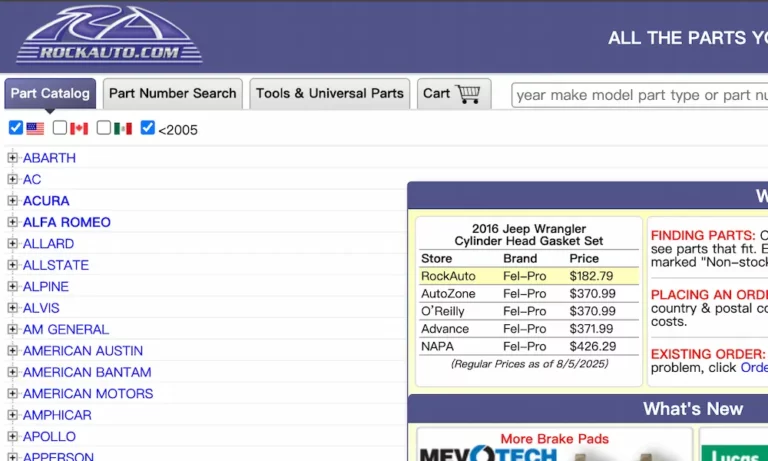
Ever wondered how RockAuto sells auto parts at prices that seem almost too good to be true? You’re looking at alternators that cost half what your local store charges or brake pads at a fraction of dealer prices. It feels like there must be a catch, right?
RockAuto’s rock-bottom pricing isn’t magic—it’s math. Their business model completely rewrites the rules of auto parts retail, cutting out costs that traditional stores can’t avoid. But these savings do come with some trade-offs you’ll want to understand before clicking “checkout.”
How Traditional Auto Parts Stores Price Their Products
The Multi-Layer Markup System
When you buy parts from a traditional auto store, you’re paying for way more than just the part itself. The typical supply chain looks like this:
- Manufacturers add 15-20% markup over production costs
- Distributors tack on another 20-40% for warehousing and logistics
- Retailers pile on a final 40-60% to cover their extensive overhead
This chain of markups means a part costing $100 to manufacture often hits $250-300 by the time you buy it at a local auto store. Each player needs their cut to stay profitable, and you’re footing the bill for all of them.
The Expensive Reality of Brick-and-Mortar Operations
Traditional auto parts stores face massive operational costs that online retailers simply don’t have:
| Expense Category | Annual Cost Range | % of Operating Costs |
|---|---|---|
| Retail Rent | $30,000-80,000 | 10-15% |
| Staff Salaries & Benefits | $150,000-350,000 | 35-45% |
| Utilities | $10,000-25,000 | 3-5% |
| Insurance | $5,000-20,000 | 2-3% |
| Maintenance | $3,000-10,000 | 1-2% |
These overhead expenses represent 25-40% of total operating costs. That fancy store with helpful staff and parts you can touch? You’re paying a premium for that experience.
RockAuto’s Revolutionary Business Model
The Online-Only Advantage
RockAuto launched in 1999 with a simple but powerful idea: cut out the expensive retail middleman. As an online-only retailer, they connect customers directly with a network of manufacturers and distributors.
Instead of costly retail locations, they operate through warehouse facilities in affordable industrial areas. Real estate costs plummet from prime retail rates to basic warehouse rates—often 70-80% less per square foot.
Their catalog system organizes parts by quality tiers, letting you choose between budget-friendly options and premium replacements. With relationships with over 300 manufacturers, they offer both current and closeout parts at significantly reduced prices.
Slashing Overhead Costs to the Bone
RockAuto’s approach is refreshingly no-frills:
- Basic website design focused on functionality, not flashy graphics
- Customer service primarily through email rather than expensive call centers
- No retail amenities or fancy showrooms
- No commissioned sales staff pushing high-margin products
This streamlined approach means RockAuto can pass savings directly to you instead of absorbing them into retail infrastructure. Their bulk purchasing power enables them to negotiate better wholesale rates when buying thousands of parts at once instead of dozens.
Smart Inventory Management
RockAuto doesn’t stock all parts in every location. Instead, they maintain inventory across multiple strategically located warehouses. This distributed system optimizes shipping costs while allowing them to offer an extensive catalog without keeping complete inventory everywhere.
Their “choose for me to minimize cost” feature automatically selects parts and shipping combinations that reduce both product and delivery expenses. This system explains why orders sometimes arrive in multiple packages from different warehouses—a small inconvenience that translates to big savings.
Breaking Down RockAuto’s Cost Structure
Comparing Traditional vs. RockAuto’s Expenses
When we analyze where your money goes, the differences become clear:
| Expense Category | Traditional Store (% of Revenue) | RockAuto (% of Revenue) |
|---|---|---|
| Product Costs | 50-60% | 60% |
| Retail Overhead | 15% | 2% |
| Staffing | 12% | 5% |
| Warehousing | 8% | 12% |
| Marketing | 5% | 8% |
| Profit Margin | 10% | 13% |
RockAuto spends more on warehousing and marketing but drastically cuts retail overhead and staffing. This restructuring allows them to maintain healthy profit margins while still offering significantly lower prices to consumers.
The Closeout Advantage
A significant portion of RockAuto’s competitive pricing comes from relationships with wholesalers specializing in surplus inventory. These closeout parts, while carrying only 30-day warranties instead of full manufacturer coverage, can be priced 30-50% below regular wholesale rates.
The company clearly identifies these closeout items in their catalog, allowing budget-conscious DIYers to access quality parts at substantial discounts. However, closeout inventory fluctuates based on manufacturer overstock, so parts may appear and disappear from the catalog as availability changes.
The Trade-Offs of Rock-Bottom Prices
The Multi-Warehouse Shipping System
RockAuto’s distributed inventory creates shipping complexities that traditional retailers avoid. Orders frequently ship from 2-3 different warehouses, resulting in multiple packages arriving on different days with separate tracking numbers.
While their website attempts to minimize these complications through warehouse icons and shipping calculators, many customers find the system confusing. Heavy items like transmissions or large body panels may incur shipping charges that approach or exceed the savings from lower part prices.
Limited Customer Support Options
Perhaps the biggest trade-off is RockAuto’s minimal customer service infrastructure. The company provides:
- No phone support
- Email-based customer service with 24-48 hour response times
- Return procedures initiated through an automated system
- Limited ability to speak with human representatives
This streamlined approach contributes to cost savings but creates frustration for customers experiencing problems. Issues with wrong parts, shipping damage, or warranty claims can become time-consuming to resolve without direct phone access. The email-only support system works for straightforward transactions but struggles with complex problems requiring immediate resolution.
Understanding Warranty Limitations
RockAuto follows manufacturer warranty policies rather than providing their own product guarantees. This means warranty coverage varies significantly between brands and part types:
- Name-brand parts typically offer 12-month coverage
- Economy options may have shorter warranties
- Closeout items carry minimal 30-day warranties regardless of the original manufacturer’s policy
Return procedures require customers to pay return shipping costs unless the error was RockAuto’s fault. For international customers or those dealing with large parts, return shipping expenses can be prohibitive. The warranty replacement process typically requires customers to purchase new parts first, then return defective items for refunds.
Quality and Authenticity Considerations
Navigating Brand Variety
RockAuto offers parts from recognized industry manufacturers including Bosch, Denso, Moog, and other established brands. Their multi-tier pricing system allows you to select from economy options to premium OEM replacements based on your quality preferences and budget.
However, the extensive catalog and multiple suppliers can create confusion about part compatibility and quality differences. Some customers report receiving parts that appear remanufactured despite being listed as new. The limited customer service makes it difficult to verify part specifications quickly.
Supply Chain Verification Challenges
As an intermediary between manufacturers and customers, RockAuto relies on supplier relationships for inventory authenticity. Their network of over 300 manufacturers and wholesalers requires robust verification systems to ensure parts meet advertised specifications.
The distributed warehouse system makes quality control more challenging compared to centralized operations. Parts may be stored and shipped by third-party facilities that RockAuto doesn’t directly control, potentially creating consistency issues in packaging and handling.
When RockAuto Makes Sense (And When It Doesn’t)
Perfect for Planned Maintenance
RockAuto’s model works exceptionally well for:
- Planned maintenance where you can order parts in advance
- DIY mechanics comfortable researching their own parts
- Budget-conscious car owners prioritizing price over convenience
- Non-urgent repairs where shipping time isn’t critical
Their comprehensive catalog and detailed fitment guides support informed purchasing decisions for those willing to do their homework.
Not Ideal for Emergency Repairs
Traditional retailers maintain advantages for:
- Emergency repairs requiring immediate parts
- Customers needing technical advice or installation guidance
- Those wanting robust warranty support with easy returns
- Professional mechanics with customers waiting for repairs
Many consumers on forums report using RockAuto for planned maintenance items but keeping relationships with local parts stores for urgent needs.
How RockAuto Has Changed the Industry
Forcing Traditional Retailers to Adapt
RockAuto’s success has forced traditional auto parts retailers to reconsider their pricing and service models. The ability to offer parts at 20-50% below traditional retail prices has created pressure throughout the industry to reduce costs and improve efficiency.
Some brick-and-mortar retailers have responded by developing online platforms and adjusting their markup structures. Many now offer price-matching policies specifically targeting online retailers like RockAuto.
Shifting Consumer Behavior
RockAuto’s growth reflects broader changes in consumer automotive purchasing behavior. DIY mechanics and cost-conscious car owners increasingly research parts online and prioritize price over convenience.
However, the tradeoffs in customer service and shipping complexity limit RockAuto’s appeal to consumers requiring immediate support or guaranteed delivery schedules. Professional mechanics and commercial customers often prefer traditional suppliers that provide phone support and predictable delivery times despite higher prices.
Is RockAuto Too Good to Be True?
RockAuto achieves its competitive pricing through systematic elimination of traditional retail costs while leveraging direct distributor relationships and warehouse-based operations. Their online-only model, minimal customer service infrastructure, and distributed inventory system enable significant cost reductions that translate to consumer savings of 20-50% compared to traditional retailers.
These savings come with meaningful tradeoffs in customer service quality, shipping predictability, and warranty support. For planned maintenance and non-urgent repairs, RockAuto’s model offers compelling value. For emergency repairs or customers requiring extensive support, traditional retailers may justify their higher prices through superior service and immediate availability.
The company’s success demonstrates how digital platforms can restructure traditional distribution chains to benefit price-conscious consumers, while highlighting the ongoing value of full-service retail models for customers prioritizing convenience and support over cost savings.


