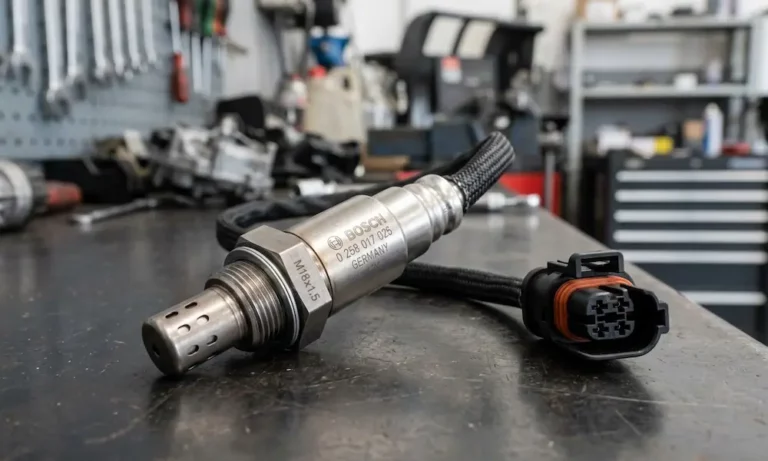
Got a check engine light glaring at you and suspect your O2 sensor’s the culprit? Before you shell out for a new one, cleaning it might actually fix the problem. This guide walks you through exactly how to clean O2 sensor the right way — including what works, what doesn’t, and what could quietly destroy your car if you get it wrong.
What Does an O2 Sensor Actually Do?
Your oxygen sensor monitors exhaust gases and tells your engine computer how much fuel to inject. It does this by comparing oxygen levels in the exhaust stream against fresh outside air.
A healthy sensor switches rapidly between low and high voltage — roughly 0.1V (lean) and 0.9V (rich) — several times per second. When it’s dirty or sluggish, it can’t do that accurately. Your engine guesses wrong, burns more fuel, and your catalytic converter quietly takes the punishment.
The bad news is that a failing sensor can tank your fuel economy by up to 40%. That’s a lot of money disappearing into your exhaust pipe.
Can You Actually Clean an O2 Sensor?
Short answer: sometimes, yes.
Long answer: it depends entirely on why it’s dirty.
According to CarParts.com, cleaning works best for carbon soot buildup from running rich or short-trip driving. It won’t work for chemical poisoning, broken heater circuits, or cracked ceramic elements.
Here’s a quick breakdown:
| Contamination Type | Cause | Cleanable? |
|---|---|---|
| Black, dry carbon soot | Rich fuel mix / short trips | ✅ Yes — high success rate |
| Dark brown oily residue | Oil burning (worn rings/seals) | ⚠️ Low chance |
| White chalky powder | Silicone poisoning | ❌ No — sensor is toast |
| White/green crystals | Coolant leak (head gasket) | ❌ No — ceramic is compromised |
| Reddish/orange tint | Fuel additives (e.g., manganese) | ⚠️ Moderate chance |
If your sensor tip looks black and velvety — good news. If it looks white and chalky, skip the cleaning and order a replacement.
What You Need Before You Start
Gather these before you pull anything apart:
- Oxygen sensor socket — a deep-well socket with a wire slot cut into the side. Standard sockets won’t cut it for most sensor locations.
- Breaker bar or long-handled ratchet — you’ll need the leverage
- Penetrating lubricant (PB Blaster or WD-40)
- Glass jar with a tight lid
- Gasoline or carburetor cleaner
- Soft-bristle brush (an old toothbrush works fine)
- Fuel-resistant gloves and safety glasses
- Digital multimeter — for testing afterward
- High-temp anti-seize compound
Don’t skip the penetrating oil. This installation guide is clear that heat cycles effectively weld sensors into exhaust manifolds over time. Skipping this step often ends with snapped threads and a much bigger repair bill.
How to Remove an O2 Sensor Without Snapping It Off
This part trips people up the most. Take it slow.
Step 1: Let the engine cool completely. Working on a hot exhaust risks burns and makes soft metal threads more likely to strip. The engine must be stone cold before you start.
Step 2: Disconnect the negative battery terminal. This prevents short circuits if your tools touch the sensor wires. It also resets the ECU’s short-term fuel trim memory — a clean slate for testing later.
Step 3: Spray penetrating lubricant around the sensor base. Let it soak for at least 15–30 minutes. If it’s really seized, spray it again and wait another hour.
Step 4: Disconnect the electrical connector. Press the locking tab and pull the harness apart. Check the wires for heat damage, fraying, or oil contamination — those issues can mimic a bad sensor entirely.
Step 5: Fit the O2 sensor socket and apply steady counter-clockwise pressure. Use your breaker bar for leverage. If it won’t budge, Reddit’s mechanic community recommends “working” it — tighten slightly, then loosen — to help penetrating oil wick deeper into the threads. Avoid sudden impact force. It can shatter the ceramic element inside the sensor.
Step 6: If it’s still stuck, heat the exhaust bung (not the sensor itself) with a torch until it just starts to glow. The metal expands slightly, breaking the rust bond. Then turn the sensor.
How to Clean O2 Sensor Step-by-Step
Once the sensor is out, here’s the method that gives you the best chance of success.
The Gasoline Soak Method
This is the most widely used DIY approach for carbon-fouled sensors. Gasoline and carburetor cleaner dissolve organic deposits — carbon soot, light oil residue, and hydrocarbon buildup.
Step 1: Fill a glass jar with gasoline or carburetor cleaner. Carburetor cleaner works faster and hits stubborn carbon harder, but gasoline with detergent additives does a solid job too.
Step 2: Submerge only the metal tip and perforated shroud. Keep the sensor body — where the wires exit — completely out of the liquid. If solvent enters the sensor body, it floods the reference air chamber and permanently ruins accuracy.
Step 3: Seal the jar and let it soak for 8–24 hours. Light fouling needs 8–12 hours. Heavily gunked sensors need the full 24.
Step 4: Swirl the jar occasionally to bring fresh solvent into contact with the element.
Step 5: After soaking, use a soft toothbrush to scrub the exterior of the shroud. Stick to plastic or soft bristles only. It warns against metal wire brushes, as they can leave conductive traces or damage the shroud slots that control exhaust gas flow.
Step 6: Rinse the tip and let it air dry completely. You can use low-pressure compressed air to clear out any trapped solvent inside the shroud. No liquid should remain before reinstallation. Trapped solvent expands fast in a hot exhaust system.
The Fuel Additive Method (Non-Removal Option)
If your sensor’s only starting to show signs of sluggishness and hasn’t thrown a hard fault code yet, We recommend adding a high-concentration fuel system cleaner to your tank. Products with polyetheramines release cleaning vapors as they burn. Drive at highway speeds for 30–60 minutes and those vapors do light cleaning work on the sensor and catalytic converter simultaneously.
This won’t fix a heavily fouled sensor. But it’s a solid preventative measure.
What About the Torch Method?
Some people heat the sensor tip with a propane torch until it glows red to burn off carbon deposits. It can work — but the risks clearly: uneven heat stress can crack the zirconium dioxide ceramic element, and extreme heat can desolder internal connections. Dunking a red-hot sensor in water to shock off carbon? That almost always shatters the ceramic. Not worth it.
Reinstalling the Sensor Correctly
Getting it back in right matters as much as the cleaning itself.
Use Anti-Seize — But Sparingly
Apply a thin layer of high-temp anti-seize to the middle section of the threads only. Never let any touch the perforated shroud or sensor tip. Most anti-seize contains metallic particles or silicone that will poison the platinum sensing elements instantly.
| Anti-Seize Type | Max Temp | Best For |
|---|---|---|
| Copper | 1100°C (2012°F) | General exhaust use |
| Nickel | 1400°C (2552°F) | Turbocharged/high-performance engines |
| Ceramic | 1500°C (2732°F) | Dissimilar metal joints, prevents galvanic corrosion |
| Aluminum | 650°C (1202°F) | Lower-heat, non-critical areas |
Torque It Properly
If you don’t have a torque wrench, This installation tips give a reliable rule of thumb:
- M18 sensors (most common): Finger-tight plus ½ to ¾ turn — about 26–33 ft-lbs
- M12 sensors: Finger-tight plus ¾ to 1 full turn — about 13–17 ft-lbs
Route the wiring exactly as it was. Keep it at least one inch away from hot exhaust components and replace any heat shields or plastic clips you removed.
How to Test If the Cleaning Actually Worked
Don’t skip this part. A visually clean sensor can still be functionally dead.
Test 1: Heater Circuit Resistance
Set your multimeter to ohms and touch the probes to the two heater wires on the sensor connector. A working heater reads 10–20 ohms. An “OL” reading means the internal heater wire is broken — no amount of cleaning fixes that.
Test 2: Live Voltage Switching
Run the engine for 15–20 minutes to reach closed-loop operation. Then check live data with a scan tool or oscilloscope:
- Healthy sensor: Voltage oscillates between 0.1V and 0.9V multiple times per second
- Still dirty sensor: Voltage moves slowly or gets stuck at one value — what techs call a “lazy” sensor
A lazy upstream sensor means the ECU can’t fine-tune fuel delivery — it defaults to a richer-than-needed map, costing you at the pump.
Test 3: Dynamic Response Check
This test is fast and reveals a lot:
- For lean response: Disconnect a large vacuum hose (like the brake booster or PCV hose). The sensor voltage should drop to near 0.1–0.2V immediately.
- For rich response: Briefly spray a small amount of carburetor cleaner into the intake. Voltage should spike to near 0.9V instantly.
Slow reactions mean the sensor’s response time is still degraded. At that point, replacement is the right call.
Why This All Matters for Your Catalytic Converter
Here’s the thing most people don’t think about: a fouled O2 sensor doesn’t just hurt fuel economy. It can destroy your catalytic converter.
When a failed sensor causes the engine to run rich, unburned fuel enters the converter and ignites on the precious metal catalyst surface. Temperatures spike way beyond design limits. The ceramic honeycomb inside melts. Replacing a catalytic converter runs into the thousands of dollars — far more than the $50–$200 cost of a replacement sensor.
Keeping your O2 sensors clean and functional isn’t just a fuel economy win. It’s cheap insurance against a repair that’ll genuinely hurt your wallet.
When Cleaning Won’t Save It
Be honest about what you’re looking at. Cleaning makes sense when:
✅ The tip looks black and sooty from carbon buildup
✅ The engine has been running rich due to a short-trip pattern
✅ There’s no broken heater circuit
✅ No silicone sealant, coolant, or oil ash contamination is present
Replacement is the smarter move when:
❌ The tip shows white powder (silicone poisoning)
❌ You see green/white crystals (coolant in the combustion chamber — fix that head gasket first)
❌ The heater circuit reads open on your multimeter
❌ The sensor still responds slowly after a full 24-hour soak and dry
In those cases, clean the root cause first — leaking injectors, a vacuum leak, worn piston rings — or you’ll foul the new sensor just as fast.