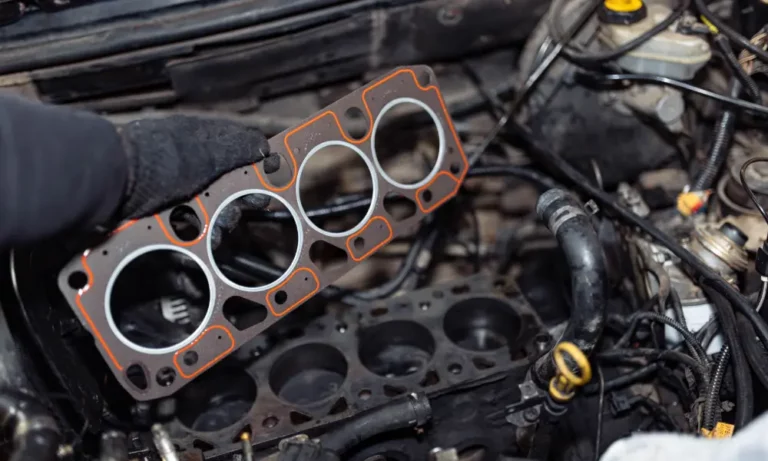
Got a Subaru with a suspicious sweet smell, a climbing temperature gauge, or a mechanic who just said the words “head gasket”? This guide breaks down exactly what’s happening, what it’ll cost you, and how to make sure the repair actually sticks. Read to the end — the section on ancillary replacements alone could save you thousands.
Why Subaru Head Gaskets Fail in the First Place
Subaru’s boxer engine sits flat. Cylinders lie horizontal. That’s great for handling and low center of gravity — but it creates a nasty problem for head gaskets.
When you shut off a conventional engine, fluids drain away from the sealing surfaces. In a boxer engine, coolant and oil pool directly against the gaskets. Every time the engine heats up and cools down, the aluminum block and heads expand and contract — scrubbing those gaskets relentlessly over thousands of cycles.
The result? Head gasket failure became one of the most widely documented reliability issues in modern automotive history.
Two Generations of Failures: Group 1 vs. Group 2
Subaru didn’t have one head gasket problem. They had two, and they’re very different.
| Failure Generation | Production Era | Impacted Models | Primary Failure Mode | Immediate Consequence |
|---|---|---|---|---|
| Group 1 | 1996–1999 | Impreza, Forester, Legacy GT, Outback (2.5L) | Internal leak — coolant enters combustion chamber | Rapid coolant loss, severe overheating |
| Group 2 | 1999–2011 | Impreza, Forester, Legacy, Outback, Baja | External seepage — oil and coolant leak along the block | Slow fluid loss, burning smell, eventual engine damage |
Group 1 failures were brutal and fast. The graphite-coated composite gaskets degraded quickly, coolant disappeared internally, and engines overheated rapidly. If you missed the early signs — an oily film in the coolant reservoir, or a sulfur smell when you popped the cap — the aluminum heads warped and the engine was toast.
Group 2 failures were slower but just as deadly if ignored. The redesigned single-layer stamped gaskets stopped most internal leaks but started weeping externally instead. You’d see green-blue crusty buildup on the block or smell something sweet near the front wheel wells. Independent specialists are blunt about this: these single-layer gaskets will eventually fail on every vehicle that has one, regardless of how well the car is maintained.
Which Engines Are Actually Affected
Not every Subaru engine shares this problem equally.
Most at risk — EJ251, EJ252, EJ253 (SOHC non-turbo, 1999–early 2010s)
These are the engines sitting at the center of the head gasket controversy. They came from the factory with those problematic single-layer gaskets. Failure typically shows up between 100,000 and 120,000 miles. When you replace the gasket on one of these engines, installing another factory gasket is considered malpractice by serious mechanics. You need a multi-layer steel (MLS) gasket.
Turbocharged variants — WRX, Forester XT, Outback XT
These came with robust multi-layer steel gaskets from the factory. Chronic external leaks are rare. When a turbo engine does fail, it’s usually from overheating caused by something else — a dead cooling fan, a blocked radiator, or bad aftermarket mods pushing boost too high.
EZ30 six-cylinder
This engine doesn’t share the typical gasket failure pattern. Instead, watch the heater core. It runs in series with the main cooling circuit, so a restricted heater core chokes coolant flow to the entire engine. The earliest warning sign: a gurgling noise behind the dashboard.
Subaru’s Response — The WWP-99 Service Campaign
When Group 2 failures surged in the early 2000s, Subaru didn’t issue a recall. Instead, in 2004, they launched a voluntary service campaign called WWP-99. Around 376,000 owners of affected 2.5-liter vehicles received letters describing the leaks as a result of “normal expansion and contraction.”
The fix? A free application of Subaru Cooling System Conditioner at the dealership.
Independent analysts quickly identified the conditioner as a repackaged stop-leak additive. Many mechanics warned — and still warn — that stop-leak products can clog radiators and heater cores, causing the exact overheating they’re supposed to prevent.
The warranty extension tied to this program stretched coverage to 8 years or 100,000 miles for external leaks only. It didn’t cover internal leaks, overheating damage, head machining, or secondary engine damage. Miss a coolant flush with Subaru’s specific additive? That extension could be voided entirely.
How to Diagnose a Failing Head Gasket
Subaru head gasket failure progresses in predictable stages. Catching it early keeps your repair bill manageable.
| Diagnostic Stage | Primary Indicator | What You’ll Notice | Confirmation Method |
|---|---|---|---|
| Early | External seepage | Sweet smell near exhaust, green crust on block | Visual inspection during oil change |
| Intermediate | Fluid depletion | Dropping coolant/oil levels, minor temp fluctuations | Cooling system pressure test |
| Advanced | Combustion breach | White exhaust smoke, bubbling overflow reservoir | Chemical block test — blue fluid turns yellow |
| Terminal | Cross-contamination | “Milkshake” consistency oil, rapid overheating | Compression test shows pressure loss |
Two tests confirm internal failure definitively. A compression test checks whether adjacent cylinders hold pressure — a big drop points to a breached gasket between them. A chemical block test draws air from the radiator through reactive fluid. Blue means clean. Yellow means combustion gases are in your cooling system, and your gasket is done.
Don’t ignore the milkshake. If your oil looks like a frothy beige shake, coolant has mixed with it. That mixture has zero lubricating properties and will destroy your bearings fast.
What Subaru Head Gasket Replacement Actually Costs
Here’s the honest breakdown, because the pricing range is genuinely enormous.
Dealerships: Base quotes typically start around $2,000 and climb to $3,800–$5,500 for a standard job. If you drove while the temp gauge was in the red, expect a full short block replacement quote instead — documented dealership quotes run from $8,000 to over $18,000. Some shops deliberately price the job that high on high-mileage vehicles — internally called a “walk-away price” — because the liability of working on a worn engine outweighs the profit.
Independent specialists: A standard head gasket replacement runs $1,200–$3,000 at a reputable independent shop. The real advantage isn’t just price — it’s parts selection. A good specialist installs upgraded MLS gaskets that fix the factory flaw permanently, not the same single-layer gasket that failed in the first place. Look for shops offering a 24-month/24,000-mile warranty on the repair.
“Side work” from unlicensed mechanics: Prices drop to around $1,500, but you give up all legal recourse and warranty protection if something goes wrong on a complex internal repair.
What the Repair Actually Involves
The labor cost is high because the job is genuinely massive. Parts rarely exceed a few hundred dollars — you’re mostly paying for 15+ hours of skilled work.
Most professional shops pull the engine completely. The horizontal layout pins the cylinder heads tight against the inner fender walls, leaving almost no room for torque wrenches inside the engine bay. The teardown involves recovering refrigerant, draining all fluids, disconnecting the wiring harness, unbolting the exhaust, separating the engine from the transmission, and stripping down to the timing components before the heads even come off.
Once the heads are off, they go to a machine shop. Overheating warps aluminum. A warped head installed with a brand-new gasket leaks immediately. Machining the head flat — plus pressure testing for hidden cracks — adds roughly $650 or more to the bill, but it’s non-negotiable for a repair that actually holds.
Reassembly requires following Subaru’s notoriously complex multi-step torque sequence. The EJ25 process involves eight stages — initial tightening, loosening 180 degrees multiple times, retightening to low specs, then two rounds of angular torque at precisely 80–90 degrees each. This stretches the head bolts into their elastic yield zone, distributing clamping force evenly across the new gasket. Skipping steps or using the wrong sequence warps the head on the first startup.
Fix Everything While the Engine Is Out
This is the move that separates a good repair from a great one. While the engine sits on the stand, other wear items are right there, accessible with minimal extra labor. Replacing them now costs only the parts. Replacing them six months later means pulling the engine again.
Replace at the same time:
- Timing belt, tensioners, and idler pulleys — mandatory on interference engines. A snapped timing belt destroys the engine instantly.
- Water pump — already right there. A failed water pump causes the overheating that just destroyed your last gasket.
- Thermostat — cheap insurance, and critical to install with the jiggle pin at the 12 o’clock position for proper air bleeding.
- Rear main seal, front crank seal, cam seals, valve cover gaskets — all seep with age and are nearly impossible to access with the engine in the car.
- Clutch (manual transmission only) — the engine is already separated from the transmission. Replacing an aging clutch here saves up to $1,000 in future standalone labor.
A shop that doesn’t bring up these items during the estimate is either cutting corners or leaving you exposed to a near-future breakdown.
Is the Repair Worth It? Do the Math
A lot of owners see a $3,000 repair bill on a ten-year-old car and want to run. That reaction is understandable but often financially wrong.
Buying a used replacement vehicle means paying sales tax, registration, dealer markup, and assuming a new set of unknown mechanical risks. If the rest of your Subaru — the AWD drivetrain, suspension, and interior — is solid, repairing the engine with upgraded MLS gaskets is frequently the smarter move. You’re not just fixing the gasket. You’re replacing a factory defect with a stronger component. After a proper repair, the engine is mechanically better than it was from the factory.
The key math question: does the repair cost exceed the car’s post-repair value? If yes, trade it. If no, fix it — and fix it right.
The FA/FB Engines: Did Subaru Actually Fix It?
Yes, mostly. By 2010, Subaru transitioned away from the EJ platform toward the FA and FB engine series. These engines featured redesigned blocks, improved cooling channels, and multi-layer steel gaskets as standard equipment across all trim levels.
The chronic head gasket problem is largely absent from FA/FB engines. However, these motors introduced their own issues — oil consumption, upper oil pan seal leaks, and cam carrier seepage. Annoying, yes. Catastrophic engine-destroying failures? Rarely.
If you’re shopping used Subarus and want to avoid the head gasket saga entirely, aim for post-2012 models with FA or FB engines.
FAQs
Does climate affect how quickly the head gaskets fail?
It accelerates things, yes. In cold climates, a freezing engine that heats up rapidly on startup experiences intense thermal shock. Thousands of those cycles in sub-zero temperatures stress the gasket material harder and faster than in mild climates. The root defect is the same — but extreme cold speeds up the timeline.
Does insurance cover a blown head gasket?
Standard auto insurance doesn’t cover mechanical failures. Standard Mechanical Breakdown Insurance (MBI) policies often do cover internal engine failures — but only if operator negligence isn’t involved. Drive through an overheating warning, and the insurer will likely deny your claim. If the claim is approved, expect coverage for the gasket and labor, but not the timing belt, clutch, or other preventive items replaced alongside it.
Can a blown head gasket damage the catalytic converter?
Absolutely. When coolant burns in the combustion chamber, the chemical byproducts coat the delicate precious metal honeycomb inside the catalytic converter. Drive long enough with an internal leak and the converter melts or clogs. You can fix the engine perfectly and still fail an emissions test until you replace the converter — which adds several hundred dollars to the total bill.
What’s the “jiggle pin” and why does it matter?
The thermostat jiggle pin is a small bleeder valve that lets trapped air escape through the closed thermostat as the cooling system fills. Because the boxer engine sits flat, air pockets don’t rise and escape easily. If the jiggle pin is missing or installed at the wrong position — it must sit at exactly 12 o’clock — air gets trapped deep in the engine block, creating superheated dry zones that destroy the new gaskets within miles of the repair.
Does coolant type actually matter after the repair?
Yes, significantly. Subaru specifies non-silicate, non-phosphate antifreeze formulations. Older silicate-based coolants act as fine abrasives inside the water jackets, physically scrubbing gasket surfaces over time. Using tap water instead of distilled water to dilute the coolant introduces minerals that cause scaling and galvanic corrosion inside the aluminum water jackets — weakening exactly the surfaces the new gasket depends on for a proper seal.