Your Subaru’s cooling system is pickier than most. Use the wrong coolant and you’re looking at gelled radiators, eroded head gaskets, and a repair bill that stings. This guide breaks down every validated Subaru super coolant equivalent so you can make a confident, engine-safe choice — stick around, because the mixing section alone could save your engine.
Why Subaru Uses a Special Coolant in the First Place
Subaru’s boxer engine is genuinely different. The cylinders lie horizontally, which means the head gaskets and cylinder heads sit continuously submerged in coolant — even when the engine’s off. That constant immersion creates a demanding chemical environment that older coolant formulas simply can’t handle long-term.
Before 2009, Subaru used a green “Long Life Coolant” built on Inorganic Additive Technology (IAT). It worked, but the protective inhibitors burned through quickly — requiring a change every 30,000 miles or two years.
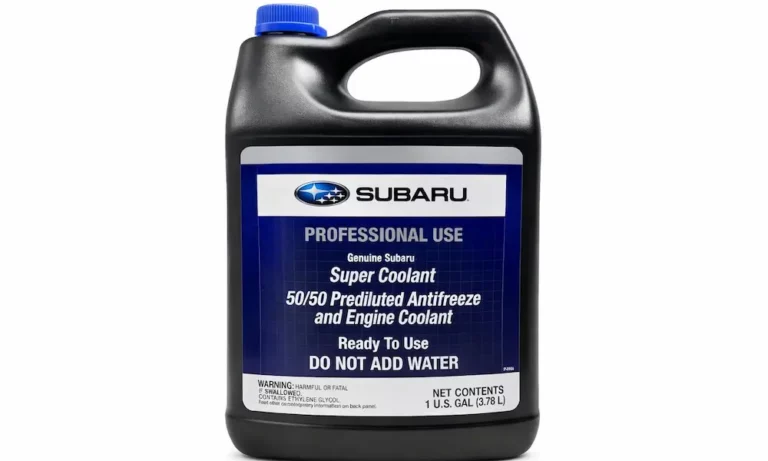
Subaru Super Coolant (Blue), which became standard around the 2009 model year, replaced that with Phosphate Organic Acid Technology (P-OAT). The result? An initial factory fill rated for up to 10 years or 120,000 miles.
| Coolant Type | Color | Technology | Service Interval |
|---|---|---|---|
| Long Life Coolant (LLC) | Green | IAT (Inorganic) | 30,000 miles / 24 months |
| Super Coolant (Blue) | Blue | P-OAT / P-HOAT | 120,000 miles / 120 months |
What Makes Subaru Super Coolant Different
Subaru Super Coolant isn’t just blue dye in a bottle. Its P-OAT inhibitor package is specifically formulated for Asian-market engine metallurgy — particularly the aluminum alloys in Subaru cylinder heads and water pumps.
Here’s what it deliberately doesn’t contain:
- No silicates — silicates can abrade water pump seals and form gels if the system chemistry goes off-balance
- No borates — borates buffer pH but can accelerate aluminum corrosion in certain conditions
- No amines or nitrites — these can react together to form carcinogens and degrade modern gasket materials
The Safety Data Sheet confirms the fluid is an ethylene glycol base (40–55%), water (45–55%), and a small proprietary blend of organic/inorganic acid salts. It’s classified as a reproductive toxin with serious risks if ingested — handle it with gloves and eye protection, and dispose of it properly per local hazardous waste rules.
The Best Subaru Super Coolant Equivalents
Matching Subaru Super Coolant isn’t about finding something blue. It’s about matching the P-OAT chemistry, meeting ASTM D3306 and JIS K2234 standards, and confirming freedom from silicates, borates, nitrites, and amines. These products do exactly that.
Aisin ACB003 — The Closest Thing to OEM
Aisin ACB003 is widely regarded as the gold standard equivalent. It’s produced by CCI Corporation — the same manufacturer behind many Subaru-branded fluids — and cross-references directly to Subaru part number SOA868V9270. If you want OEM chemistry without the OEM price tag, this is it.
It’s a non-silicate, non-amine, non-nitrite, non-borate P-HOAT with a service life of 5 years or 150,000 miles for refill intervals.
Valvoline Zerex Asian Vehicle Blue
Zerex Asian Vehicle Blue is specifically engineered for Subaru, Honda, Acura, Infiniti, and Nissan vehicles. It’s a silicate- and borate-free HOAT that uses phosphate inhibitors to protect aluminum surfaces — exactly what the boxer engine needs.
It comes pre-mixed 50/50 with deionized water, meets ASTM D3306, and carries a 5-year/150,000-mile guarantee. It’s one of the most widely available options in North America.
Peak OET Asian Blue
Peak Original Equipment Technology Asian Blue is purpose-built for Subaru vehicles from 2009 onward. It’s a Phosphate-enhanced OAT (POAT) formulation that meets JIS K2234 and is free of borates, nitrites, silicates, and amines.
Peak claims a service life of up to 15 years or 400,000 miles after a complete flush — one of the longest claims on the market. That figure assumes a clean, properly flushed system with no contamination from older fluid.
Pentosin Pentofrost A3
Pentofrost A3 from Pentosin is a phosphated OAT — categorized as a HOAT in the U.S. market. It meets ASTM D3306 for corrosion and cavitation protection and is manufactured to OE specifications for Asian vehicles. Professionals who want precision formulations often reach for Pentosin.
Prestone Max Asian Blue
Prestone Max Asian Blue covers Honda, Acura, and Subaru 2009 and newer. It uses Prestone’s “Cor-Guard” technology and is claimed to outperform competing fluids on rust and corrosion prevention. Prestone backs it with a 15-year/350,000-mile guarantee — the boldest service life claim in the aftermarket.
Recochem OEM Premium Blue
Recochem’s OEM Extended Life Blue uses proprietary extended-life corrosion inhibitor technology that’s fully compatible with P-OAT systems. It’s recommended for model years requiring phosphate-based OAT coolant and covers up to 150,000 miles.
Quick Comparison Table
| Product | Technology | Color | Service Life | OEM Cross-Reference |
|---|---|---|---|---|
| Subaru Super Coolant | P-OAT / HOAT | Blue | 10 yr / 120,000 mi | SOA868V9270 |
| Aisin ACB003 | P-HOAT | Blue | 5 yr / 150,000 mi | SOA868V9270 |
| Zerex Asian Blue | HOAT | Blue | 5 yr / 150,000 mi | SOA868V9270 |
| Peak OET Blue | POAT | Blue | 15 yr / 400,000 mi | SOA868V9270 |
| Pentofrost A3 | P-OAT | Blue | 5 yr / 150,000 mi | SOA868V9270 |
| Prestone Max Blue | POAT | Blue | 15 yr / 350,000 mi | SOA868V9270 |
| Super Tech OE Blue | P-HOAT | Blue | 5 yr / 150,000 mi | SOA868V9270 |
Never Mix Green and Blue Coolant — Here’s Why
This is critical. Mixing IAT green coolant with P-OAT blue coolant causes a chemical reaction between the inorganic silicates and organic acids. The result is a gelatinous sludge that clogs radiator tubes and the heater core. Your engine overheats. Your cabin heat disappears.
Beyond gelling, mixing chemistries causes “inhibitor dropout” — the protective additives fall out of suspension and form solid deposits. The metals are now unprotected. In a boxer engine where head gaskets stay submerged around the clock, electrolysis kicks in. The coolant becomes electrically conductive, and aluminum at the head gasket interface erodes rapidly until the gasket fails.
If your system has mixed fluids, a simple drain isn’t enough. Here’s the correct remediation process:
- Add a cleaner compound to dissolve particles, sediment, and rust
- Flush the entire system with distilled water until discharge runs completely clear
- Refill with the correct P-OAT coolant at a 50/50 ratio
Color isn’t a reliable chemistry indicator across brands. Don’t assume blue means P-OAT or green means IAT — always check the spec sheet.
What About the Subaru Cooling System Conditioner (SOA635071)?
Subaru’s Cooling System Conditioner (Part No. SOA635071) is a 4.4oz stop-leak additive introduced via Service Bulletin 01-167-08R to address external head gasket weeping common in EJ25 SOHC engines from the early-to-mid 2000s. The bulletin continues to list it as a “Recommended Material” for all Subaru vehicles as recently as 2022.
That said, there’s active debate among specialist shops. The organic inhibitors in Super Coolant Blue may already handle what the conditioner was designed to prevent. Some experienced Subaru technicians also note that the conditioner can restrict radiator passages over time — particularly problematic on high-mileage vehicles. If you’ve already replaced head gaskets with quality multi-layer steel (MLS) versions, many specialists recommend skipping it.
| Item | Part Number | Notes |
|---|---|---|
| Coolant Conditioner | SOA635071 | Required by TSB 01-167-08R — evaluate based on engine series |
| Super Coolant (Blue) | SOA868V9270 | Standard for 2009+ models |
| LLC (Green) | SOA868V9210 | Standard for pre-2009 models |
Flush Intervals and Water Quality — Don’t Cut Corners
The factory interval for Subaru Super Coolant is 11 years or 137,500 miles. But after the first change, most experts recommend a more conservative 6-year or 75,000-mile interval. Residual old coolant always stays in the system after a drain, which dilutes the fresh inhibitor package and shortens its effective life.
If you’re converting an older vehicle from green to blue, don’t stretch it to the 10-year factory spec. Stick to 5 years or 60,000 miles — the system wasn’t originally designed for that extended drain cycle.
When using a concentrated equivalent instead of a pre-diluted formula, water quality is everything. Tap water contains calcium and magnesium that form insulating scale inside the engine and radiator. That scale causes hot spots, reduces heat transfer, and can warp cylinder heads. Always use distilled or deionized water — no exceptions.
What the Standards Actually Mean
Any legitimate Subaru super coolant equivalent must meet two key benchmarks:
ASTM D3306 is the North American standard for ethylene glycol-based automotive coolants. It tests corrosion protection for copper, solder, brass, steel, cast iron, and aluminum — plus cavitation protection for aluminum water pumps.
JIS K2234 is the Japanese Industrial Standard, and it’s often the more stringent test for Subaru applications. Japanese standards are historically stricter about silicate use, which matters because silicates damage the water pump seals common in Asian engine designs. A fluid needs to meet both standards to be genuinely safe for long-term Subaru use.
If a product doesn’t reference both ASTM D3306 and JIS K2234, look elsewhere.