Picking the wrong Subaru Forester trim package is an expensive mistake. Miss a feature you wanted, and you’ll spend years wishing you’d spent $1,500 more. Overshoot your budget, and you’re paying for stuff you’ll never use. This guide breaks down every Subaru Forester trim package — including the new Wilderness and Hybrid — so you buy exactly the right one.
What Every Forester Has in Common
Before we dig into the differences, here’s the good news. Every single Forester — base price or top spec — comes with the same mechanical foundation.
Every trim includes:
- Symmetrical All-Wheel Drive as standard. Not optional. Not an upgrade. Standard. Unlike most competitors, Subaru’s system stays connected to all four wheels all the time, rather than waiting for you to lose traction first.
- A 2.5-liter Boxer engine producing 180 HP and 178 lb-ft of torque
- 8.7 inches of ground clearance (9.3 inches on the Wilderness)
- EyeSight Driver Assist Technology, including pre-collision braking and adaptive cruise with lane centering
That last point matters. Subaru treats safety as a non-negotiable. You don’t have to pay extra for the good stuff.
| Spec | All Standard Gasoline Trims |
|---|---|
| Engine | 2.5L Boxer 4-Cylinder |
| Horsepower | 180 HP |
| Torque | 178 lb-ft |
| Transmission | Lineartronic CVT |
| Ground Clearance | 8.7 inches |
| AWD | Symmetrical, Standard |
Subaru Forester Trim Packages: The Full Lineup
The 2025 and 2026 Forester trim packages break down into five core gasoline levels — Base, Premium, Sport, Limited, and Touring — plus the Wilderness sub-brand and a new Hybrid lineup. Here’s what separates them.
Base: The No-Nonsense Starting Point
The Base trim is exactly what it sounds like. It skips the luxury extras and delivers Subaru’s core strengths at the lowest price point.
You still get LED steering-responsive headlights that pivot with the steering wheel — a genuine safety feature, not a gimmick — plus 17-inch alloy wheels, roof rails, cloth upholstery, and a dual 7-inch StarLink touchscreen. Apple CarPlay and Android Auto work out of the box.
The Base trim is the right pick if:
- AWD reliability is your main reason for buying a Forester
- You don’t need a moonroof or heated seats
- Budget is the priority
Worth noting: the Base trim actually offers the most cargo space — up to 74.4 cubic feet total — because there’s no moonroof eating into headroom.
Premium: The Sweet Spot for Most Buyers
The Premium trim is the volume seller for good reason. It jumps from a 7-inch to an 11.6-inch tablet-style StarLink touchscreen, adds wireless CarPlay and Android Auto, and introduces X-MODE with Hill Descent Control.
X-MODE deserves a mention here. It optimizes the engine and AWD system for low-friction surfaces — think packed snow, gravel, or muddy boat ramps. It’s a real-world feature for anyone in a snowy state.
Other Premium additions:
- Panoramic power moonroof
- 10-way power-adjustable driver’s seat
- All-Weather Package (heated front seats, heated mirrors, windshield wiper de-icer)
- Keyless access with push-button start (added for 2026)
- 4G LTE Wi-Fi hotspot (2026)
If you’re buying one Forester and want a daily driver with modern conveniences, the Premium is your trim.
Sport: Built for People Who Actually Go Outside
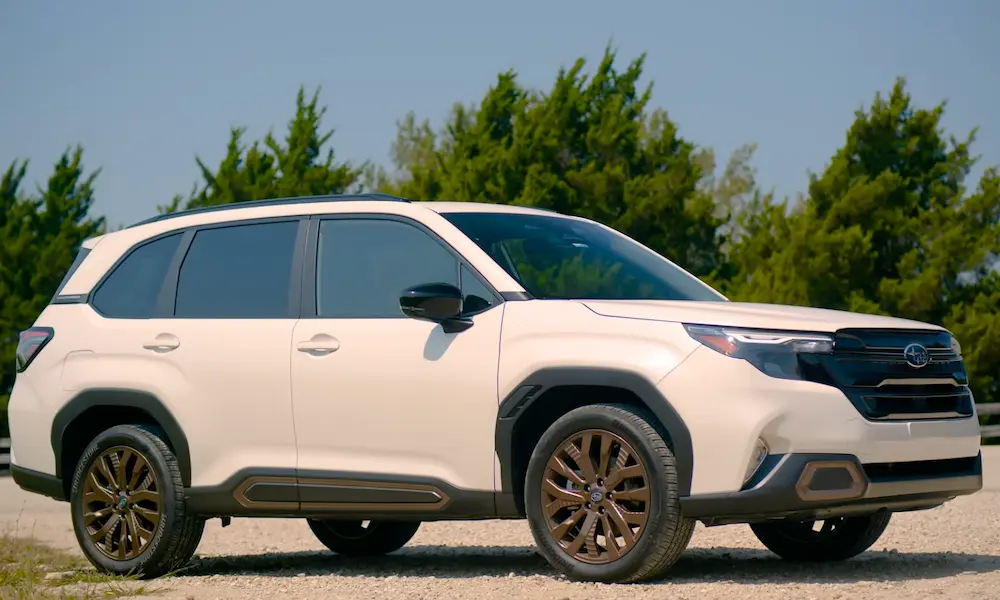
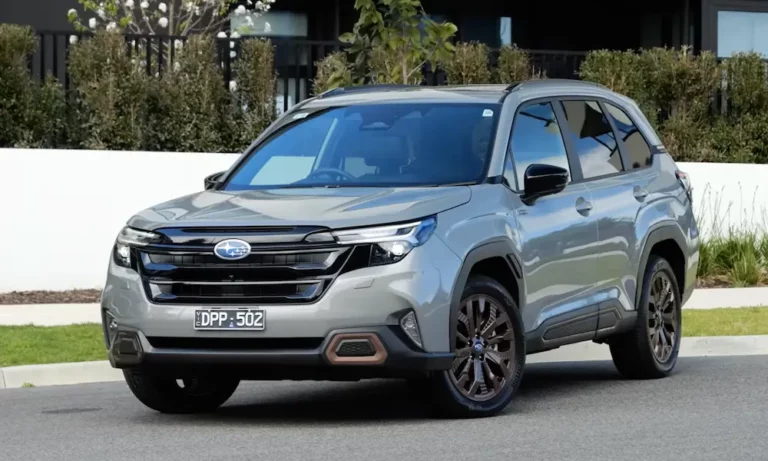
The Sport trim makes a statement before you open the door. 19-inch bronze-finish alloy wheels and matching bronze accents on the grille and cladding give it an aggressive look that stands apart from the rest of the lineup.
Inside, you get dark gray StarTex upholstery — animal-free and water-repellent. Muddy hiking boots, wet swimsuits, dog hair — it handles all of it without drama.
The Sport also upgrades to dual-function X-MODE, which adds a dedicated Deep Snow and Mud setting. This setting actually allows more wheelspin to keep you moving through soft terrain, rather than locking up the wheels and digging yourself in.
The suspension gets a retuned setup for better handling without ruining ride quality, and the CVT gains an 8-speed manual mode with paddle shifters.
2026 Sport Onyx Edition — new for this model year — swaps the bronze accents for dark metallic wheels and black underguards. It also makes the 11-speaker Harman Kardon audio system standard, rather than an add-on.
The Sport hits the mark for buyers who want function and style without jumping to the Limited’s price point.
Limited: Comfort and Convenience Done Right
The Limited shifts focus from sport to refinement. Perforated leather seating replaces StarTex, and the passenger seat adds 8-way power adjustment. You also get a heated steering wheel — small thing, massive difference on a cold morning.
The standout feature here is the foot-activated hands-free power rear gate. Wave your foot under the rear bumper and it opens automatically. It sounds like a novelty until you’re standing in a parking lot holding two bags of groceries and a wet dog.
Safety steps up too. Blind-spot detection with lane change assist and rear cross-traffic alert become standard on the Limited — no option package required. Externally, 18-inch machine-finish alloy wheels round out the look.
The Limited is the right call if leather seats, blind-spot monitoring, and the power liftgate are must-haves for you.
Touring: The Top of the Standard Lineup
The Touring is where the Forester gets genuinely premium. Perforated leather with Ultrasuede bolsters, heated and ventilated front seats, and heated rear outboard seats make long trips noticeably more comfortable.
The big exclusive feature: DriverFocus Distraction Mitigation System. An infrared camera monitors your face and can detect drowsiness or inattention. It sounds unsettling until you’ve driven 400 miles after a bad night’s sleep and realize the car caught you drifting before you did.
Other Touring exclusives:
- 360-degree surround-view monitor for tight parking
- Smart rearview mirror that switches to a camera feed when the cargo area’s loaded
- Heated rear seats
The Touring trim competes with luxury crossovers that cost significantly more. If you want the best safety tech and the most comfort, this is it.
Forester Wilderness: The Off-Road Sub-Brand
The Wilderness isn’t just a trim level. It’s a separate engineering exercise aimed at people who actually use their SUV off-road.
What Makes the Wilderness Different
The 2026 Forester Wilderness gets a suspension lift that pushes ground clearance to 9.3 inches using longer springs and shock absorbers. That extra clearance translates directly to better obstacle clearance on trails.
The geometry changes are significant:
| Metric | Wilderness | Standard Forester |
|---|---|---|
| Ground Clearance | 9.3 inches | 8.7 inches |
| Approach Angle | 23.5° | 19.0° |
| Breakover Angle | 21.0° | 19.6° |
| Departure Angle | 25.5° | 24.6° |
| Towing Capacity | 3,500 lbs | 1,500 lbs |
That towing number is the biggest headline. Standard Foresters tow 1,500 pounds — fine for a small utility trailer. The Wilderness tows 3,500 pounds, which opens the door to teardrop campers and small travel trailers. That jump happens because of an upgraded transmission cooler and a shorter final drive ratio that pulls harder at low speeds.
The CVT also gets shorter gearing for better control on slow-speed technical terrain, and a rear differential temperature sensor protects the drivetrain during extended off-road use.
Outside, you get Yokohama Geolandar all-terrain tires, matte black 17-inch wheels, hexagonal LED fog lights, and underbody skid plates. The roof rails handle up to 800 pounds of static load — enough for a full rooftop tent setup.
For 2026, the Wilderness adds an available 12.3-inch digital gauge cluster with dedicated off-road readouts including pitch and roll indicators.
The New 2026 Forester Hybrid: Worth the Switch?
The 2026 Forester Hybrid is a genuine first for the nameplate. It uses a series-parallel system with a 2.5-liter Atkinson/Miller-cycle Boxer engine and dual electric motors, backed by a 1.1-kWh lithium-ion battery.
| Hybrid Performance | Spec |
|---|---|
| Combined System Power | 194 HP |
| City Fuel Economy (est.) | 35 MPG |
| Highway Fuel Economy (est.) | 34 MPG |
| Total Range | 581 miles |
| Towing Capacity | 1,500 lbs |
That’s a 40 percent improvement in city fuel economy over the standard gas models. The Hybrid keeps all-wheel drive and 8.7 inches of ground clearance, so you don’t give up capability to get better mileage.
The Hybrid comes in four trim levels: Premium, Sport, Limited, and Touring. Every single Hybrid trim includes the 12.3-inch full digital gauge cluster and the 11.6-inch multimedia system with navigation as standard — an upgrade compared to the gas equivalents.
If you’re a daily commuter who drives mostly in the city, the Hybrid pays for itself faster than you’d think.
Option Packages: Adding Features Without Jumping Trims
Subaru uses numbered option packages to let you customize without buying a whole new trim level. Here’s how the main packages stack up:
| Package Code | Key Features | Approx. MSRP |
|---|---|---|
| Code 15 | Power rear gate, blind-spot detection, rear cross-traffic alert | $1,200 |
| Code 24 | Harman Kardon audio, power rear gate, reverse automatic braking | $1,700 |
| Code 33 | Harman Kardon audio, navigation, power rear gate, digital gauge cluster | $2,200 |
| Code 42 | Harman Kardon audio, navigation, reverse automatic braking | $1,600 |
For example, a Premium trim buyer can add Code 15 to get the power liftgate and blind-spot monitoring without buying the Limited. Smart way to build exactly what you need.
EyeSight: What Every Trim Gets (and What You Unlock Higher Up)
EyeSight is standard on every Forester, but the system expands as you move up the trim ladder.
Every trim includes:
- Pre-collision braking
- Adaptive cruise with lane centering
- Lane departure and sway warning
- Pre-collision throttle management
The third wide-angle mono camera added for the sixth generation significantly improves the system’s ability to detect pedestrians approaching from the sides — a major real-world upgrade.
Higher trims (Limited and above) unlock:
- Blind-spot detection with lane change assist
- Rear cross-traffic alert
- Automatic emergency steering
- Reverse automatic braking (Sport, Limited, Touring)
These additions use radar sensors in the rear bumpers, not just the front cameras. Together, they give you a safety bubble around the entire vehicle, not just the front.
Which Subaru Forester Trim Package Is Right for You?
Here’s the honest, no-fluff version:
- Base — You want AWD and safety tech, nothing else matters
- Premium — Daily driver for a family; heated seats and moonroof are non-negotiable
- Sport — You’re active outdoors and want looks that match your lifestyle
- Limited — Leather seats, hands-free liftgate, and blind-spot monitoring are must-haves
- Touring — You want the best safety tech and the most comfort available
- Wilderness — You actually go off-road, or you need to tow more than 1,500 pounds
- Hybrid — You commute daily and want to stop feeling guilty at the gas station
The 2026 Forester is built at Subaru of Indiana Automotive in Lafayette, which improves U.S. availability and speeds up delivery for custom orders. And with 96% of Foresters sold in the last decade still on the road today, you’re buying a vehicle that’ll stick around.
Whatever trim you land on, you’re not compromising on the fundamentals. That’s the whole point of the Forester lineup.