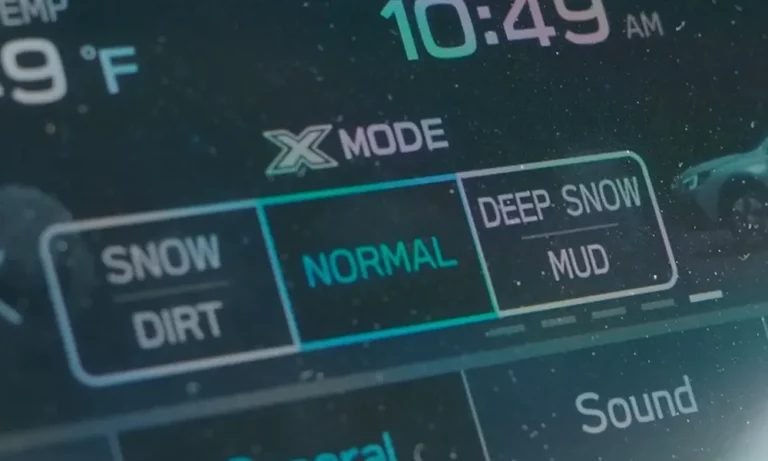
Ever wondered what that X-Mode button actually does — and whether you should press it? You’re about to find out. This guide breaks down exactly how Subaru X-Mode works, what happens under the hood when you engage it, and which settings to use in snow, mud, or steep descents. Stick around, because the details here could save your drivetrain.
What Is Subaru X-Mode?
Subaru X-Mode isn’t a separate piece of hardware bolted to your car. It’s a software-defined control system that coordinates your engine, transmission, AWD clutch, and brakes into one unified traction-focused mission.
Think of it as your car switching from “commuter mode” to “get me through this” mode with a single button press.
In normal driving, each system optimizes independently — the engine chases efficiency, the CVT shifts high, and the AWD runs front-biased. When you engage X-Mode, all of that changes. Every system reconfigures to prioritize grip over economy.
It’s particularly valuable because Subaru’s CVT — great on the highway — defaults to high gear ratios and low engine speeds. Those settings work against you on slick trails or deep snow. X-Mode fixes that conflict.
How Subaru X-Mode Works: The Five Systems It Controls
1. Engine Throttle Mapping
On a slippery surface, even a small throttle surge can break traction instantly. X-Mode instructs the ECU to soften the throttle map — meaning you need more pedal travel to get the same throttle response.
This acts as a digital buffer between your foot and the engine. Torque builds gradually, letting the tires search for grip rather than spinning out. Once the system senses stable traction, it progressively allows more power to maintain momentum through deep slush or sand.
2. Transmission Control (CVT)
The CVT normally hunts for the highest, most efficient gear ratio. X-Mode overrides this and forces lower gear ratios for maximum torque multiplication — similar to engaging “Low Range” on a traditional 4×4.
It also modifies the transmission’s lock-up clutch. In off-road conditions, the system may deactivate it so the torque converter can absorb terrain shocks more effectively and better redirect power after a slip event.
3. AWD Coupling
Standard AWD in CVT Subarus runs a front-biased torque split for efficiency. When X-Mode engages, hydraulic pressure on the AWD coupling clutch increases significantly, pushing the system toward a more even front-rear split — before any wheel slip even occurs.
This “pre-loading” means if your front wheels hit ice, the rears are already pulling their weight. You don’t lose momentum waiting for the system to react.
4. Vehicle Dynamics Control (Brake-LSD Simulation)
Open differentials send torque to whichever wheel has the least resistance. In off-road conditions, that’s usually the wheel that’s spinning in mid-air or stuck on ice — not helpful.
X-Mode recalibrates the VDC to act like a virtual limited-slip differential. When a wheel spins, the system instantly applies the brake to that wheel, forcing torque through the differential to the wheel that actually has grip. As long as one wheel bites, you keep moving.
5. Hill Descent Control (HDC)
HDC is X-Mode’s most underrated feature. It operates as an automated low-speed brake system for descents, functional below 12 mph.
Remove your feet from the pedals entirely. The ABS actuator pulses the brakes on individual wheels to hold a steady, predictable descent speed. You focus on steering — the car handles the speed. If you want control back, just tap the brake or gas and HDC releases instantly.
X-Mode Subsystem Summary
| System | Normal Mode | X-Mode Active | Goal |
|---|---|---|---|
| Engine (ECU) | Linear throttle response | Softened throttle map | Prevent wheel spin on slick surfaces |
| Transmission (CVT) | High gear ratios for efficiency | Holds lower ratios | Torque multiplication and engine braking |
| AWD Clutch | Front-biased split | Increased coupling pressure | Proactive power to all four wheels |
| VDC / Braking | Stability-focused | Aggressive brake-LSD logic | Redirect torque from spinning to gripping wheels |
| HDC | Manual braking | Automated below 12 mph | Steady descent speed for steering focus |
Single X-Mode vs. Dual-Function X-Mode
Not all X-Mode setups are equal. Base trims on most Subaru models get single-mode X-Mode, while higher trims unlock Dual-Function X-Mode — two distinct settings for two very different types of terrain.
Snow/Dirt Mode
This is the original X-Mode logic, refined. It’s built for surfaces with a solid base — packed snow, icy roads, gravel, hard dirt. The goal is preventing wheel spin entirely. The throttle taming and brake-LSD functions work together to keep your tires hooked up and your stability intact.
Deep Snow/Mud Mode
This one flips the script. On soft, viscous surfaces, stopping wheel spin is the wrong strategy. Tires need to spin to self-clean and keep biting through mud. They need momentum to float over deep snow rather than sink.
Deep Snow/Mud Mode relaxes the VDC logic and allows controlled wheel spin. The system lets the engine rev higher and the wheels rotate faster than the vehicle’s actual ground speed — all while maintaining brake-LSD to keep power balanced across the axles. It’s a smarter, more permissive approach to messy terrain.
When to Use X-Mode (And When Not To)
You can engage X-Mode at speeds below 25 mph, but the system only enters full operation below 18 mph. Above that threshold, it drops into standby or deactivates automatically.
Use X-Mode when:
- Driving on icy roads or packed snow
- Navigating muddy trails or unpaved forest roads
- Descending steep, slippery hills
- Driving through deep snow or heavy slush
- Tackling loose gravel at low speed
Don’t use X-Mode when:
- Driving on dry pavement at normal speeds
- Cruising on the highway
- Roads are clear and traction is excellent
Using it on dry pavement at speed causes unnecessary drivetrain wear and kills fuel economy. It’s a tool for specific conditions — not a permanent setting.
Subaru Wilderness: When Hardware Meets X-Mode Software
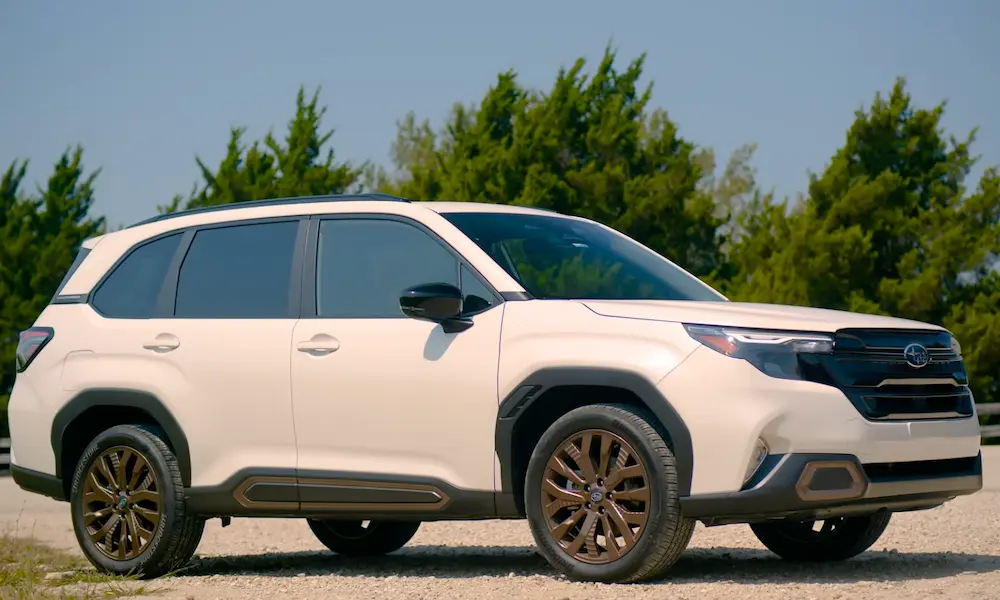
The Wilderness lineup (Crosstrek, Forester, Outback) doesn’t just run X-Mode software on standard hardware. Subaru redesigned the underlying drivetrain to amplify what X-Mode can do.
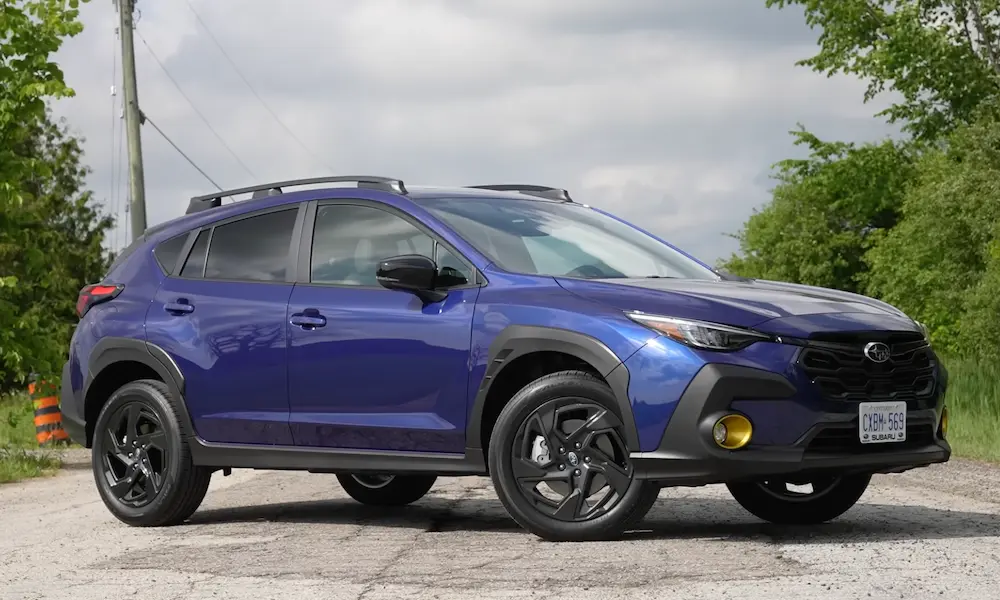
The Crosstrek Wilderness uses a higher final drive ratio than standard trims, delivering more torque at the wheels at any given engine speed. Combined with an exclusive “Low Speed / Low Ratio Gradient Control” feature — which locks the CVT to its absolute lowest ratio on steep inclines — you get crawl capability that standard Subarus simply can’t match.
Wilderness models also add a dedicated transmission oil cooler, which isn’t just a nice extra. Extended X-Mode sessions generate serious heat in the CVT. Without additional cooling, fluid degrades, and CVT variator damage can cost thousands to repair. The oil cooler also allows Wilderness trims to tow up to 3,500 lbs — double the standard trim capacity.
Standard vs. Wilderness: Key Differences
| Feature | Standard Trim | Wilderness Trim | Impact |
|---|---|---|---|
| Final Drive Ratio | 3.700:1 | 4.111:1 | More low-end torque |
| Transmission Oil Cooler | No | Yes | Better durability under sustained load |
| Ground Clearance | 8.7 inches | 9.2–9.5 inches | Less risk of high-centering |
| Tires | All-Season | Yokohama GEOLANDAR® A/T | Better mechanical grip |
| Towing Capacity | 1,500 lbs | 3,500 lbs | Haul heavier gear and trailers |
Subaru X-Mode vs. The Competition
The adventure crossover segment is crowded, but not all traction systems are built the same way.
Toyota RAV4 Trail Mode uses a rear electric motor in hybrid models. It’s efficient, but battery state-of-charge and thermal limits can constrain rear torque delivery. Subaru’s mechanical AWD connection can direct more available engine torque to the rear under heavy demand. In diagonal slip tests — where two wheels are off the ground — the Forester Wilderness consistently outperforms the RAV4 Woodland.
Mazda CX-50 Off-Road Mode is excellent for gravel and light snow. It raises idle RPM and increases AWD engagement, but it lacks a sophisticated automated Hill Descent Control, and lower ground clearance limits its real-world trail capability.
Honda CR-V TrailSport leans heavily on software tweaks and all-terrain tires. Without the mechanical advantage of a proper torque-vectoring system, it’s better described as a ruggedized commuter than a genuine trail vehicle.
2025–2026 Competitive Comparison
| Model | Ground Clearance | AWD Type | Hill Descent Control | Towing |
|---|---|---|---|---|
| Subaru Forester Wilderness | 9.2 in | Symmetrical Mechanical | Yes (HDC) | 3,000 lbs |
| Toyota RAV4 Woodland | 8.6 in | Hybrid e-AWD | Yes | 3,500 lbs |
| Honda CR-V TrailSport | 8.2 in | Reactive AWD | No | 1,000 lbs |
| Nissan Rogue Rock Creek | 8.2 in | Reactive AWD | No | 1,500 lbs |
| Mazda CX-50 Meridian | 8.6 in | i-Activ AWD | Basic | 3,500 lbs |
X-Mode in the Subaru Solterra: The EV Version
The Solterra required a complete rethink of X-Mode. In a combustion engine, there’s a delay between pressing the pedal and torque arriving at the wheels. Electric motors deliver torque almost instantly.
The Solterra’s dual-motor setup allows independent torque control of each axle — no driveshaft, no mechanical clutch required. X-Mode on the Solterra operates with more precision than any combustion vehicle can match.
It also introduces Grip Control — a step beyond Hill Descent Control. While HDC only works on descents, Grip Control lets you set a target crawl speed between 2 and 6 mph on any terrain — uphill, downhill, or flat. The motors modulate output and regenerative braking automatically. You steer, the car handles the rest.
X-Mode Across the 2025–2026 Subaru Lineup
| Model | Single X-Mode | Dual-Function X-Mode | Notes |
|---|---|---|---|
| Crosstrek | Base | Premium, Sport, Limited, Wilderness | Wilderness adds 9.3″ clearance |
| Forester | Premium | Sport, Wilderness, Limited, Touring | Wilderness adds 9.2″ clearance |
| Outback | Base, Premium, Limited | Onyx, Wilderness, Touring | Wilderness adds 9.5″ clearance |
| Ascent | Base, Premium | Limited, Touring | Standard 8.7″ clearance |
| Solterra | N/A | All Trims (Standard) | Includes Grip Control |
In the 2026 Outback, X-Mode controls moved into a 12.1-inch touchscreen running a Qualcomm Snapdragon processor — and Subaru can now push over-the-air updates to refine the traction logic as real-world driving data comes in. That’s a notable shift: your X-Mode software can actually improve over time without a dealership visit.
Maintenance Matters: Protecting Your Drivetrain When Using X-Mode Regularly
X-Mode’s brake-pulsing and high-pressure AWD engagement generate significant heat. If you use it often, the standard maintenance intervals aren’t enough.
| Component | Standard Interval | Severe/X-Mode Interval | Why |
|---|---|---|---|
| CVT Fluid | 100,000 miles | 30,000–40,000 miles | Heat cycles oxidize fluid faster |
| Differential Fluid | 60,000+ miles | 30,000 miles | Trail use causes water and mud contamination |
| Brake Fluid/Pads | Wear-based | Every 2 years / 30,000 miles | HDC’s constant pulsing boils brake fluid |
| Cooling System | 100,000 miles | Annual inspection | Mud and debris block airflow |
One more thing: don’t substitute generic CVT fluid. Subaru’s High Torque CVTF is chemically formulated for the pressures X-Mode demands. Off-brand fluid causes CVT shuddering during X-Mode engagement and can trigger error codes like P0841 or P0868. It’s not worth the savings.
Real-World Limits: What X-Mode Can’t Do
X-Mode is genuinely impressive — but it has hard limits worth knowing.
Ground clearance is physics, not software. Standard Subarus have 8.7 inches of clearance. If your chassis rests on a rock or snow mound, no traction software in the world will move it. Wilderness models help with their extra half-inch to three-quarters of an inch of clearance, but even those have limits.
Deep sand can outsmart the system. In some sand conditions, maintaining high wheel speed is what keeps you floating on the surface. If X-Mode reads that as wheel spin and applies brakes, you lose momentum and sink. Experienced off-roaders sometimes disable traction control entirely in deep sand — even with X-Mode active for throttle control.
Brake fade on long descents is real. HDC constantly pulses the brakes to hold speed, which builds heat in the rotors. On a very long steep descent, the brake fluid can approach its boiling point. For moderate grades, using the CVT’s paddle shifters to engine-brake is a smarter, cooler strategy — saving HDC for the genuinely technical sections.
Subaru X-Mode is one of the most capable traction management systems in the crossover segment. Used correctly, it turns a capable commuter into a genuinely confident trail machine. Use it in the right conditions, maintain your drivetrain on an appropriate schedule, and it’ll keep delivering — whether that’s a snowy driveway in January or a muddy forest road in October.