Your Subaru key fob stopped working, and now you’re standing in a parking lot wondering what to do next. Whether it’s a dead battery, a new fob that won’t sync, or a replaced key that just won’t start the engine — this guide covers every era of Subaru key fob programming, from the late ’90s to today’s digital key systems.
First, Know Which Type of Subaru System You Have
Before you touch anything, you need to identify your system. Subaru has used several completely different programming architectures across four decades of vehicles. Using the wrong method wastes your time and can lock out your system entirely.
Here’s a quick reference:
| Era | Years | Fob Type | Programming Method |
|---|---|---|---|
| Alpine/Code Alarm | 1990–2000 | Basic remote | Physical button under dash |
| On-Board Sequence | 2000–2004 | Teardrop | Ignition + door lock switch |
| 8-Digit Serial Code | 2005–2014 | Teardrop/Head-Key | Manual code entry |
| Proximity Smart Key | 2015+ | Bulging rectangle | OBD-II diagnostic tool |
| Digital Key | 2023+ | Smartphone app | Over-the-air via Bluetooth |
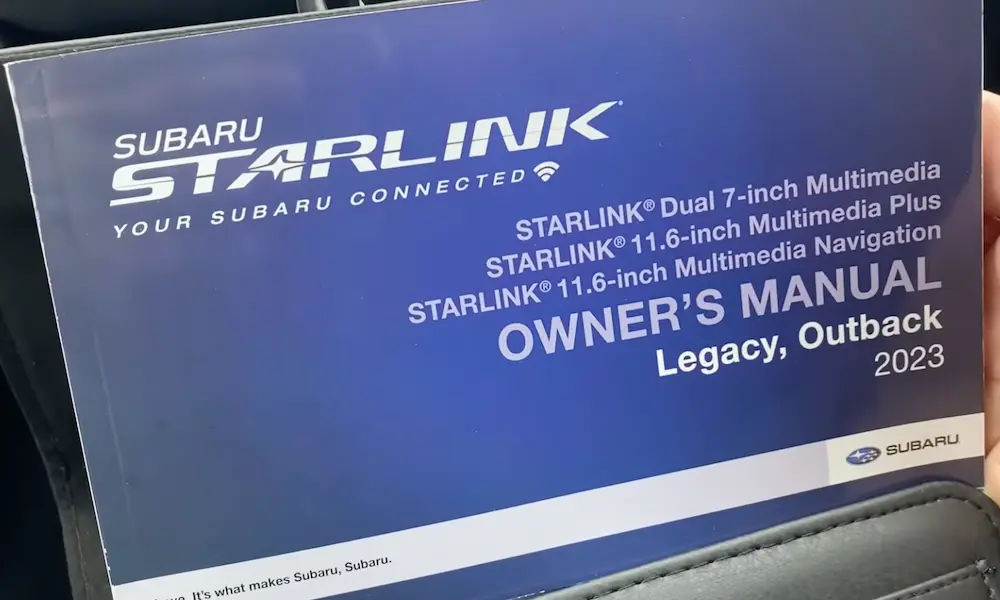
Your owner’s manual and the fob’s physical shape are your two fastest clues. When in doubt, check your VIN — it tells a technician exactly which version of hardware your car uses.
How to Program a Subaru Key Fob on Older Models (2000–2004)
If you drive an early 2000s Legacy, Outback, or Impreza, you can often handle Subaru key fob programming yourself without any tools.
Here’s the sequence for the 2000–2004 Outback and Legacy, as documented in Subaru’s own keyless entry guides:
- Sit in the driver’s seat and close all doors
- Hold the Unlock side of the power door lock switch
- While holding it, cycle the ignition key six times within 10 seconds
- Watch for the turn signals to flash three times — that’s your confirmation
- Press any button on the fob within 45 seconds
- The turn signals flash again to confirm the fob registered
For models between 1999 and 2002, the process used a small physical programming button mounted under the dashboard on the driver’s side. You’d hold it for 15 seconds until the siren chirped three times, then press your fob button. Simpler, but you need to find that button first.
Important: Some early Foresters with automatic transmissions could only register one key unless you physically disconnected the Green Connector on the Transmission Control Unit during programming. This quirk stems from Subaru’s early shared communication bus design.
The 8-Digit Code Method (2005–2014 Models)
This is where Subaru key fob programming gets genuinely tricky. Models like the Impreza, Forester, Outback, and Legacy from this era use a unique 8-digit serial number printed on the circuit board inside each fob.
You don’t just press a button — you manually type the code into the car using the door lock switch.
How to Find Your 8-Digit Code
Open the fob by removing the battery cover and the battery. Look at the internal circuit board. The 8-digit number is printed directly on the PCB. Write it down before you close anything up.
The Programming Sequence
This method involves ten ignition cycles in 15 seconds — which sounds easy until you try it:
- Start with all doors closed and the key out of the ignition
- Turn the key to “On” and back to “Lock” ten times in 15 seconds — don’t start the engine
- The car chimes and the dome light flashes to signal you’re in programming mode
- You now have 45 seconds to enter each digit:
- Press the Lock button the number of times equal to each digit
- Press the Unlock button to advance to the next digit position
- For a zero, press Lock ten times
- After entering all eight digits, the hazard lights flash to confirm success
Why This Fails (And How to Fix It)
The most common failure point is the ignition cylinder itself. Subaru’s mechanical ignition detent requires pushing the key slightly inward to reach the Lock position, which slows most people down enough to miss the 15-second window.
The fix: practice the motion a few times before you start counting. If you fail, start the car, shut it off, and try again — this clears the BIU’s temporary buffer.
Also know that most Subaru systems from this era cap out at four registered fobs. If the memory is already full with old keys from a previous owner, you can’t add yours until the old codes get wiped — and that usually requires a diagnostic tool.
The Immobilizer Is a Separate System
Here’s something that confuses a lot of Subaru owners: programming your remote to lock and unlock the doors doesn’t mean your car will start.
The engine immobilizer is a completely separate system that reads the transponder chip inside your physical key. Subaru’s security design creates a “triangle” between the key chip, the ECU, and in some models the instrument cluster — all three must recognize each other before the engine fires.
Subaru has used three main transponder types:
- Non-immobilizer keys — Basic metal keys with no chip, found in earlier 2000s Forester X trims
- G-type keys — Mid-2010s standard; require advanced diagnostic tools to register
- H-type keys — Used from around 2018 onward; high-security encryption, often dealer-only for programming
If you replaced a key and the car won’t start even though the remote works, the transponder chip isn’t registered. A Subaru Diagnostic System (SDS) connection or equivalent aftermarket tool is the only fix.
Proximity Keys and Smart Fobs (2015 and Newer)
The bulging rectangle fob that came with your push-button start Subaru uses a completely different approach. These fobs use DST AES encryption and communicate with sensors in the door handles, center console, and rear cargo area via low-energy radio.
There’s no DIY ignition sequence here. These fobs require a bi-directional handshake through an OBD-II diagnostic tool. That means a trip to a locksmith or dealer.
The PIN Code Access Feature
If you have a newer Subaru with a rear liftgate, check the hatch for a small button. This is the PIN Code Access feature, which lets you tap a 5-digit code to unlock the car when your keys are inside. It’s genuinely useful for hiking, biking, or any activity where you don’t want to carry a fob.
Programming it requires a working fob and a coordinated sequence of presses between the fob’s lock button and the hatch request switch.
Battery Replacement: The Quick Fix You Might Be Overlooking
Before you go down the programming rabbit hole, replace the battery. A weak battery causes the exact same symptoms as a sync error — intermittent response, short range, or complete failure.
Subaru uses three coin-cell types depending on the fob:
- CR2032 — Proximity/smart keys; replace every three years due to constant polling drain
- CR2025 — Teardrop fobs; solid middle-ground between size and capacity
- CR1620 — Integrated head-keys; smallest form factor
Experts recommend swapping the battery if it reads below 2.5V on a multimeter. Also note that moisture damage is a common cause of fob failure — Subaru fobs aren’t waterproof, and wet internals corrode the antenna traces silently over time.
Dealer vs. Locksmith vs. DIY: What It Actually Costs
The cost of Subaru key fob programming has climbed sharply as the technology has advanced. A basic teardrop fob from an online marketplace runs $20–$60. A proximity key for a 2025 Outback can exceed $400 before programming.
Here’s how the service options compare:
- Subaru Dealership: Highest cost. OEM fobs plus a flat programming fee. They access Subaru’s Lock Information Site (SLIS) via the SDS system, which requires verified ownership and charges per immobilizer request. Expect to provide your driver’s license, vehicle title or registration, and sign Form D-1 for their records.
- Automotive Locksmith: Typically 30–50% cheaper. Mobile service eliminates towing costs for all-keys-lost situations. Many use professional tools like the ABRITES SB002 (which supports 2021+ models and can perform Smart System Resets) or the Autel MX808S for broader 2000–2020 coverage.
- DIY: Only viable for teardrop-era fobs. Total cost is the fob itself. No labor, no appointment, but requires patience with the timing sequences.
One caution on cheap aftermarket fobs: a fob can look identical to the original but contain the wrong chip type. In the 2025 Forester, the trim level determines which version of part number 88835XC00A you need. Programming a mismatched fob burns the technician’s time — and you’ll likely still get charged even if it doesn’t work.
This official NHTSA service bulletin also outlines key security compliance requirements worth understanding if you’re dealing with a dealer or professional service.
What’s Next: Digital Keys and the Solterra
The 2023+ Solterra takes Subaru key fob programming in a completely new direction. There’s no physical fob required at all. The Digital Key system delivers an over-the-air credential to your phone through the Solterra Connect app, which pairs via Bluetooth Low Energy. You hold your phone near the start button to finalize pairing, and you can share access with up to seven drivers — no keys, no codes, no ignition cycles.
It’s a complete departure from everything above. And it’s where the rest of the lineup is heading.
Whether you’re typing an 8-digit code into a 2008 Forester or setting up a digital key on a new Solterra, the most important step is always the same: confirm exactly which system your VIN uses before you start. Get that right, and the rest follows.