You found an old car seat in the garage, and you’re wondering if it’s still safe to use. It might look perfectly fine—but looks can be deceiving with car seats. Here’s everything you need to know about how long car seats are good for, when to toss one, and what to do with it when it’s done.
Car Seats Actually Expire—Here’s Why
Yes, car seats have expiration dates. And no, it’s not a marketing trick to make you buy a new one.
A car seat is a precision safety instrument, not a piece of furniture. The materials that protect your child during a crash—plastic shells, energy-absorbing foam, and harness webbing—all break down over time.
Think about what a car seat endures every single day. Summer heat can push interior temperatures past 140°F. Winter drops them below freezing. UV rays pour through the windows. Every buckle, click, and adjustment wears at the webbing. After years of this, the materials degrade in ways you can’t see—until a crash reveals the damage.
What Actually Breaks Down Inside a Car Seat
The Plastic Shell Gets Brittle
The outer shell is made from high-impact plastic polymers. These absorb and redirect crash energy to protect your child. But repeated heating and cooling causes the plasticizers in the shell to break down over time, making the plastic brittle.
A new seat shell flexes slightly under crash forces. An old, brittle shell shatters. That’s the difference between a working restraint system and a catastrophic failure.
UV rays speed this process up even when the seat isn’t in direct sunlight.
The Foam Stops Absorbing Energy
Beneath the fabric cover, layers of expanded polystyrene or polypropylene foam cushion your child’s body during impact. Heat and humidity compress and dry out this foam over time. Once the foam loses its resilience, it can’t absorb crash energy—and that energy transfers directly to your child’s body instead.
The Harness Webbing Weakens
Micro-abrasions from daily tightening and loosening, plus exposure to food spills and cleaning products, weaken the harness fibers over time. The buckles and adjusters collect debris and can corrode internally without showing any visible damage.
During a crash, a harness must withstand thousands of pounds of force. A compromised harness won’t.
How Long Are Car Seats Good For by Brand?
Most car seats last between 6 and 10 years from the date of manufacture. The exact lifespan depends on the brand, the model, and how it’s built.
| Brand | Standard Lifespan | Key Details |
|---|---|---|
| Graco | 7–10 years | 7 years for plastic-reinforced; 10 years for steel-reinforced or boosters |
| Britax | 6–10 years | 6 years for infant seats; 10 years for ClickTight models |
| Chicco | 6–8 years | 6 years for infant seats; 8 years for boosters |
| Evenflo | 6–10 years | As of January 2025, all new models expire at 10 years |
| Diono | 8–12 years | Radian series: 8–10 years; newer boosters: 12 years |
| Nuna | 7 years | Pipa infant seats and most models are 7 years |
| Maxi-Cosi | 8–12 years | Magellan models: 12 years; most infant seats: 8 years |
| Clek | 9 years | Uniform 9-year lifespan across all current models |
| UPPAbaby | 7 years | Mesa infant seats and most models are 7 years |
| Babyark | No expiration | Requires a 10-year maintenance check to stay valid |
| Bubblebum | 4 years | Inflatable boosters have a much shorter lifespan |
Graco, for example, distinguishes between plastic-reinforced and steel-reinforced construction—steel handles thermal fatigue better, so those seats last longer. Diono’s full-steel frame in the Radian series was one of the first on the US market to offer a 10-year lifespan for the same reason.
Babyark is currently the only US car seat with no fixed expiration date, using carbon fiber, bio-polymers, and high-strength steel. After 10 years, a professional inspection keeps it certified rather than replacing it entirely.
How to Find Your Car Seat’s Expiration Date
Flip the seat over or check the back of the shell. Look for a white or silver sticker. Federal law requires every car seat to display its model name, model number, and date of manufacture.
The expiration info appears in one of two ways:
- Direct expiration: The label says “Do Not Use After” or “Expires [date]”
- Calculated expiration: The label shows the manufacture date only—you add the lifespan from the manual or manufacturer’s website
On infant seats, check both the carrier and the base separately. They’re often manufactured at different times and may expire at different points.
If the label is missing or unreadable, the NHTSA recommends treating the seat as expired and removing it from service immediately.
When a Crash Ends a Car Seat’s Life Early
A car seat doesn’t have to reach its expiration date to become unsafe. One crash can do it instantly.
The NHTSA does allow car seat use after a “minor” crash—but only if every single one of these conditions is met:
- The vehicle drove away from the crash site under its own power
- The door nearest to the car seat wasn’t damaged
- No one in the vehicle was injured
- The airbags didn’t deploy
- There’s no visible damage to the car seat—no cracks, stress marks, or distortions
Miss even one of these? Replace the seat. If a passenger had a minor cut, or the car had to be towed—that counts as a moderate crash, and the seat goes.
Some manufacturers, including Chicco and Britax, recommend replacement after any crash regardless of severity. Always check your specific manual.
Many insurance companies will reimburse the cost of a replacement seat as part of a vehicle damage claim—so call your insurer before you toss it.
The Truth About Used Car Seats
Buying a secondhand car seat from a stranger is a genuine risk. You can’t verify whether it’s been in a crash, cleaned with harsh chemicals, or stored somewhere that accelerated its degradation.
If you must use a secondhand seat, only accept one from someone you fully trust. Before using it, run through the NHTSA’s used car seat safety checklist and confirm all of the following:
- It’s never been in any crash
- All original labels are intact, including the manufacture date
- It hasn’t expired
- No active recalls exist (check the NHTSA website)
- All parts are present—harness, chest clip, tether, base
- The original manual is available
- The harness straps were never submerged in water or machine-washed
That last point matters more than people realize. Harness webbing is treated with coatings that make it strong and fire-resistant. Soaking straps destroys those coatings—and there’s no way to see the damage.
Is It Illegal to Use an Expired Car Seat?
There’s no specific federal law against it. But it’s not quite that simple.
Most states require children to be “properly restrained” in a car seat according to manufacturer instructions. Using an expired seat directly contradicts the manufacturer’s instructions—which can lead to a citation. In Michigan, officers can issue citations for seats that appear outdated or misused.
California goes further—state law prohibits the sale or transfer of car seats that have expired or been in a crash.
For daycare providers and schools, the stakes are even higher. Using an expired seat can void insurance coverage or cost an operating license.
The Right Way to Get Rid of an Expired Car Seat
Don’t leave an expired seat on the curb. Someone will take it, not know its history, and strap their child into it. Before disposal, always destroy it first:
- Cut the harness straps completely with scissors so the seat can’t restrain a child
- Remove the fabric cover and foam pads and toss them separately
- Write “EXPIRED—DO NOT USE” across the shell in large permanent marker
- Remove metal components if possible to make recycling easier
Recycling Options
You don’t have to send it straight to the landfill. Several programs make responsible disposal easy:
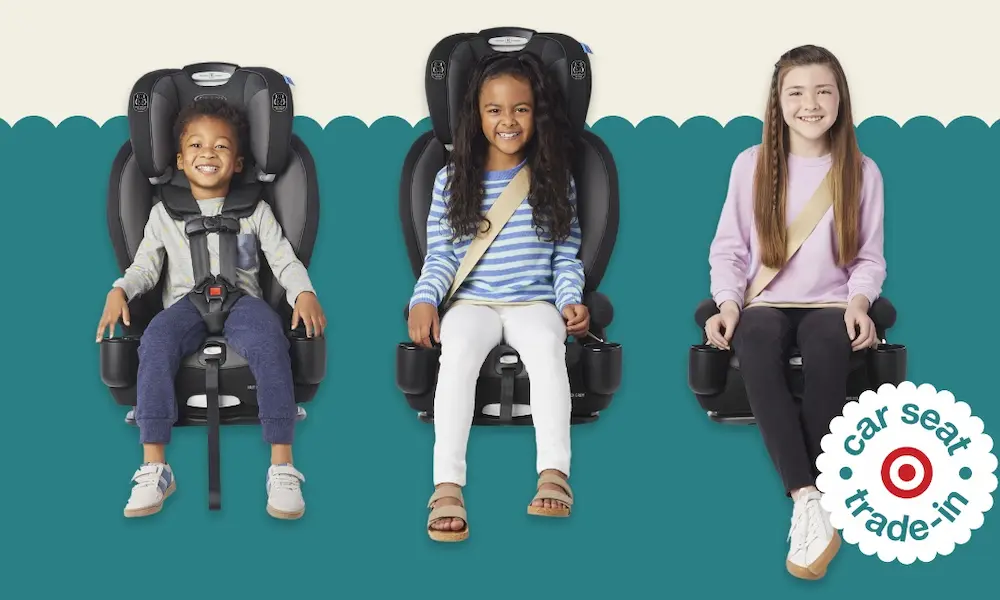
- Target Trade-In Events – Usually in April and September; trade an old seat for a 20% discount on baby gear. Target works with industrial recyclers to repurpose materials
- Walmart/TerraCycle – TerraCycle partnerships allow car seat recycling at select Walmart locations
- Clek Recycling Program – Clek accepts any brand of car seat year-round for a small shipping fee
- TerraCycle Zero Waste Boxes – Buy a baby gear box and ship old seats for 100% recycling
How Long Is a Car Seat Good For Your Child Specifically?
A seat can still be within its expiration date but no longer right for your child. Size limits matter just as much as age limits.
The NHTSA outlines a clear progression for car seat types:
| Stage | Child Size | Restraint Type |
|---|---|---|
| Infant | Birth to ~30–35 lbs | Rear-facing only or convertible rear-facing |
| Toddler | Up to 40–50 lbs | Rear-facing as long as possible |
| Preschooler | Outgrown rear-facing | Forward-facing with 5-point harness and tether |
| School Age | Outgrown forward-facing | Booster seat until seat belt fits correctly |
| Tween | 4’9″ tall | Seat belt alone in the back seat |
The biggest mistake parents make is rushing through these stages. Even if a child turns two, keep them rear-facing if they still fit within the height and weight limits. Rear-facing is safer—full stop.
And regardless of size or seat type, all children should ride in the back seat until age 13. Front-seat airbags deploy with enough force to seriously injure a child, especially one in a rear-facing seat.
Keeping a Car Seat Safe for Its Full Lifespan
Getting to year six, eight, or ten in good shape requires some basic maintenance.
Cleaning the harness correctly: Never submerge straps in water. Never machine-wash them. Never use bleach or harsh chemicals on the webbing. Wipe straps with a damp cloth and mild soap only. If they’re beyond cleaning, contact the manufacturer for replacement straps.
Storing it properly: If you’re saving a seat for a second child, store it indoors in a climate-controlled space—not in an attic or garage. Extreme heat and humidity accelerate plastic and foam breakdown. When you pull it out of storage, inspect it carefully for signs of mold, pest damage, or chewed webbing.
Staying current on recalls: Register your seat with the manufacturer the day you buy it. The NHTSA tracks all active recalls, and registration ensures the manufacturer can contact you directly if yours is affected.
What to Do Right Now
Check the label on your car seat today—not before your next road trip, today. Find the manufacture date, calculate the expiration, and write it somewhere you won’t forget.
If it’s expired: cut the straps, mark the shell, and look up the next Target trade-in event. If it’s been in a crash that didn’t meet all five NHTSA minor-crash criteria: replace it and call your insurer. If it came from a stranger: verify every item on the NHTSA’s used seat checklist before it goes in your car.
A car seat’s whole job is to protect your child in the worst moment imaginable. Treat it like the safety equipment it is—not the hand-me-down it might look like.