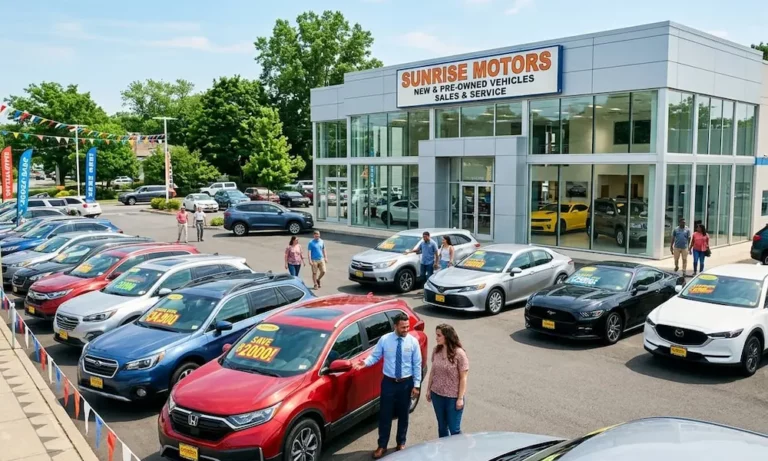
Ever driven past a car dealership on a Sunday and wondered why the lot is full of cars but zero salespeople? It’s not a coincidence. In 19 U.S. states, selling cars on Sunday is actually illegal. The reasons behind this are stranger, more political, and more interesting than you’d expect. Stick around — this one’s worth reading to the end.
It Goes Back Further Than You Think
The short answer to why are car dealerships closed on Sunday is: blue laws.
Blue laws are old statutes that restrict certain activities on Sundays. The earliest ones date back to 1610 in Virginia’s Jamestown Colony, where the General Assembly literally banned secular labor and required church attendance on Sundays. By the time America became a country, these restrictions were baked into the legal culture of many states.
Fast forward to the mid-20th century: conservative social movements and labor unions pushed to extend these Sunday restrictions to big-ticket retail, especially cars.
But here’s the twist — the name “blue laws” isn’t even clearly explained. One theory says Connecticut printed its strict moral codes on blue paper in the 1700s. Another links it to the blue stockings worn by Cromwellian puritans in England. Nobody really knows for sure.
Did the Supreme Court Ever Weigh In?
Yes — and the ruling still holds today.
In 1961, the U.S. Supreme Court decided McGowan v. Maryland, an 8-to-1 decision that changed everything. Chief Justice Earl Warren ruled that even though Sunday closing laws started as religious rules, they’d evolved into secular ones. States have broad power to regulate commerce for the “health, safety, recreation, and general well-being” of their citizens. A uniform day of rest? Totally legal.
That ruling gave states the green light to keep Sunday car sales bans in place — framed not as religious enforcement, but as civil labor regulation. Courts have leaned on this precedent ever since.
Which States Still Ban Sunday Car Sales?
Nineteen states still restrict or fully ban Sunday car sales. Here’s a breakdown of how they compare:
| State | Type of Restriction | Notable Detail |
|---|---|---|
| Colorado | Full ban | Misdemeanor; up to $1,000 fine + 6 months jail |
| Illinois | Full ban | No motorcycles or off-road vehicle exemption |
| New Jersey | Full ban | $100 fine + 10-day jail sentence for first offense |
| Minnesota | Full ban | Second offense = gross misdemeanor |
| Pennsylvania | Full ban | Survived a 1978 state Supreme Court challenge |
| Texas | Flexible closure | Must close Saturday or Sunday — dealers pick Sunday |
| Utah | Flexible closure | Choose one weekend day to close |
| Maryland | Partial ban | Sales allowed in only four specific counties |
| Michigan | Partial ban | Only counties with populations over 130,000 |
| Rhode Island | Hours restriction | Dealerships can only open noon to 6 PM |
| North Dakota | Full vehicle ban | General morning retail bans repealed in 2019; car ban stayed |
| Oklahoma | Full ban | Exempts antique and classic car auctions |
| Louisiana | Full ban | No exceptions |
| Iowa | Full ban | No exceptions |
| Mississippi | Full ban | No exceptions |
| Maine | Full ban | Repeal efforts keep dying in committee |
| Missouri | Full ban | Motorbikes exempt |
| Indiana | Full ban | Off-road vehicles exempt |
| Wisconsin | Full ban | Saturday Sabbath observers get a pass |
States like California, New York, and Florida have no such restrictions — you can walk onto a lot any day of the week.
The Real Reason Dealers Actually Support the Ban
Here’s where it gets interesting. Most people assume dealerships hate being forced to close. Many of them actually love it.
It Solves a Classic Business Problem
Think about it this way: if one dealership opens on Sunday, every competitor in town feels pressure to do the same. But opening on Sunday doesn’t make people buy more cars that week. Vehicle demand doesn’t work like that. You’re just spreading the same number of sales across seven days instead of six.
Meanwhile, Sunday is expensive. Electricity, heating, air conditioning, sales staff — all of that adds up. Industry data shows Sunday typically generates less than half the average daily sales volume. The Sunday ban essentially acts as a government-enforced truce that saves everyone money without anyone losing market share.
It Helps Keep Good Employees Around
Car sales is brutal. Long hours, high pressure, commission dependency — the industry burns through people fast. A guaranteed Sunday off, every single week, is a major recruiting tool. It lets dealers attract salespeople who actually want work-life balance. That’s not nothing.
When employees know their Sundays are protected, they tend to stick around longer. Dealerships actively use this perk to hire more stable, family-oriented staff.
State-by-State Stories Worth Knowing
Colorado: Family Values Written Into Law
Colorado passed its Sunday car ban in 1955. When it was challenged, the Colorado Supreme Court upheld it in Mosko v. Dunbar (1957) with some genuinely wild reasoning. The justices argued that forcing workers to work on weekends contributed to divorce and juvenile delinquency. Seriously. They wrote that a non-working spouse has a “natural right” to companionship, and that kids left alone on weekends were more likely to get into trouble. The law was later modernized and is now codified as C.R.S. Section 44-20-300.
Illinois: Lobbyists Did This
Illinois passed its Sunday car ban in 1982. The push didn’t come from church groups — it came from large franchise dealerships trying to crush smaller competitors who were willing to open Sundays. To sell the idea publicly, lobbyists claimed the ban would attract “better caliber” and more “family-oriented” salespeople. Critics called it exactly what it is: regulatory capture dressed up in moral language. The FTC has repeatedly opposed the Illinois ban, arguing it hurts consumers and limits competition.
New Jersey: Nearly 90 Years and Counting
New Jersey’s ban dates back to 1937. Selling a car on Sunday is a disorderly persons offense — first offense gets you a $100 fine, up to 10 days in jail, or both. In 2013, a bill to allow optional Sunday sales got introduced but failed. Dealer associations argued the closure protects workers. Consumer advocates pointed out that New Jersey buyers can just cross into New York or Delaware to shop. The ban stayed anyway.
Texas: Pick a Day, Any Day
Texas takes a unique approach. Under Texas Transportation Code Section 728.002, dealerships can’t operate on consecutive weekend days. They pick Saturday or Sunday to close. The overwhelming majority choose Sunday. Back in 1961, Texas had a comprehensive blue law covering 42 product categories — clothing, TVs, tools, furniture, you name it. Most of those restrictions got repealed in 1985. Cars and alcohol survived.
Banks Are Closed Too — And That’s a Problem
Even in states without a legal ban, buying a car on Sunday creates practical headaches.
- Most banks and lenders don’t process loan approvals on Sundays
- DMV offices are closed, so title transfers can’t happen
- Insurance agencies may not be reachable to set up mandatory coverage
- Independent mechanics — who buyers use for pre-purchase inspections — are almost universally closed on Sundays
So even if a dealer technically wants to hand you the keys, the supporting infrastructure simply isn’t there. You’d drive away in an unregistered vehicle without confirmed financing. That’s a legal mess waiting to happen.
The FTC Isn’t Happy About Any of This
The Federal Trade Commission has a long, consistent track record of opposing Sunday car sales restrictions. They sent formal opposition letters in 1988 and again in 2014 regarding Illinois legislation.
In 1989, the FTC went further. It prosecuted the Detroit Auto Dealers Association after a group of Detroit-area dealerships collectively agreed to limit their evening and weekend hours. The FTC ruled that this was a horizontal restraint of trade — meaning competitors colluding to limit options for consumers. The Sixth Circuit Court of Appeals agreed.
The FTC’s position is straightforward: when laws strip dealerships of the ability to choose their own hours, consumers pay the price — literally.
Sunday Shopping Has Moved Online Anyway
Here’s the irony: Sunday might be a dealer’s busiest digital day, even when the showroom’s dark.
Consumers use their Sundays to research vehicles, compare prices, get online quotes, and apply for digital financing. Online marketplaces let buyers browse full inventories, lock in pricing, and in some cases complete the entire purchase — contract, financing, and home delivery — without ever stepping foot in a showroom.
The physical Sunday ban is becoming a brick-and-mortar problem in a world that’s gone largely digital. State legislatures can keep showroom doors locked, but they can’t stop someone from buying a car from their couch on a Sunday afternoon.
The blue laws that started in a Virginia colony in 1610 are still technically on the books in nearly half the country. They’ve survived Supreme Court challenges, FTC opposition, consumer advocacy, and the internet. Whether they survive the next decade of digital retail is a different question entirely — and one the market may answer before lawmakers get the chance.