Your BMW’s temperature gauge sits perfectly still in the middle — and that’s actually hiding a problem. Modern BMWs use a smart, electronically controlled thermostat that quietly manages engine temperature behind the scenes. When it fails, your wallet feels it fast. This guide breaks down everything you need to know about BMW thermostat replacement — costs, symptoms, repair steps, and how to avoid a $4,000+ mistake.
What Makes a BMW Thermostat Different From a Regular Car
Most people picture a thermostat as a simple wax valve. Open, closed, done. BMW’s system is far more sophisticated than that.
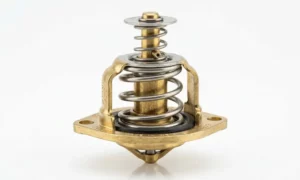
Modern BMWs use a map-controlled thermostat paired with an electric water pump. Instead of passively reacting to coolant temperature, this thermostat takes direct orders from the engine control module (ECM). A small heating resistor sits inside the wax element, and the ECM pulses electricity through it to force the thermostat open earlier than it naturally would.
Why does that matter? Because your BMW needs to run at different temperatures depending on what you’re doing:
- Economy driving: Engine runs hot (~111°C) to reduce oil viscosity and improve fuel efficiency
- Normal driving: Drops to ~105°C as load increases
- Hard acceleration: Falls to ~80–85°C so denser, cooler air fills the cylinders for more power
- Performance/sport mode: Full cool-down mode kicks in to prevent engine knock
A conventional thermostat can’t do any of that. This is why engines like the N55 with its twin-scroll turbocharger demand this level of thermal precision — turbochargers generate extreme heat, and the cooling system has to manage both the engine block and the turbo bearing housing simultaneously.
Warning Signs Your BMW Thermostat Is Failing
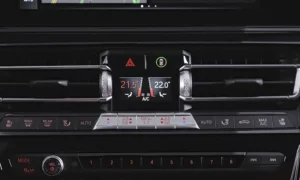
Here’s the tricky part: your dashboard temperature gauge is programmed to stay centered as long as coolant temperature stays within a broad acceptable range. So by the time the needle moves, things are already serious.
Watch for these signs instead:
- Check Engine Light with fault codes P0597, 2E81, 2E82, or 2E85
- “Increased Emissions” warning on the dashboard
- Poor cabin heat — the heater barely warms up, especially in winter
- Worse fuel economy — engine oil stays thick because the engine never gets hot enough
- Transmission acting strange — delayed shifts, refusal to use top gear, or rough jolts during acceleration
- Sweet smell from the engine bay with no visible leak (often a cracked plastic coolant flange)
That last symptom — the transmission behavior — catches a lot of people off guard. The transmission control module relies on coolant temperature data to manage shift timing and torque converter lockup. A stuck-open thermostat can trap your transmission in a cold-start warm-up program indefinitely, causing erratic shifting and accelerated clutch wear. Technicians unfamiliar with this interconnection often misdiagnose it as a transmission fault entirely.
How a Stuck-Open Thermostat Quietly Damages Your BMW
When the thermostat’s heating element burns out — which happens due to constant thermal cycling — the ECM detects an open circuit immediately. The good news is the thermostat defaults to a stuck-open position, so the engine won’t overheat and leave you stranded.
The bad news? A stuck-open thermostat creates its own chain of problems:
- Engine never reaches optimal operating temperature
- Oil stays viscous, increasing internal friction and fuel consumption
- Heater core never gets enough heat — cold cabin in winter
- Transmission stays in warm-up mode, stressing the clutch packs
- Check Engine Light stays on, and your car may fail emissions testing
The ECM monitors coolant temperature against expected warm-up curves. If the engine takes too long to reach target temperature, the system flags it — even if the needle on your dash looks normal.
BMW Thermostat Replacement Cost: Dealership vs. Independent Shop
This is where things get real. BMW thermostat replacement isn’t cheap, but the price gap between a dealership and a qualified independent shop is significant.
Independent specialists typically charge 30–50% less than dealerships for the same job with equivalent parts. That delta comes down to labor rates: dealerships in major cities charge $150–$200+ per hour, while independent European shops generally run $100–$140 per hour. Since the job takes 3–5 hours of disassembly work, that difference adds up fast.
Here’s a full breakdown of what you’re likely to pay:
| Repair Type | Components Replaced | Independent Shop (USD) | Dealership (USD) |
|---|---|---|---|
| Minor Repair | Radiator hose, clamps, coolant vent line | $150–$350 | $300–$600 |
| Thermostat Only | Map-controlled thermostat and housing | $400–$800 | $800–$1,100 |
| Water Pump Only | Electric water pump replacement | $700–$1,100 | $1,200–$1,800 |
| Combined Overhaul | Water pump + thermostat + coolant flush | $1,100–$1,500 | $1,800–$2,500 |
| Catastrophic Repair | Head gasket from severe overheating | $2,500–$4,500 | $4,000–$6,000+ |
Important: Always replace the thermostat and water pump together if either one fails near 60,000–80,000 miles. The labor overlap is so significant that doing them separately means paying for the same disassembly twice. Industry professionals universally treat this as one job — doing otherwise is a false economy.
Also worth knowing: under the Magnuson-Moss Warranty Act, using an independent shop or quality aftermarket parts does not void your BMW’s factory warranty. A dealer can’t reject a warranty claim simply because an independent tech replaced your thermostat — as long as the work was done correctly with proper parts and documentation.
The Bolt Problem Nobody Tells You About
Here’s something that catches even experienced mechanics off guard. Engines like the N52 use a composite magnesium-aluminum block to save weight. If you thread a standard steel bolt into magnesium, you trigger galvanic corrosion — an electrochemical reaction that destroys the block’s threads permanently.
BMW solves this with aluminum bolts — but aluminum bolts are torque-to-yield fasteners. That means:
- They stretch beyond their elastic limit during installation
- You torque them to spec, then rotate an additional angular degree (e.g., 90°)
- Once stretched, they’re single-use only — no exceptions
Reusing an aluminum bolt is a critical mistake. A pre-stretched bolt will either snap during installation or pull the threads right out of the block. That turns a $1,200 repair into an engine block re-threading job. Always use new hardware when doing BMW thermostat replacement on N52 or magnesium-block engines.
The N54, by comparison, uses a different block construction and permits steel bolts — so confirm your exact engine variant before ordering hardware.
What the Replacement Actually Involves
The thermostat and water pump sit at the lower front-right of the engine, which means most of the work happens from underneath the car on a lift. Here’s what the job actually looks like:
Teardown steps:
- Remove underbody splash shields (up to 20 fasteners)
- Drain the cooling system — this gets messy fast
- Disconnect power steering lines, sway bar, intercooler charge pipes as needed
- Unplug the thermostat and water pump electrical connectors
- Extract single-use E-Torx aluminum bolts
- Carefully remove brittle plastic coolant hose fittings — these crack easily after years of heat cycling
Smart upgrades while you’re in there:
On B46, B48, and B58 engines, replace the upper coolant vent hose — nicknamed the “Mickey Mouse” flange due to its shape. This plastic connector fails regularly and causes slow hidden leaks. The coolant drips onto the hot engine block, evaporates, and leaves only a faint sweet smell. Upgrading to an aluminum flange while the system is already open permanently eliminates this common failure point.
The Electronic Bleeding Procedure
This step separates a proper BMW thermostat replacement from a botched one. You can’t just fill the coolant and start the engine.
Because the electric water pump operates independently of engine speed, BMW built in an automated electronic bleeding sequence. Follow these steps exactly:
- Connect a high-amperage battery charger — the pump will run for 10+ minutes without the alternator spinning
- Press the start button once — accessories on, engine off
- Set interior climate control to maximum heat, lowest fan speed
- Press the accelerator to the floor and hold it for exactly 10 seconds
That sequence signals the ECM to run the purge protocol. The electric pump cycles on and off at varying speeds for 10–12 minutes, pushing all trapped air out of the heater core, engine block passages, and radiator. Trapped air acts as a thermal insulator — it causes localized boiling and can warp the cylinder head within minutes of driving.
Once the pump stops, top off the expansion tank, run a diagnostic scan to clear any fault codes, and verify the thermostat hits its proper operating temperature on a test drive. Check that transmission shift behavior has returned to normal — that’s your confirmation the whole system is working correctly again.
For a visual walkthrough of the full process, this N20/N26 water pump and thermostat DIY from FCP Euro covers each step in detail.
One Leak You Can’t Afford to Ignore
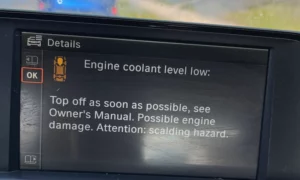
The cost table above shows a head gasket repair at $2,500–$6,000+. That’s not a scare tactic — it’s the realistic outcome of a small coolant leak left unaddressed.
Here’s the chain: a dripping coolant vent hose introduces air into the system → air pockets cause localized boiling → aluminum cylinder head warps → head gasket fails. The BMW cooling system repair cost breakdown from BimmerFix confirms this exact failure sequence is one of the most common and expensive outcomes of deferred maintenance.
The preventive cost? Often under $200 for a new coolant flange and hose while the system is already open during a thermostat or water pump job.
Frequently Asked Questions
Can I use universal coolant when doing a BMW thermostat replacement?
No. BMW engines use specific alloys and electronic sensors that react badly to standard universal coolants. Silicate or phosphate-based fluids designed for cast-iron blocks can degrade the plastic thermostat housing and leave mineral deposits on the electric water pump impeller — eventually causing the pump to fail early. Use an approved European-formula coolant mixed 50/50 with distilled water only.
Does replacing the thermostat at an independent shop void my BMW warranty?
No. Under the Magnuson-Moss Warranty Act, using an independent shop or equivalent-quality parts doesn’t void your factory warranty. A dealership can’t deny a separate warranty claim just because an independent technician did your thermostat replacement — provided the work was correct and properly documented. Keep your service records.
Are performance tunes that lower the thermostat’s target temperature safe?
Not long-term. Keeping the heating resistor energized continuously — instead of during high-load events only — burns it out prematurely. The resistor was engineered for intermittent use, not 100% duty cycle. A failed resistor means a failed thermostat, a permanent check engine light, and degraded engine management.
What happens if the thermostat’s electrical connector breaks or gets left unplugged?
The ECM flags an open circuit and stores a fault code, but the thermostat still works mechanically. It falls back to conventional operation, opening only when coolant reaches its natural threshold (~97°C). You lose the ability to proactively drop engine temperature ahead of high-load events — which means reduced peak performance, higher detonation risk under hard acceleration, and a permanent check engine light.
Is it safe to drive immediately after the electronic bleeding procedure?
Not quite yet. After the purge cycle, the coolant level in the expansion tank drops as air pockets are replaced by fluid. Top off the level, confirm the cap is secure, then drive. If you skip this step and the tank ran dry during bleeding, you’ll introduce new air into the system — putting you right back where you started.