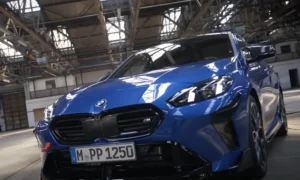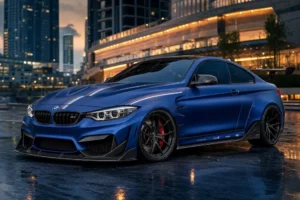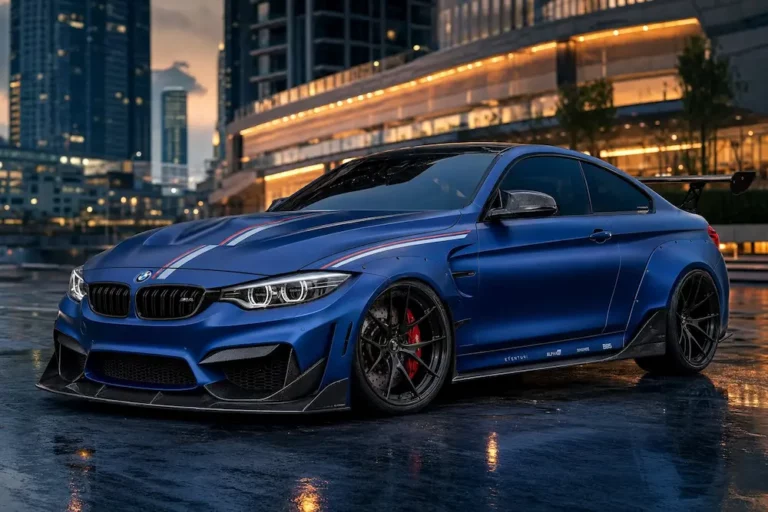
Thinking about modifying your BMW M4? Good news — both the F82 and G82 platforms have enormous untapped potential. This guide breaks down every major BMW M4 modification worth your money, from ECU tuning to big brake kits. Read to the end — the legal section alone could save you thousands.
Engine Tuning: Where Every Build Starts
The S55 and S58 engines leave the factory deliberately restricted. BMW dials back boost pressure, ignition timing, and fuel mapping to accommodate lower-grade global fuels and strict emissions rules. Fix those restrictions, and you unlock serious power without cracking open the engine.
Piggyback Controllers vs. Flash Tuning
You’ve got two main routes here.
Piggyback controllers from brands like Burger Motorsports (JB4), RaceChip, and Dinan intercept sensor data before it hits the factory ECU. They trick the computer into requesting higher boost without overwriting factory software. That matters for warranty purposes — you can physically remove them before a dealership visit.
The JB4 even supports ethanol sensor integration, which opens the door to big ethanol-blend power gains. The downside? Power delivery can feel peaky, and you can’t touch secondary engine functions like cold-start behavior or cooling fan thresholds.
Flash tuning via platforms like Bootmod3, MHD Tuning, and MG Flasher completely overwrites the ECU software. You get direct, precise control over boost, timing, fueling, and torque limiters. The result is smoother, more linear power that feels factory-refined at twice the output. You can also add features like on-the-fly map switching from the steering wheel.
| Feature | Piggyback (JB4, Dinan) | Flash Tuning (Bootmod3, MHD) |
|---|---|---|
| Method | Intercepts sensor signals | Overwrites ECU software |
| Power delivery | Can feel peaky | Smooth and linear |
| Advanced features | Boost by gear, ethanol reading | Map switching, anti-lag, custom maps |
| ECU unlock required | No | Yes (post-June 2020 vehicles) |
| Warranty risk | Lower — removable | High — flash counter triggered |
The Post-June 2020 ECU Lock Problem
Here’s where things get complicated. Starting June 2020, BMW rolled out updated Bosch encryption (MG1 and MDG1 series ECUs) that blocks all traditional flash tuning through the OBD port. Every G82 M4 and many late F82 models need a hardware-level unlock before any flash software works.
For years, the only solution was FEMTO — a service based in Helsinki, Finland. You physically remove your ECU, ship it internationally, wait 8–15 business days, and get it back unlocked. Total cost including a Bootmod3 license runs $1,300–$2,500. Oh, and if your dealer pushes a routine software update during that time? The unlock gets erased. You start over.
A newer alternative, Autotuner, changes the game. After the initial unlock, a dealer update can be reversed locally by an authorized shop — no international shipping required. Autotuner also stores a complete binary backup of your factory software, which protects you against failed flashes or software corruption.
Tuning Stages and What to Expect
- Stage 1 (software only): +40–60 hp on the S55. On the S58, expect roughly 600 hp and 550+ lb-ft of torque.
- Stage 2 (downpipes + intake required): S58 builds hit 650–700 hp by reducing exhaust backpressure and improving airflow.
- Stage 3 (upgraded turbos, fuel pump, injectors, ethanol tuning): G82 builds regularly exceed 800 hp. Documented quarter-mile times dip into the 9-second range on street tires — the factory block handles it.
Transmission Tuning: Match the Gearbox to Your Engine
More torque from your tune creates a new problem. The factory transmission control unit has hardcoded torque limits to protect the drivetrain under normal conditions. Push past those limits with a tune and you’ll get premature throttle cuts, slipping clutch packs, and erratic shifts.
The fix is xHP Flashtool, which recalibrates the ZF8 or DCT to match your engine’s output:
- Stage 1: Removes internal torque limiters. Engine tuning no longer needs falsified torque calculations to work around factory safety logic. Shift points optimize for daily driving and fuel economy.
- Stage 2: Shift times improve by ~25%. Sharper throttle blips on downshifts. Great balance for street and spirited driving.
- Stage 3: Maximum hydraulic line pressure, 50% faster shift times in sport mode, and true manual mode that refuses to auto-upshift at the rev limiter. Built for the track.
Before flashing the transmission, change the fluid. The ZF8’s fluid and filter module degrade over time. Raising hydraulic line pressure on dirty fluid is a fast way to kill the gearbox.
Mechanical Reliability: Fix These Before Anything Else
Power modifications expose factory weak points. Two of them can destroy your engine if you ignore them.
The S55 Crank Hub: F82 Owners, Pay Attention
The S55’s crank hub holds the timing chain sprocket to the crankshaft using friction alone — no keyway, just a single bolt clamping sintered washers. Under factory power levels, failure rates sit below 1%. Once you push past ~500 hp or start tracking the car, that calculation changes fast.
A harsh downshift or aggressive kick-down sends torsional shockwaves through the drivetrain. If the friction gives way even slightly, the sprocket moves independently of the crankshaft. Timing goes out of sync. Pistons hit valves. Engine destroyed. Repair costs exceed $20,000, and the ECU shuts the car down immediately to prevent further damage.
Here are your three fix options:
| Solution | How It Works | Installation | Best For |
|---|---|---|---|
| Crank bolt capture plate | Prevents central bolt from backing out | Low | Mild Stage 1 builds |
| Pinned crank hub | Steel pins drilled into crankshaft | High — precision drilling required | High-hp and track use |
| Spline-lock hub | Hardened splines pressed into crankshaft | High — hydraulic press required | High-hp, avoids drilling |
If you’re above 500 hp or tracking your F82, a mechanical lock — pinned or splined — isn’t optional. It’s insurance.
Oil Cooler Protection: Both Platforms
BMW mounted the oil cooler horizontally under the front bumper on both the F82 and G82. The only thing protecting it from road debris is a thin plastic shroud. One rock strike or parking block contact can puncture it, drain your entire oil supply in seconds, and seize the engine.
Fall-Line Motorsports and Turner Motorsport make heavy-duty stainless steel and aluminum skid plates that bolt directly to the chassis frame. They replace the plastic entirely and feature precision-cut louvers that maintain BMW’s factory airflow extraction. You get full protection without compromising thermal management.
Exhaust Modifications: Sound and Flow
The factory exhaust isn’t just restrictive — it sounds bad. The asymmetric routing of the S55 and S58 creates out-of-phase exhaust pulses that clash, producing a coarse rasp more suited to an economy hatchback than a high-performance straight-six.
Single Midpipe vs. Equal Length Midpipe
Two very different solutions to the same problem:
The single midpipe merges both downpipes immediately into one large-diameter pipe (3–3.5 inches) running down the transmission tunnel. This improves exhaust scavenging, pulls gases away from the turbos faster, and builds low-end torque quickly. Sound profile: deep, bass-heavy, loud. It reduces rasp but doesn’t eliminate it.
The equal length midpipe takes a completely different approach. It uses complex sinusoidal pipe routing to artificially extend the shorter exhaust tract until both sides travel the exact same distance before meeting. When pulses arrive synchronized, the clash disappears. The result is a smooth, high-pitched howl that sounds like a naturally aspirated straight-six. Active Autowerke holds patents on this crossover geometry specifically because the acoustic engineering is that precise.
| Midpipe Type | Sound Profile | Rasp Reduction | Performance Focus |
|---|---|---|---|
| Single midpipe | Deep, bass-heavy, aggressive | Moderate | Low-end torque, fast turbo spool |
| Equal length midpipe | Smooth, high-pitched, exotic | Significant to complete | Top-end horsepower |
Axle-Back Systems
Pair your midpipe with a valved axle-back from Valvetronic Designs or Fi EXHAUST. These systems integrate with the factory drive modes — closed valves give you a quiet, refined note for daily commuting; open valves bypass the muffler entirely for full aggression on track days.
Suspension: Lower, Stiffer, Sharper
The factory suspension compromises between comfort and performance. At the limit, the rear feels underdamped in fast transitions and the front loses precision under hard cornering loads.
Height Adjustable Springs
KW’s Height Adjustable Spring (HAS) kits use threaded collars on the factory shocks to let you set exact ride height — typically 10–25mm lower. Spring rates match the factory damper curves, so the ride stays compliant. Best of all, the factory Electronic Damper Control still works. You keep Comfort, Sport, and Sport Plus modes while achieving proper stance and corner balance.
Performance Coilovers
For track use, ditch the factory dampers entirely. Öhlins Road & Track systems use Dual Flow Valve technology — a secondary hydraulic path that instantly bleeds excess pressure when hitting sharp bumps. Traditional single-valve dampers get overwhelmed by sudden impacts, momentarily lifting the tire off the road. The DFV prevents that, keeping the tire planted and grip consistent at the limit.
| Suspension Type | Height Adjustable | Damping Control | EDC Compatible | Best For |
|---|---|---|---|---|
| KW HAS Springs | 5–25mm drop | Retains factory modes | Yes | Street, aesthetic lowering |
| KW V3/V4 Coilovers | Full range | 2-way or 3-way | No (needs cancel kit) | Street and track days |
| Öhlins Road & Track (DFV) | Full range | Dual Flow Valve | No | Dual-purpose street/track |
| Öhlins Advanced Track Day | Full range | Multi-way independent | No | Dedicated track cars |
Brakes: Stop as Fast as You Go
Street Pads: Fix the Dust Problem First
BMW’s factory brake pads coat your wheels in black dust within days and squeal at low speeds. iSweep’s ceramic-blend pads solve this without sacrificing stopping performance:
- IS1500: 90% less dust, zero squeal, factory-level bite. Pure street use.
- IS2000: 75% less dust, sharper pedal feel, better heat resistance for canyon driving.
Track Brakes: AP Racing Radi-CAL Kits
Continuous track sessions overheat the factory iron rotors. The fluid boils, pads glaze, and brake fade becomes a very real safety concern. The solution is the AP Racing Radi-CAL Competition Brake Kit, distributed by Essex Parts.
The Radi-CAL calipers (CP9660 and CP9668) use finite element analysis to place aluminum only where structure demands it. The result is 30% higher dynamic stiffness than conventional designs, which eliminates caliper flex under high line pressure and delivers a firm, precisely modulated pedal feel.
- CP9660: 18mm pad thickness — sprint racing applications
- CP9668: 25mm pad thickness — endurance racing, no mid-race pad change needed
The two-piece floating rotors feature 72 internal cooling vanes that act as centrifugal fans, pulling cold air through the hub and evacuating heat continuously. Despite being physically larger, the kits use aluminum mounting hats and hollow caliper designs to reduce unsprung weight by nearly 20 lbs per axle — improving steering response and suspension reaction over mid-corner bumps.
Aerodynamics and Aesthetics
A proper aero package does more than look aggressive — it balances the car at speed. Carbon fiber front lips from ADRO or M Performance-style designs improve high-speed stability, but always pair them with a rear diffuser and wing. A front lip without rear downforce creates imbalance, not downforce.
Inside and in the engine bay, carbon fiber engine covers transform the bay into a showcase. Carbon paddle shifter extensions improve reach and tactile feedback on every gear change. CSL-style yellow LED DRL modules and snake-eye headlights set the car apart visually without touching performance.
Budget Planning by Phase
| Phase | Modifications | Estimated Cost |
|---|---|---|
| Phase 1 | ECU tune, drop-in filters, low-dust pads | $1,500–$3,500 |
| Phase 2 | Midpipe, HAS springs, carbon aesthetics | $5,000–$10,000 |
| Phase 3 | Coilovers, AP Racing brakes, oil cooler guard | $15,000–$25,000 |
| Phase 4 | Upgraded turbos, built transmission, ethanol tune | $25,000–$50,000+ |
Know the Rules Before You Modify
Your Warranty Rights Under Federal Law
Here’s the myth that costs enthusiasts money: installing aftermarket parts doesn’t automatically void your warranty. The Magnuson-Moss Warranty Act (1975) explicitly protects you. Under federal law, a dealership must prove the aftermarket part directly caused the failure in question — they can’t just point at your exhaust and deny your window regulator claim.
The Act also prohibits “tie-in sales,” meaning BMW can’t legally require you to use OEM parts or dealer service to maintain coverage. That said, flash tuning a failed rod bearing is a clear causal link. Document everything and know that SEMA actively supports legislation protecting your rights if a dealer acts unfairly.
EPA and CARB Compliance
Installing catless downpipes violates the Clean Air Act. Full stop. The EPA has significantly escalated enforcement, leveling major financial penalties against companies producing defeat devices — including software that kills the check engine light when cats are removed. The reputable aftermarket has shifted hard toward high-flow catted downpipes and emissions-compliant calibration.
If you’re in California or a CARB-aligned state, every powertrain-affecting part must pass laboratory emissions testing before hitting public roads. Parts that pass receive a CARB Executive Order number. Without it, your car fails smog inspection and operates illegally. Always check for EO numbers before purchasing intake or exhaust components in CARB states.
With Advanced Clean Cars II regulations tightening the screws on internal combustion further, compliant tuning solutions aren’t just smart — they’re the future of this hobby.