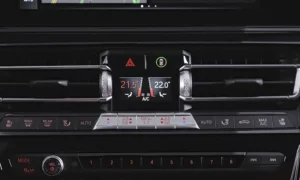
Your BMW’s AC just stopped blowing cold air. Before you panic about a massive repair bill, you need to know what you’re dealing with. This guide breaks down every common failure, what it costs to fix, and a few smart tricks that could save you thousands.
How BMW AC Systems Actually Work
BMW’s AC doesn’t “make” cold air. It pulls heat out of your cabin and dumps it outside. Refrigerant does the heavy lifting by cycling between liquid and gas states.
Here’s the short version of the cycle:
- The compressor pressurizes refrigerant vapor and sends it to the condenser
- The condenser (at the front of the car) releases that heat into outside air
- The receiver-drier filters moisture out of the refrigerant
- The expansion valve drops the pressure, making the refrigerant ice cold
- The evaporator (behind your dashboard) absorbs cabin heat and cools the air
Older BMWs use refrigerant R-134a. Models built after 2017 use R-1234yf, which is more environmentally friendly but, as you’ll see, brings its own headaches.
The Most Common BMW AC Problems (And Their Symptoms)
Your Air Is Warm or Barely Cool
This is the most common complaint in BMW air conditioning repair. Warm air almost always means low refrigerant from a leak. The AC loop is sealed. Refrigerant doesn’t “run out” — it escapes through a crack or a failing seal.
Common leak spots:
- Service port valves
- O-ring seals at the compressor
- Condenser fins (damaged by road debris)
- Evaporator core (the expensive one)
Air Starts Cold but Warms Up After 30 Minutes
This points to a freezing evaporator. If your cabin filter is clogged or the evaporator temperature sensor is faulty, the core can ice over. Airflow drops, the system shuts the compressor down as a precaution, and warm air returns. Replace the cabin filter first — it’s the cheapest fix.
Grinding or Clunking Sounds When AC Turns On
That noise is coming from the compressor. Either the internal pistons are starting to seize, or the electromagnetic clutch is failing. Don’t ignore this. A failing compressor can destroy the entire system if it lets go completely (more on that in a moment).
A squealing or chirping sound instead? That’s typically a worn serpentine belt or a failing pulley bearing — a much cheaper fix.
Musty or “Dirty Sock” Smell From the Vents
Bacteria and mold are growing on your evaporator core. The evaporator lives in a dark, damp plastic box behind your dashboard — basically a petri dish if the drain gets blocked or the filter goes too long between changes.
A sweet or chemical smell is different and more serious. That’s refrigerant leaking — and you don’t want to breathe concentrated R-1234yf in an enclosed cabin.
Component Life Expectancy and Failure Impact
| Component | Estimated Life | Impact of Failure |
|---|---|---|
| AC Compressor | 100,000–150,000 miles | Total cooling loss; possible system contamination |
| AC Condenser | 80,000–120,000 miles | Reduced idle cooling; compressor overpressure risk |
| Evaporator Core | 60,000–100,000 miles | Refrigerant loss; mold odors; extremely high labor cost |
| Blower Motor | 100,000–120,000 miles | No airflow; electrical fire risk in older models |
| Cabin Air Filter | 15,000–20,000 miles | Weak airflow; musty odors; ~20% efficiency drop |
The “Black Death” Compressor Failure
This is the nightmare scenario in BMW AC repair. Modern BMWs use variable displacement compressors — they’re efficient, but they’re sensitive to lubrication. If a refrigerant leak goes unaddressed long enough, the oil escapes with the refrigerant. The compressor runs dry and disintegrates internally.
The industry calls this “black death.” Metallic debris and burnt oil spread through every line, hose, and valve in the system. Simply swapping the compressor won’t work — the new unit will immediately ingest the contamination.
The fix? A full system flush, new lines, new orifice valves, new receiver-drier, and a new compressor. The bill climbs fast.
The lesson: Fix small leaks early. A $300 refrigerant recharge is infinitely better than a $4,000 compressor replacement.
The G-Chassis Evaporator Crisis
If you own a 2018–2022 BMW X5 (G05) or 5 Series (G30), pay close attention. There’s a well-documented pattern of premature evaporator failure on these models — sometimes with fewer than 26,000 miles on the odometer.
The likely culprit? The newer R-1234yf refrigerant appears more corrosive to the aluminum alloys used in these evaporator cores. Microscopic pinhole leaks develop, and because the evaporator is buried deep inside the dashboard, accessing it is a massive undertaking.
Technicians have to remove the steering column, center console, and the entire dashboard structure to reach the HVAC housing. In major US cities, this BMW air conditioning repair regularly costs between $6,000 and $8,000.
Many owners also report that the job introduces new rattles and electrical gremlins — because hundreds of plastic clips and connectors get disturbed during the disassembly.
The Condenser: Your First Line of Defense
The condenser sits at the very front of your BMW, which means it takes constant punishment from road salt, gravel, and insects. Over time, the aluminum fins flatten and corrode. When that happens, the condenser can’t shed heat efficiently.
The result? High-side pressure spikes. The system either shuts itself down automatically or overloads the compressor.
If you drive in coastal areas or the salt-heavy rust belt of the Midwest and Northeast, rinse the condenser with low-pressure water periodically. It’s free maintenance that protects a $600–$1,200 part.
Recalls and Technical Service Bulletins You Should Know About
SIB 64 06 17 — The Gel Formation Issue
This Technical Service Bulletin addresses a chemical reaction between engine coolant and manufacturing flux residue inside the water-cooled condenser. The reaction creates a gel that clogs AC control valves and kills cooling performance entirely. For in-warranty vehicles, BMW covers this. Out-of-warranty, the repair is substantial — it involves replacing the low-temperature radiator and the entire intake system.
Recall 17V-676 and 19V-579 — Blower Motor Fire Risk
BMW issued safety recalls affecting hundreds of thousands of 3 Series and 1 Series models. The blower motor wiring harness can overheat and melt, creating a genuine fire hazard. Recall 17V-676 covers this on earlier models. These repairs are always free at any authorized BMW center, regardless of mileage or ownership history.
Check your VIN at BMW’s recall portal — if your car has an open recall, get it fixed immediately at no cost to you.
What BMW AC Repair Actually Costs Across the US
Labor rates swing dramatically depending on where you live. Here’s what you’re looking at for 2025/2026:
| State | Dealer Rate (Per Hour) | Independent Rate (Per Hour) |
|---|---|---|
| California | $271 | $155–$200 |
| New York | $251 | $135–$180 |
| Florida | $254 | $130–$160 |
| Texas | $252 | $120–$150 |
| Michigan | $211 | $115–$145 |
| Alabama | $250 | $140–$150 |
| Mississippi | $242 | $90–$155 |
| Iowa | $214 | $130–$145 |
Source: AAA Automotive 2026 Labor Rate Report
A California BMW owner pays nearly double the labor cost of someone in Michigan for the exact same repair.
Dealer vs. Independent Shop: Which One Should You Choose?
BMW dealerships argue their technicians have access to proprietary diagnostic software — especially important for newer models where replacing a compressor or blend door actuator requires software coding. That’s a legitimate point for G-chassis and F-chassis vehicles.
But independent BMW specialists often match dealer capabilities. Many are run by former dealership technicians who’ve invested in the same tools. They source OEM parts directly from manufacturers like Denso (compressors) or Behr (radiators) — skipping BMW’s branded markup. That alone can save you 20–30% on parts.
For complex jobs like evaporator replacements or IHKA module coding, verify the shop has the right diagnostic software before you commit.
Your Legal Rights: The Magnuson-Moss Warranty Act
Here’s something BMW dealers don’t advertise. Under the Magnuson-Moss Warranty Act, enforced by the FTC, BMW cannot void your warranty simply because you used an independent shop or did routine maintenance yourself.
They’d have to prove your independent repair directly caused the subsequent failure. That’s a high bar.
This means you can:
- Have an independent shop recharge your refrigerant
- Replace your cabin filter yourself
- Service your BMW outside the dealership
…without losing your factory warranty coverage on unrelated components. Don’t let a service advisor convince you otherwise.
How to Ask BMW for Goodwill Coverage
Got an out-of-warranty evaporator failure on a low-mileage G-chassis? Don’t just accept the $8,000 quote.
BMW dealerships use a Dealer Self-Authorized (DSA) goodwill matrix that weighs several factors:
- Service loyalty — did you always come to a BMW dealer for maintenance?
- Brand history — is this your first BMW or your fifth?
- Proximity to warranty expiration — within 12 months or 10,000 miles is the sweet spot
- Component type — wear items (belts, filters) rarely qualify; “lifetime” components like evaporators often do
Owners who document that they reported the issue while still under warranty, maintain a polite tone, and escalate to BMW North America’s customer service line frequently see repair bills cut by 70–90%. A $7,000 quote can become $700. It’s worth one phone call.
Preventative Maintenance That Actually Protects Your BMW AC
Replace Your Cabin Air Filter Every 15,000–20,000 Miles
A clogged filter forces the blower motor to draw more power. That burns out the final stage resistor and strains the evaporator. It also lets dust and organic material build up on the evaporator fins, feeding the mold that causes Dirty Sock Syndrome. This is a $20–$40 DIY fix. Do it on schedule.
Run the AC Every Few Weeks — Even in Winter
In cold-weather states, run your AC for at least 10 minutes every few weeks. This circulates the refrigerant oil through the system and keeps compressor seals lubricated. Seals that dry out over winter will leak come spring — and that’s how a $300 recharge turns into a $1,500 compressor job.
Check the Evaporator Drain Annually
If the drain tube gets blocked, water backs up into the HVAC box and spills onto your carpets. In hybrid and electric BMW models, backed-up water near high-voltage components is a safety issue. A quick visual check or a squirt of low-pressure air into the drain keeps this from becoming a problem.
Inspect the Condenser Each Spring
Before AC season hits, look at the front of your car. If the condenser fins look bent, black, or heavily crusted with road salt, a gentle rinse with a garden hose can restore airflow. This is especially important if you’ve driven through a winter with road salt treatment — the rust belt between Minnesota and New England is particularly hard on aluminum condensers.
The bottom line on BMW air conditioning repair: small maintenance habits and early diagnosis keep the bills manageable. Ignore a slow refrigerant leak or a clogged filter long enough, and you’re looking at a repair that rivals a used car payment.