Your BMW won’t start, it’s misfiring on three cylinders, or the “Engine Malfunction” light just killed your morning. The culprit might be your DME — and the dealer wants $3,000+ to fix it. Before you hand over your credit card, read this first.
What Is a BMW DME, Exactly?
The Digital Motor Electronics unit is your BMW’s engine brain. It manages fuel injection, ignition timing, and airflow. It reads hundreds of sensor inputs every second and adjusts everything in real-time.
It also talks to your transmission, stability control, and immobilizer. So when the DME fails, the symptoms aren’t always obvious. You might get a single warning light, a rough idle, or a car that simply won’t crank.
That’s what makes BMW DME repair tricky — the DME touches almost everything.
How BMW DME Systems Evolved Over Time
Understanding which DME your BMW has tells you a lot about what can go wrong.
Early Bosch Motronic units (E30, E36 era) handled basic fuel and spark. They were simple, and their biggest enemies were cracked solder joints and failed relays.
Siemens MS and Bosch MEVD units arrived in the 2000s. These added Valvetronic variable valve lift and direct fuel injection. Direct injection needs much higher electrical current to fire injectors — which puts serious heat stress on the DME’s internal components.
That’s where modern failure patterns began.
The Most Common BMW DME Failures
Siemens MSD80: The Notorious Injector Driver Problem
If you own a 2007–2010 BMW 335i, 535i, or 135i with the N54 twin-turbo engine, pay attention. The Siemens MSD80 is famous for one specific failure: blown injector driver transistors.
Here’s what happens:
- The DME uses MOSFET transistors to fire the high-pressure piezo injectors
- Those transistors run hot under normal load
- Over time, heat cycling kills them — usually in a shorted state
- When one transistor fails, that cylinder goes dead permanently
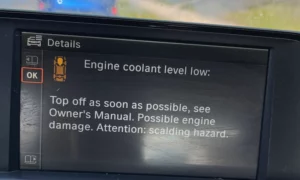
Because the injector drivers are grouped in banks of three, one failed transistor can knock out an entire cylinder bank. The result? Massive power loss and the “Engine Malfunction” warning lighting up your dash.
The fault codes to watch for:
| Fault Code | What It Means |
|---|---|
| 30BA | Internal power stage failure, cylinder bank 1 |
| 30BB | Internal power stage failure, cylinder bank 2 |
| 29CD | Misfire, cylinder 1 |
| 29D0 | Misfire, cylinder 4 |
| 29CC | Multiple cylinder misfires (shared fault) |
Shops like Automotive Circuit Solutions and Circuit Board Medics replace all six transistors at once — not just the failed one. That’s the right call. Thermal wear hits them all, not just the one that gave out first.
Critical note: A faulty injector can actually kill the transistor by drawing excessive current. Always inspect your injectors when doing BMW DME repair on an MSD80.
Valvetronic System Failures
BMW’s Valvetronic system replaced the traditional throttle body with variable valve lift. It’s brilliant engineering — and a real source of DME-related headaches.
The Valvetronic motor drives an eccentric shaft to adjust valve lift. If that shaft binds from wear or dirty oil, the motor draws more current than the DME’s driver circuit can handle. That kills the circuit.
Early warning signs:
- Rough idle during cold starts
- Hesitation during light acceleration
- A rapid clicking noise from the engine bay when you unlock the car (the system is trying to calibrate and hitting resistance)
- Fault codes 2A67 (power limitation) or P1030 (sluggish movement)
There’s another sneaky failure: the eccentric shaft sensor lives under the valve cover, soaking in engine oil. If its seal fails, oil contaminates the signal pins. The DME thinks the shaft is in the wrong position and throws the engine into limp mode.
Before you blame the DME itself, check the sensor connector for oil. If it’s wet, clean or replace the sensor first. It’s a $50 fix that saves you from an unnecessary $500 repair.
Internal Memory and Processor Faults
These are the serious ones. When the DME’s own self-tests fail, it logs internal fault codes. Here’s what they mean:
| Fault Code | System | What It Indicates |
|---|---|---|
| 1211 | DME Control Unit | Internal self-test failure |
| 2AB2 | Internal RAM | Volatile memory error |
| 2AB3 | Checksum Error | Permanent memory corruption |
| P0601 | Internal Control Module | Main memory checksum error |
| 150 | DME Memory Fault | Unit can’t save learned engine data |
The standard diagnostic move: clear the codes and run a drive cycle. If the fault comes back within 30 seconds, it’s a persistent hardware or software defect — not a one-time glitch.
BMW DME and the Immobilizer Problem
Here’s where a lot of people get blindsided. You can’t just swap in a used DME and drive away. BMW’s immobilizer system won’t let you.
EWS vs. CAS: The Security Handshake
Early BMWs used the EWS immobilizer system. The key talks to an EWS module, which tells the DME it’s okay to start. EWS II and III added rolling codes that change with every start. If the codes fall out of sync — say, from a dead battery mid-crank — the car cranks but won’t fire.
In 2002, BMW introduced the Car Access System (CAS). The DME stores a unique Individual Serial Number. Before startup, the CAS and DME verify that their serial numbers match. Plug in a used DME from another car? The handshake fails. Engine won’t start.
Post-2012 F-series models moved to Front Enclosure Module (FEM) or Body Domain Controller (BDC) systems with high-level encryption. A water-damaged FEM can mimic a failed DME by blocking the start authorization signal entirely.
Specialist shops like The ECU Pro and DUDMD Tuning can “virginize” used modules — resetting them to factory-new state so they can marry to a different vehicle. That’s what makes plug-and-play repairs possible.
BMW DME Repair vs. Replacement: What Does It Actually Cost?
| Service Type | Estimated Cost | Hardware Source | Programming Required |
|---|---|---|---|
| Dealership Replacement | $1,900 – $3,300+ | New Factory Unit | Included by dealer |
| Independent Cloning | $300 – $600 | Used Donor Unit | Pre-programmed (plug & play) |
| Component-Level Repair | $150 – $500 | Your Original Unit | None (data preserved) |
The dealer replaces the whole unit with a new one. They can’t legally install used modules due to BMW’s security architecture. And that new unit? It often ships from Germany, pre-coded to your VIN. You could be waiting a week or more.
The independent route offers two smarter options:
Cloning works when your original board is too damaged to repair. A specialist reads all your data — VIN, immobilizer codes, engine calibration — and writes it to a compatible used unit. The result is plug-and-play: your original keys work, no additional programming needed.
Component repair is ideal when the board itself is saveable. Your original unit goes to a bench, gets repaired at the component level, and comes back with all your data intact. Services like Bimmerscan in California and ECU Medics in Canada handle this daily via mail-in.
What Happens During a Physical BMW DME Repair
Burnt Traces and Cracked Solder Joints
When a high-current circuit fails, it can burn right through the copper traces on the board. Technicians scrape the solder mask back, expose bare copper, and bridge the gap with fine-gauge jumper wire. They then secure it with fresh solder.
Cracked solder joints are sneaky — they’re often microscopic and only visible under high magnification. They create intermittent connections that make the engine stall or run rough when it’s hot. The fix is reflowing the joint and adding fresh solder. Professional shops use digital microscopes to verify the work and check for accidental solder bridges between adjacent pins.
Water Damage Recovery
Water in the DME is an emergency. It creates a conductive path between chip pins. If you apply power while the board is wet, you’ll fry the silicon components instantly.
The recovery process: clean with 90% isopropyl alcohol, use a soft brush to remove mineral deposits, then bake the board at low temperature to pull all moisture out of the multilayer board structure before bench testing.
How to Ship Your BMW DME for Repair
Most BMW owners don’t live near a specialized shop. Mail-in repair is the standard solution — but you need to pack the unit correctly.
Before you remove it:
- Disconnect the battery first. Always.
- Inspect the connector pins for corrosion or burnt smell — document this for the repair shop.
- For cloning jobs, you’ll also need to send the CAS or FEM module and at least one working key.
Packing the unit:
- Wrap it in an anti-static bag — not regular bubble wrap, which generates static that can fry the chips
- Double-box it: tight inner box, outer box with foam or packing peanuts
- Declare the actual replacement value when purchasing shipping insurance — standard coverage caps at $100, and a new DME costs $2,000+
Preventing BMW DME Failure in the First Place
Keep the E-Box Drained
Your DME sits in a plastic enclosure called the E-box, near the windshield. Leaves and pine needles block the drains nearby. When it rains hard, backed-up water flows straight into the E-box.
Clear those drains regularly. It takes five minutes and could save you $500 in BMW DME repair costs. If you ever remove the E-box cover, make sure the rubber seal seats perfectly and all locking clips are fully engaged before closing it.
Voltage Stability Is Non-Negotiable
BMW electronics are extremely sensitive to voltage swings. A failing alternator or a weak battery can corrupt the DME’s stored data during cranking.
During any software flash or programming session, connect a dedicated voltage stabilizer. If power drops mid-write, you end up with a bricked DME.
And when jump-starting a modern BMW, always use the designated jump terminals in the engine bay — never connect directly to the trunk battery. Doing so can bypass protection circuits and send a surge through the communication lines, potentially damaging the DME or body modules.
If your car has flickering lights or erratic gauge readings, test the voltage regulator immediately. Catching it early protects the far more expensive control units downstream.