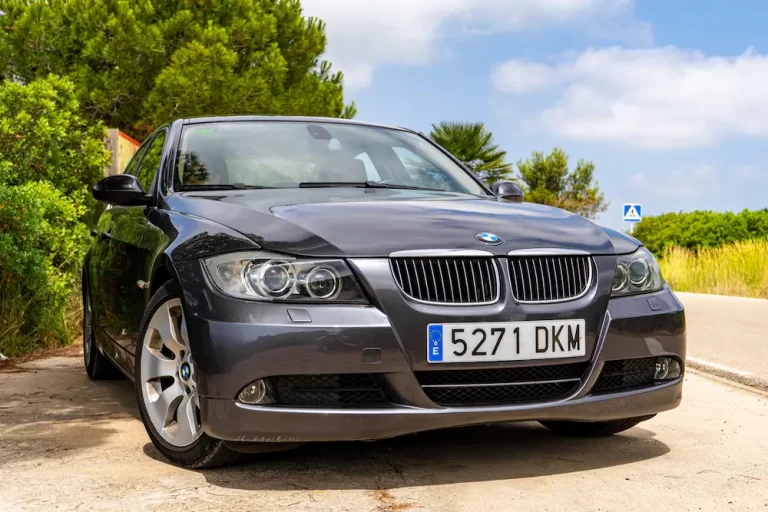
Your BMW refuses to turn off at red lights. The little icon with the circular arrow just sits there, crossed out. You’re wondering if something’s broken, or if your car’s just being stubborn. Good news: you’ll probably find your answer in the next few minutes. This guide walks through every common reason your BMW auto start-stop system calls it quits—and what you can do about it.
What Is BMW’s Auto Start-Stop System?
BMW calls it MSA (automatic start-stop). It’s part of their EfficientDynamics package that shuts down your engine when you’re stopped—think traffic lights or bumper-to-bumper gridlock. Once you lift off the brake, the engine fires right back up.
The system lives inside your car’s brain: the Digital Motor Electronics (DME) or Digital Diesel Electronics (DDE). It talks to your transmission, climate control, and battery sensor to decide if it’s safe to kill the engine.
Here’s the twist: the system won’t work unless 21 different conditions are met. Miss just one, and you’re stuck with your engine idling.
Why Your BMW Auto Start-Stop System Stops Working
Your Battery Isn’t Happy
This is the number one culprit. BMW uses something called an Intelligent Battery Sensor (IBS) that clips onto your negative battery terminal. It measures current, voltage, and temperature—then tells the DME whether there’s enough juice for frequent restarts.
If your battery charge drops below 70-80%, the system shuts down. You won’t always get a warning light. The auto start-stop icon just stays crossed out.
Signs your battery’s the problem:
- Clock resets randomly
- Warning lights flicker on and off
- Car struggles to start in the morning
- Check Control messages like CC-ID 229 (“Battery Charge Low”) or CC-ID 304 (“Check Battery Condition”)
A failing IBS can also send bad data to the DME, making the car think the battery’s dead when it’s not. That’s why simply replacing the battery doesn’t always fix things.
You Replaced the Battery But Didn’t Register It
BMW batteries aren’t plug-and-play. When you install a new one, the DME needs to know. Shops call this “battery registration.”
Without it, the DME keeps using the old battery’s charging profile. Your new battery gets overcharged or undercharged, wears out fast, and the auto start-stop quits working.
You’ll need diagnostic software—ISTA or similar tools—to register the battery. It’s not something you can do from the driver’s seat.
The Engine Hasn’t Warmed Up Yet
The DME wants your engine between 87°C and 121°C (188°F to 250°F) before it’ll allow the auto start-stop to kick in. Cold engines create more wear, and the catalytic converter needs heat to work properly.
If you’re driving short trips or it’s freezing outside, your engine might never reach that sweet spot. The system stays offline to protect itself.
It’s Too Hot or Too Cold Outside
BMW’s auto start-stop system shuts down in extreme temperatures:
- Below 3°C (37°F): Too cold for the battery to handle repeated starts
- Above 30°C (86°F) with A/C on: Engine needs to keep running to power the compressor
In Los Angeles summer heat, this is incredibly common. Your car prioritizes keeping you cool over saving a thimble of gas.
Your A/C or Heater Is Working Hard
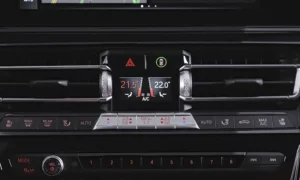
The Integrated Heating and Air Conditioning (IHKA) module can veto the auto start-stop any time it wants. If the system detects your windshield might fog up, it’ll keep the engine running or restart it immediately. Same goes if you’ve cranked the A/C to max cool.
Recent BMW service bulletins point to software glitches in the IHKA module (SIB 64 13 25 for X5/X6 models) that trigger false errors and disable the auto start-stop as a side effect.
You’re on a Hill
If your car’s on an incline steeper than 12%, the system won’t stop the engine. It’s protecting you from rolling backward when the engine restarts.
Same deal if your steering wheel is turned more than 6 degrees. The DME assumes you’re in the middle of a maneuver and keeps the engine alive.
Brake Vacuum Is Low
Your brake booster needs vacuum pressure to work. The brake vacuum sensor tells the DME if there’s enough stored up. When it’s low, the system refuses to shut down the engine.
A failing sensor is a known issue on E90 and F30 models. You might not see a warning light, but a diagnostic scan will pull codes like P0555, P0556, or P0557.
Your Diesel’s Regenerating the DPF
Diesel BMWs have a Diesel Particulate Filter (DPF) that needs to burn off soot periodically. That requires high exhaust temperatures—which means the engine stays running even when you’re stopped.
You’ll sometimes see a message on the dash telling you to keep driving. The auto start-stop comes back once regeneration finishes.
You Haven’t Driven Fast Enough
The system requires you to reach at least 9 mph since your last start. This prevents rapid on-off cycling in parking lots, which would murder your starter motor.
If you’re just crawling through a garage or moving the car in your driveway, don’t expect the auto start-stop to activate.
Common Conditions That Block Auto Start-Stop
| Condition | Why It Matters |
|---|---|
| Seatbelt unbuckled | Safety interlock—prevents restart with no driver |
| Door open | Same reason—system thinks you’re getting out |
| Steering wheel turned | Electrical power steering draws too much current |
| Engine coolant below 87°C | Engine isn’t warm enough yet |
| Battery charge below ~75% | Not enough power for reliable restarts |
| Gradient over 12% | Prevents rollback on steep hills |
| A/C on max in hot weather | Compressor needs continuous power |
Software Issues and Recalls You Should Know About
48V Mild-Hybrid Problems
Newer BMWs use 48V starter-generators instead of traditional starters. Service bulletins warn that loose electrical connections (SIB 24 02 25 for X5) or damaged batteries (SIB 61 24 25 for 5 Series) can prevent the system from working.
There’s even a recall for certain X5 and 3 Series models (Recall 25V644000 and 25V202000) related to starter motor overheating from repeated start attempts.
Software Calibration Updates
Some auto start-stop issues are purely software-related:
- SIB 12 24 19 (X2 M35i): Engine shuts off immediately after an MSA restart. Fixed with DME update F056-19-07-520 or higher.
- SIB 12 07 23 (X1): Slight hesitation when taking off after an auto start-stop. Requires improved throttle calibration.
- SIB 12 15 12 (All Models): Allows dealers to code the system to remember your last setting (on or off) between drives. Many owners requested this because they got tired of turning it off every time.
If your car’s software is outdated, the system might misbehave or stay disabled for reasons that have already been fixed in newer versions.
How Mechanics Diagnose the Problem
Step 1: Pull the Inhibitor List
Professional shops use BMW’s ISTA diagnostic software to read the “inhibitor list” from the DME. This tells them exactly which of the 21 conditions failed during the last several stops.
It’s like reading the system’s diary: “3:42 PM—didn’t stop because battery was at 68%. 3:45 PM—didn’t stop because A/C was on max.”
Step 2: Check Battery Health
They’ll run an “Energy Diagnosis” test to measure your battery’s State of Charge (SOC) and State of Health (SOH). If the battery’s weak or the IBS is sending garbage data, that’s usually the smoking gun.
Step 3: Monitor Live Sensor Data
Techs watch real-time feeds from the brake vacuum sensor, steering angle sensor, and temperature sensors. If something’s reading outside normal ranges, they’ve found the culprit.
Advanced shops like Bimmer PhD Motorsports in Pasadena use lab-grade oscilloscopes (PicoScope or ATS EScope) to spot electrical noise on the BSD bus—the communication line between the IBS and the DME.
Step 4: Update Software
If the car’s Integration Level (I-level) is behind, they’ll flash the latest updates. Many auto start-stop headaches disappear after a software refresh.
What You Can Do Right Now
Quick Checks You Can Perform
- Make sure your seatbelt’s buckled and the door’s closed
- Let the engine warm up fully (coolant temp gauge in the middle)
- Turn down the A/C or heater
- Check if you’re on level ground
- Drive at least 9 mph before expecting the system to work
What to Tell Your Mechanic
If the system’s been down for a while, mention:
- When it stopped working (after a battery replacement? Cold snap? Software update?)
- Any warning lights or messages
- Whether the car’s had recent electrical issues (clock resets, flickering lights)
- If you drive mostly short trips or mostly highway
That context helps them skip the guesswork and zero in on the real problem.
Should You Just Leave It Off?
Some owners disable the auto start-stop permanently. BMW even released a service bulletin (SIB 12 15 12) allowing dealers to code the system to remember your preference.
But here’s the thing: if your BMW auto start-stop isn’t working, it’s often telling you something else needs attention—usually your battery or cooling system. Ignoring it might mean you’re a few months away from a dead battery or an overheating engine.
The Bottom Line
Most BMW auto start-stop failures aren’t failures at all. The system’s just being cautious. It’s designed to shut down only when 21 different conditions line up perfectly. Miss one—low battery, cold engine, turned steering wheel—and it stays offline.
If your system’s been down for more than a week, start with the battery. Check the charge, test the IBS, and verify it was registered properly if it’s new. If that checks out, look at software updates and temperature-related issues.
And if you’re in a hot climate with brutal traffic, don’t be surprised when the system takes frequent vacations. It’s choosing comfort and safety over saving you a few cents of gas—which is exactly what it’s supposed to do.