Want concert-hall sound during your commute? The right car makes that happen straight from the factory. This guide breaks down which cars with good sound systems actually deliver, from ultra-luxury flagships to surprisingly impressive mainstream picks. Stay with us — there’s a lot here worth knowing.
Why the Car You Drive Shapes How Music Sounds
Your car is actually a listening room. Glass, upholstery, seat placement, and road noise all affect what you hear. Modern automakers partner with serious audio brands — Bose, Bang & Olufsen, Burmester — and get involved before the first prototype is built. They help shape the chassis itself so speaker placement and cabin materials work together from day one.
The result? Some factory systems now rival home hi-fi setups that cost far more.
Electric vehicles raised the bar further. No engine drone means the audio system has a silent canvas to work with. Subtle details that combustion engines once buried now come through clearly.
The Technology Behind Great Factory Audio
Before picking a car, it helps to understand what separates a great system from a mediocre one.
Amplifier Class Matters More Than Wattage
Class AB amplifiers sound warm and natural but waste energy as heat. Class D amplifiers run up to 90% efficiency and pack more power into a smaller space — critical in modern vehicles where every inch counts. Panasonic and Texas Instruments even developed 48-volt car audio systems using gallium-nitride transistors, giving premium systems cleaner, more stable power delivery.
Some high-end setups use hybrid designs: analog amplification for midrange warmth, Class D for bass grunt. Best of both worlds.
Digital Signal Processing Is the Real Magic
Raw speaker hardware only gets you so far. Digital Signal Processing (DSP) handles the precision work. It applies microsecond time delays to individual speakers so sound waves from every driver reach your ears at exactly the same moment. That creates a focused, realistic soundstage instead of audio chaos.
Volvo’s Bowers & Wilkins systems explain this well — DSP compensates for asymmetric seating positions that would otherwise wreck stereo imaging.
3D and 4D Audio: What Those Terms Mean
Dolby Atmos, HARMAN QuantumLogic Immersion, and Dirac Unison treat sounds as objects floating in three-dimensional space. Height speakers in headliners and headrests add a vertical dimension. The fourth dimension? Physical sensation. Tactile exciters mounted in seat frames vibrate in sync with the music. You feel the bassline without eardrum-damaging volume levels.
Best Cars With Good Sound Systems: Ultra-Luxury Tier
These systems push the limits of what’s physically possible inside a vehicle.
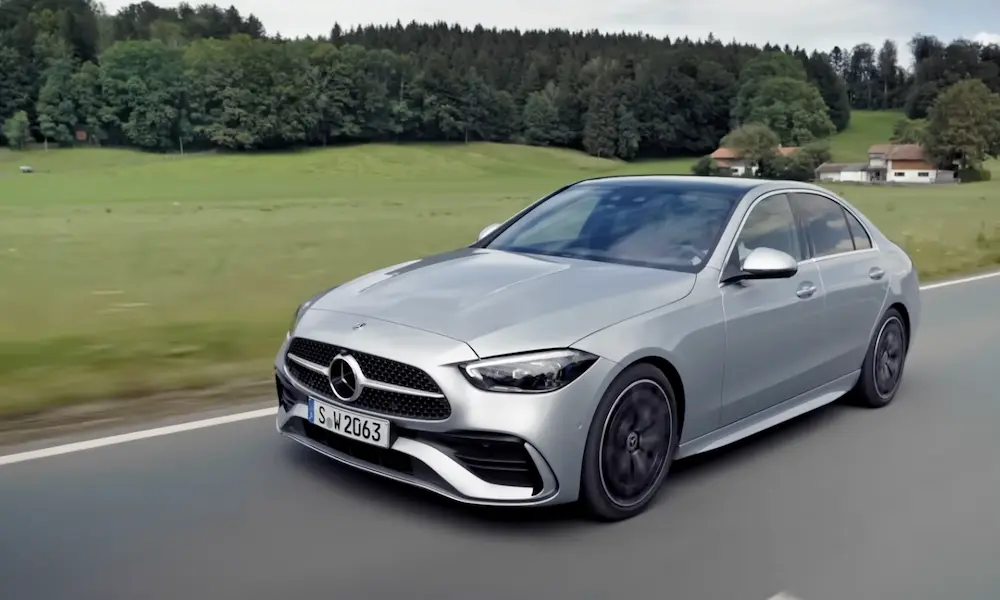
Mercedes-Benz S-Class: Burmester 4D
The Burmester High-End 4D Surround Sound System in the S-Class and Maybach runs 31 speakers plus 8 seat-mounted tactile exciters. Total power: 1,750 watts. The tweeters in the mirror triangles and rear doors actually rotate 360 degrees on motor-driven mounts when you power the system on.
Eight exciters synchronize to the transient envelope of each bass note. You physically feel the rhythm without distortion bleeding into the midrange. A dedicated “Focused” mode uses microphone arrays to aim the soundstage at one specific occupant — it creates an acoustic bubble around you that’s genuinely unsettling the first time you experience it.
BMW i7: Bowers & Wilkins Diamond Surround
HARMAN and Bowers & Wilkins brought their most advanced automotive system to the BMW 7 Series. The i7 spec runs up to 36 speakers with a 32-channel amplifier producing 1,965 watts — the highest wattage figure in this comparison.
The name comes from the synthetic diamond dome tweeters. Diamond is exceptionally rigid and light, pushing the breakup frequency so far above human hearing that high-frequency distortion effectively disappears. Midrange drivers use Bowers & Wilkins’ proprietary Continuum cone material, which delivers vocals and acoustic instruments with startling clarity.
Genesis G90: Bang & Olufsen Acoustic Lens
Genesis partnered with Bang & Olufsen to build a 23-speaker, 1,700-watt system around a striking piece of engineering. Bang & Olufsen’s Acoustic Lens Technology features mechanical tweeters that rise from the dashboard corners when you start the car. They disperse high frequencies in a wide horizontal arc while blocking reflections from the windshield.
The subwoofer bolts directly to the chassis, using the car’s structural cavities as the acoustic chamber. No bulky box needed. The G90 also offers Virtual Venues software — it uses in-car microphones and algorithms to replicate the acoustic signature of specific performance spaces, including Boston Symphony Hall.
| Car | Audio Partner | Speakers | Power | Standout Feature |
|---|---|---|---|---|
| Mercedes-Benz S-Class | Burmester | 31 + 8 exciters | 1,750W | Motorized tweeters + seat tactile exciters |
| BMW i7 | Bowers & Wilkins | 36 | 1,965W | Diamond dome tweeters |
| Genesis G90 | Bang & Olufsen | 23 | 1,700W | Pop-up Acoustic Lens + structural subwoofer |
Best Cars With Good Sound Systems: Large SUVs
Big cabins create big acoustic problems. These systems solve them.
Cadillac Escalade: AKG Studio Reference
AKG brings studio-reference sound to the Escalade with 36 to 40 speakers powered by 28 discrete amplifier channels. Speakers sit at varying heights, including headliner and headrest positions, to create a spherical listening experience across all three rows.
What makes the Escalade system genuinely practical: it integrates microphones for conversational enhancement, picking up front-row voices and broadcasting them subtly to rear speakers. Navigation audio comes from directional speakers that correspond to the actual turning direction. This isn’t just entertainment — it’s an acoustic interface built into daily driving.
Jeep Grand Wagoneer: McIntosh MX1375
McIntosh’s automotive debut in the Grand Wagoneer feels exactly like you’d expect from a brand famous for glowing blue watt meters and glass faceplates. The MX1375 packs 23 speakers — including a 12-inch dual voice coil subwoofer — into a 1,375-watt, 24-channel amplifier.
McIntosh adapted its Power Guard technology for automotive use. It monitors input and output signals in real time, preventing clipping at high volumes. The result: crystal-clear audio at deafening levels. The system specs confirm the engineering depth. Digital blue power meter animations display on the infotainment screen, which is either wonderful or ridiculous depending on your taste. Probably both.
Lincoln Navigator: Revel Ultima 3D
Lincoln’s exclusive Revel Ultima 3D system builds its 28-speaker setup around Point Source Architecture. Tweeters and midrange drivers sit in extremely close physical proximity within each door panel. This ensures all frequencies arrive at your ears simultaneously, eliminating phase smearing that typically wrecks imaging in large vehicles.
Custom waveguides molded into the door panels control high-frequency dispersion. QuantumLogic 3D Surround extracts spatial cues from recordings to build three-dimensional soundstages. Choose from Stereo, Audience, or Onstage modes depending on whether you want to sit in front of the band or inside it.
Best Cars With Good Sound Systems: Performance and Mid-Size
Tighter cabins, less installation depth, more engine noise to compete with. Different challenges, equally impressive solutions.
Porsche 911: Burmester High-End Surround
A twin-turbo flat-six behind you creates serious acoustic competition. Burmester’s 855-watt, 13-speaker system for the 911 uses Air Motion Transformer tweeters to cut through it. Rather than a piston-style dome, AMT tweeters use a folded pleated diaphragm that squeezes air like an accordion. The What Hi-Fi review of the 911 Burmester system confirms the transient response is substantially faster than conventional designs, delivering treble clarity that doesn’t get buried under road and engine noise.
Lexus LX and LS: Mark Levinson Reference
Lexus and Mark Levinson have worked together for over 25 years. The flagship system in the LX and LS runs 25 speakers and 2,400 watts — the highest wattage figure for a non-SUV application in this list.
Clari-Fi technology sets this system apart. It analyzes compressed streaming audio in real time and rebuilds the high and low frequencies that digital compression removed. Your Spotify stream sounds substantially richer without any manual adjustment. Unity coincident drivers combine mid and high frequencies into a single driver for phase accuracy that makes vocals sound genuinely live.
Acura MDX Type S: ELS Studio 3D Signature Edition
Panasonic and eight-time Grammy winner Elliot Scheiner built the ELS system around one goal: replicate what a professional mixing console actually sounds like. The Signature Edition in the MDX Type S uses carbon fiber speaker cones for faster transient attack and cleaner mid-bass. Six overhead speakers mount in the headliner to float the soundstage above the dashboard. TwinTelford subwoofers angle inward on the rear parcel shelf to minimize structural vibration.
Volvo EX90: Bowers & Wilkins with Dolby Atmos
Volvo’s EX90 delivers native Dolby Atmos through 25 speakers and a 1,610-watt amplifier. The Tweeter-on-Top design houses the center channel tweeter in a standalone aluminum pod on top of the dashboard, physically separating it from windshield reflections that would otherwise color the sound.
The fresh-air subwoofer vents outside the cabin entirely, using the wheel arch and rigid body structure to move air. Audiophile-focused coverage confirms it produces sub-bass extension that sealed-box designs simply can’t match. Abbey Road Studios Mode uses DSP to replicate the exact sonic character of the legendary London studio.
| Car | Audio Partner | Speakers | Power | Signature Feature |
|---|---|---|---|---|
| Porsche 911 | Burmester | 13 | 855W | Air Motion Transformer tweeters |
| Lexus LX/LS | Mark Levinson | 25 | 2,400W | Clari-Fi compression restoration |
| Acura MDX Type S | ELS Studio | 25 | 1,000W+ | Carbon fiber cones + TwinTelford subs |
| Volvo EX90 | Bowers & Wilkins | 25 | 1,610W | Fresh-air subwoofer + Dolby Atmos |
Best Cars With Good Sound Systems: Mainstream Picks
You don’t need a six-figure car to get genuinely good factory audio.
Ford F-150: B&O Unleashed
Bang & Olufsen and Ford built an 18-speaker, 1,080-watt system specifically for the F-150’s boxy acoustic challenges. Speakers sit in the front headrests and headliner, putting sound exactly where it needs to be for both driver and passengers. Alpine also offers a dedicated upgrade package if you want to go further without cutting a single factory wire.
Toyota Tundra: JBL Premium
Toyota’s JBL partnership brings 12 speakers and a 1,200-watt amplifier to the Tundra. Horn-loaded tweeters in the A-pillars project high frequencies across the cabin with efficiency that conventional dome tweeters can’t match. JBL voices its systems for energetic, high-impact sound — rock, pop, and electronic music hit hard. QuantumLogic Surround expands the soundstage well beyond the physical speaker positions.
Subaru Outback: Harman Kardon
Harman Kardon’s 12-speaker, 576-watt system for the Outback uses GreenEdge amplification technology specifically engineered to draw less current from the alternator. You get strong output without putting a load on the electrical system. The system includes a center channel, subwoofer, and streaming audio correction — genuinely impressive for a mainstream wagon.
Honda Accord and Mazda CX-90: Bose
Honda uses Bose’s Centerpoint algorithm in the Accord to distribute a stereo signal across multiple channels continuously. The 2026 Honda Accord offers this in upper trims, creating a wide concert-like staging from standard two-channel audio.
Mazda pairs Bose with AudioPilot in the CX-90. Interior microphones monitor road and rain noise, then automatically adjust equalization and volume in real time. You stop manually turning up the volume every time road texture changes.
| Car | Audio Partner | Speakers | Power | Key Feature |
|---|---|---|---|---|
| Ford F-150 | B&O Unleashed | 18 | 1,080W | Headrest and headliner speakers |
| Toyota Tundra | JBL Premium | 12 | 1,200W | Horn-loaded A-pillar tweeters |
| Subaru Outback | Harman Kardon | 12 | 576W | GreenEdge efficient amplification |
| Honda Accord | Bose | 12 | 180W+ | Centerpoint surround algorithm |
| Mazda CX-90 | Bose | 12 | 600W+ | AudioPilot noise compensation |
Electric Vehicles and the Silent Cabin Advantage
EVs changed the rules. No combustion engine means an ambient noise floor that reveals micro-dynamics and subtle reverb tails that ICE vehicles simply mask.
The Lucid Air’s Surreal Sound Pro system uses 21 speakers tuned specifically for Dolby Atmos in this quiet environment. Warning chimes, navigation prompts, and blind-spot alerts map to individual speakers — you instinctively know which direction a hazard comes from without looking. The 900-volt electrical architecture provides the stable power foundation the amplifiers need during bass transients.
The Kia EV9’s Meridian system brings 14 speakers and 708 watts to a three-row family SUV with a genuinely glass-heavy cabin. Meridian’s DSP specifically compensates for reflective surfaces that would otherwise turn the soundstage into acoustic mud.
When the Factory System Isn’t Enough: Aftermarket Options
Modern vehicles make aftermarket upgrades complicated. Factory head units now control climate, driver assistance alerts, and navigation — you can’t just swap them out. The 2026 car audio upgrade guide from GAN Tuning explains why DSP amplifiers from brands like Match, Helix, and Mosconi are the practical solution.
These devices intercept the high-level signal from the factory amplifier, strip out the built-in equalization curve, and deliver a clean, flat signal to aftermarket speakers. Professional installers use laptop software to set microsecond time alignment and parametric equalization for every speaker channel individually. The result often surpasses factory systems that cost five times more.
For the Tesla Model S specifically, Light Harmonic offers an Ultimate Package that drops speaker impedance to near 1 ohm and adds a 1,350-watt Class D amplifier — all within the existing wiring harness. Total harmonic distortion stays below 0.1%.
For older vehicles where the head unit is still replaceable, Crutchfield’s best car stereo guide for 2026 walks through floating-screen options from Alpine and Sony that fit standard dash openings while bringing modern wireless connectivity to aging cabins.
How to Pick the Right Car Audio System for You
Not every system suits every listener. Here’s a quick guide:
- You stream music constantly → Prioritize systems with compression restoration (Clari-Fi in Lexus, ELS in Acura)
- You want raw impact and energy → JBL in Toyota or B&O Unleashed in Ford F-150
- You care about natural, uncolored sound → Sonus faber in Maserati or Bose in Mazda
- You want 3D immersion → Burmester in Mercedes, Bowers & Wilkins in Volvo or BMW
- Budget matters but audio still matters → Harman Kardon in Subaru Outback, Bose in Honda Accord
- You drive an EV and want max detail → Lucid Air Surreal Sound Pro, Volvo EX90 B&W
The best cars with good sound systems share one thing: the audio brand was involved before the car was designed, not bolted in afterward. That collaboration makes the difference between a speaker system riding inside a vehicle and a vehicle built around the speakers.